
Livraison le jour même ou le lendemain

Qualité garantie

Débloquez vos offres de bienvenue: Livraison GRATUITE | Jusqu'à -80 % | 30 jours d'essai gratuits à JoyPlus
Téléchargez l'application
The pedal-assist electric bike (e-bike) has become an essential ally for daily commutes and weekend rides alike. But with an overwhelming selection and often vague marketing claims, it can be hard to know where to start. As a product expert at Joybuy, my mission is to help you cut through the noise. Let's break down the pitfalls to avoid and the key criteria for choosing an electric bike that's perfectly suited to your needs.
The e-bike market is full of tempting promises that can unfortunately hide costly disappointments. Here are two key points to watch out for.
It's the number one marketing claim: range. The promise of an electric bike with 100?km of range sounds fantastic, but this figure is almost always achieved in a lab under ideal conditions: flat terrain, no wind, a featherweight rider, and the lowest level of assistance.
In reality, your battery's range will depend on many factors:
Our advice: Don't just trust the marketing hype. The only true indicator is the battery's capacity, expressed in watt-hours (Wh). A 500?Wh battery is an excellent baseline for comfortable real-world range.
You might think that the more watts a motor has, the more powerful it is. This is a common misconception. European regulations are clear: to be classified as a pedal-assist electric bike (and not a moped), the motor must not exceed 250?W of nominal power, and the assistance must cut out above 25?km/h.
The true performance metric for climbing hills isn't power in watts, but motor torque, expressed in newton-metres (Nm). A 250?W electric bike motor with 45?Nm of torque will be much more capable on an incline than another with the same power but only 30?Nm.
To make the right choice, focus on the features that will directly impact your comfort and daily riding enjoyment.
Choosing the right frame is essential: it must be suited to your body type and how you plan to use it.
A removable battery is an almost essential feature. It allows you to easily charge it at home or at the office, without having to bring the entire bike up in the elevator. It's also a security measure: by removing the battery when you park your e-bike outside, you make it much less attractive to thieves.
On an e-bike, which is heavier and often faster than a conventional bike, high-performance braking is not an option. Disc brakes (either mechanical or hydraulic) provide far superior and more consistent stopping power than rim brakes (V-Brakes), especially in wet weather.
To help you move from theory to practice, here are a few models that cater to specific user profiles, in line with the criteria we've just discussed.
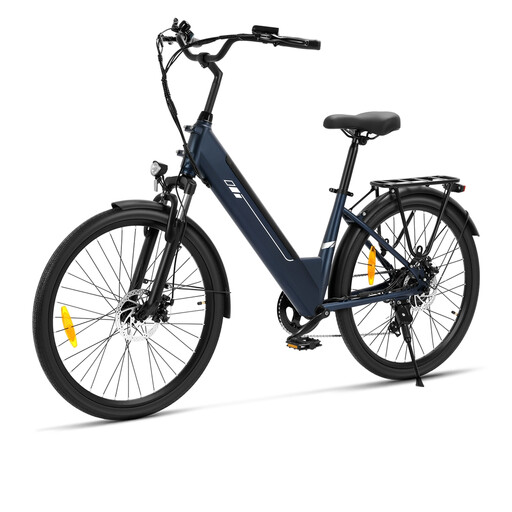
Why this model? Perfect for commuting and running errands in the city. Its low-step frame lets you get on and off effortlessly, even in business attire, while its front suspension smooths out bumps in the road for a comfortable ride.
Its 561.6 Wh battery offers a comfortable, real-world capacity. The manufacturer is transparent, specifying the conditions required to reach the maximum 100 km range, a far cry from empty promises.
Low-step frame for easy mounting; removable battery for simplified charging; standard rear rack.
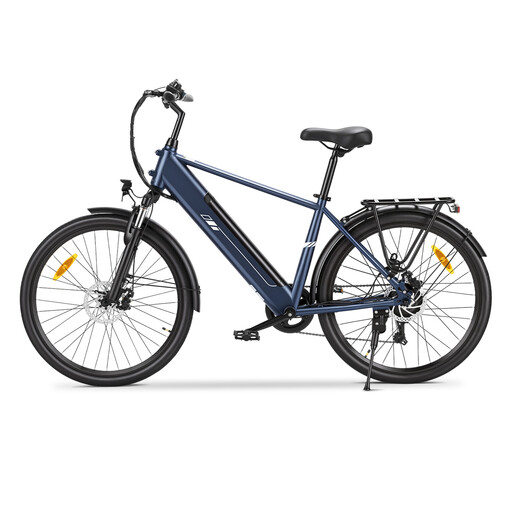
Why this model? Built for versatility, this hybrid e-bike is just as comfortable in the city as it is on towpaths or forest trails. Its high-step frame ensures excellent rigidity for dynamic handling, and its long range is perfect for extended getaways.
Its 250 W motor complies with regulations, but it's the 45 Nm of torque that makes the difference, providing the necessary thrust to tackle inclines without being fooled by misleading wattage figures.
45 Nm of motor torque for effortless climbing; up to 100 km of range to go the distance; dual disc brakes for maximum safety.
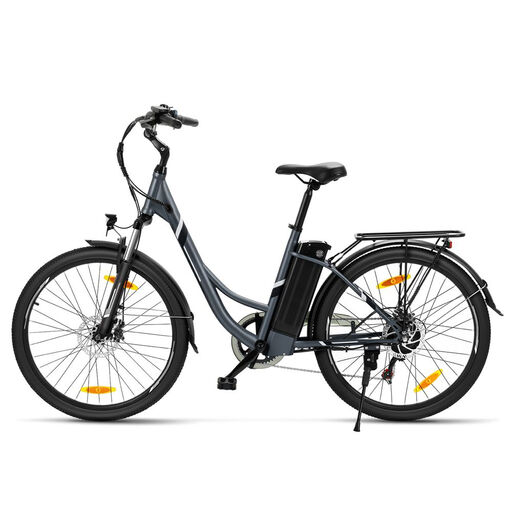
Why this model? This is the quintessential city bike, focusing entirely on comfort and range. Its step-through frame, adjustable stem, and 100 mm suspension fork make it a truly comfortable ride for daily commutes and leisurely outings.
This model doesn't just rely on a number. It combines a high-capacity battery (561.6 Wh) with 5 levels of assistance, giving you full control over consumption so you never see your range melt away.
Fork with 100 mm of travel for supreme comfort; extended range of up to 90 km; StVZO-certified lighting to see and be seen.
We've rounded up the models with the best endurance. Discover our selection of high-capacity battery electric bikes for limitless journeys.
An e-bike battery typically lasts between 500 and 1,000 full charge cycles, which translates to several years of use. To preserve it, avoid deep discharges and prolonged 100% charges. Ideally, keep the charge level between 20% and 80%. Store it in a dry place at room temperature, and only use the original charger.
Yes, absolutely. As we've discussed, the 250?W power rating is a legal standard. The real difference on hills comes from the motor torque (Nm). A torque of 40?Nm is already comfortable for most gentle inclines in the city. For steeper slopes or if you're carrying heavy loads, a torque of 45?Nm or more, like on the Touroll Roamer models, will provide much more responsive and powerful assistance.
In France, an e-bike (with assistance up to 25?km/h) does not require registration or specific insurance. However, having third-party liability insurance is essential. It covers any damage you might cause to others. The good news? This guarantee is often already included in your home insurance policy. Be sure to check.