
Livraison le jour même ou le lendemain

Qualité garantie

Débloquez vos offres de bienvenue: Livraison GRATUITE | Jusqu'à -80 % | 30 jours d'essai gratuits à JoyPlus
Téléchargez l'application
Finding the perfect eco-friendly washing-up liquid can be a complex challenge: it needs to be tough on grease, gentle on your hands, and, of course, kind to the planet. With shelves saturated with green promises and claims of natural ingredients, how can you separate marketing hype from genuine commitment? Our editors have investigated to help you make an informed decision. Here are the pitfalls to avoid and the criteria that truly matter when making the right choice.
Your intentions are good—choosing an eco-friendly household cleaner—but be wary of often misleading marketing claims.
To avoid being misled, focus on concrete evidence. Here are the three things to check before you buy.
Instead of marketing slogans, look for official labels. The most reliable in Europe is the EU Ecolabel. It guarantees that the product meets strict criteria:
The label is a goldmine of information, provided you know how to read it. For a truly effective hypoallergenic washing-up liquid, look for formulas based on:
A truly eco-friendly product is sustainable right down to its packaging. Check if the bottle is made from 100% recycled plastic and is itself recyclable. Also, consider multi-pack formats. This often delivers a double win: you lower the cost per litre while reducing the carbon footprint associated with packaging and transport.
To put theory into practice, our editors have selected a few products that tick all the right boxes, each tailored to a specific need.
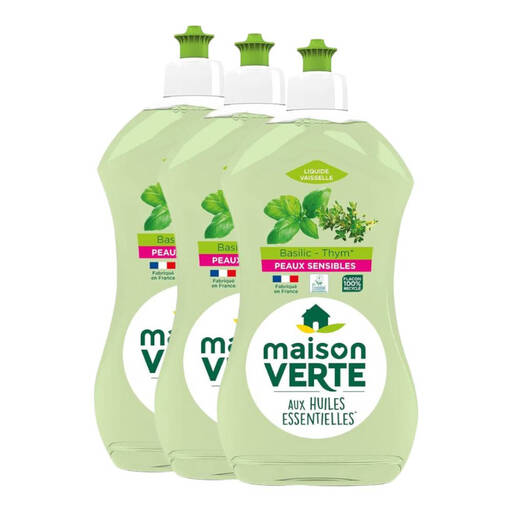
Why we recommend it: Perfect for daily family use. It cares for the most delicate skin without compromising on effectiveness.
No empty promises here. The formula is not only hypoallergenic but also Ecolabel certified. A dual guarantee of gentleness and respect for the environment.
Its formula with plant-based cleaning agents is effective yet gentle: no more tight, dry hands after doing the dishes.
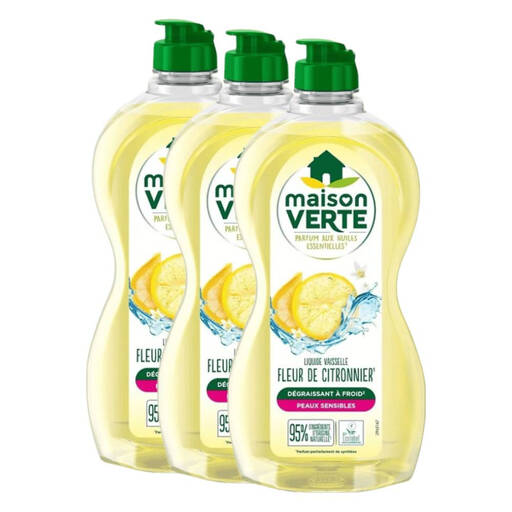
Why we recommend it: The perfect solution for reducing your energy bill by washing in cold water, without sacrificing a spotless clean, even on the greasiest dishes.
It debunks the myth that an eco-friendly product is less effective. Its cold-water degreasing formula is designed for maximum performance even at 20°C, an effectiveness proven by the Ecolabel certification.
It delivers real energy savings. As a bonus, its formula is kind to sensitive skin: it's guaranteed to be free from MIT/BIT preservatives and microplastics.
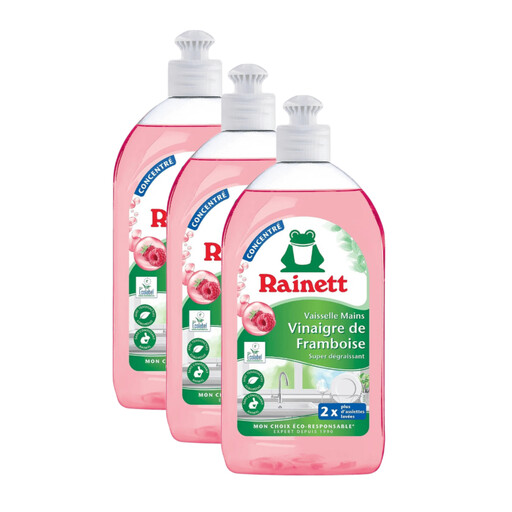
Why we recommend it: For tackling the most stubborn dishes. It combines a super-powerful degreasing action with a pleasant fruity scent, all with an eco-certification.
The Rainett washing-up liquid proves that you can combine ecology with ultra-performance. Its concentrated formula, certified with the Ecolabel, guarantees formidable effectiveness against grease with a controlled environmental impact.
Its super degreasing power, boosted by raspberry vinegar. Its bottle is made from 100% recycled plastic and is fully recyclable.
Explore our full selection of products that meet our strict criteria and European standards.
1. Is an eco-friendly washing-up liquid really as effective as a conventional one? Yes, absolutely, as long as you choose the right one. Products certified with the EU Ecolabel, for example, undergo strict performance tests. Their effectiveness must be at least equivalent to that of conventional market leaders. Modern formulas, with their plant-based cleaning agents and ingredients like vinegar, are formidable at dissolving grease.
2. What does the "Ecolabel" on a washing-up liquid really mean? It's the official ecological label of the European Union, and it's a guarantee you can trust. It certifies that the product's environmental impact is minimised, from its manufacturing to its disposal. It also imposes very strict restrictions on substances that are harmful to health and aquatic life.
3. Is buying in a multi-pack really more economical and ecological? Yes, it offers a dual advantage. On one hand, buying a multi-pack of washing-up liquid lowers the price per litre, which is good for your wallet. On the other hand, it's a positive step for the planet: less packaging per unit and optimised transport, which reduces the overall carbon footprint.