
Livraison le jour même ou le lendemain

Qualité garantie

Débloquez vos offres de bienvenue: Livraison GRATUITE | Jusqu'à -80 % | 30 jours d'essai gratuits à JoyPlus
Téléchargez l'application
Choosing your menstrual products is a personal decision. Whether for health reasons or environmental concerns, many of you are turning to ecological sanitary pads. The problem: the market is saturated, and it's easy to get lost between marketing promises and the actual ingredients. Make no mistake: green packaging is no guarantee of a healthy product.
Finding the right one can feel like a real challenge. Some products, despite their natural appearance, contain irritating ingredients, while others overstate their biodegradability. Our guide is here to help you gain clarity, identify the pitfalls, and make a choice that truly aligns with your needs and values.
To make the right choice, you need to know how to read between the lines on the packaging. Three essential criteria will help you judge the quality and safety of a sanitary pad.
The topsheet is in direct, prolonged contact with the most intimate area of your body. Forget conventional pads with their plastic (polypropylene) topsheets, which trap heat and moisture, leading to discomfort and irritation.
For a pad for sensitive skin, choosing natural-origin materials is essential. A topsheet made of organic cotton or plant-based fibres (like bamboo or sugarcane) ensures far better breathability and unparalleled softness. A hypoallergenic pad worthy of the name must guarantee a plastic-free composition where it touches the skin.
That brilliant whiteness we associate with cleanliness? It's often achieved through chlorine bleaching processes, which can leave behind dioxin residues—toxic compounds. The key is to look for the TCF (Totally Chlorine Free) label, which guarantees bleaching without chlorine or any of its derivatives.
Following the same logic, avoid fragrances, lotions, and dyes, which are well-known sources of allergies and irritation. A truly natural menstrual product must be free of these unnecessary additives. In this case, simplicity in the ingredient list is the best guarantee of quality.
The term "eco-friendly" is often overused. A plastic-free sanitary pad is an excellent starting point, but you also need to ensure the entire product is biodegradable. Be sure to check the percentage of bio-based or biodegradable materials.
To avoid being fooled by greenwashing, official certifications are your best guide. Labels like the EU Ecolabel, FSC (for cellulose from sustainably managed forests), or Cruelty Free and Vegan offer solid, verifiable guarantees about the product's environmental impact and manufacturing ethics.
To help you put theory into practice, here are a few products that meet these criteria to the letter, each designed for specific needs.
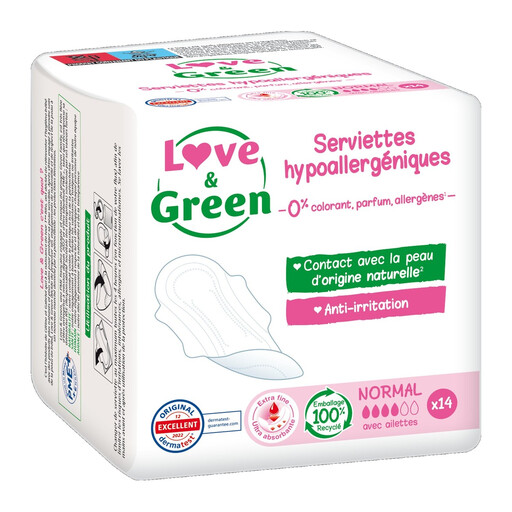
Why we chose it: The choice for those who demand total transparency and a controlled environmental impact. Love & Green pads tick all the boxes: natural-origin materials and an arsenal of certifications.
It knocks out greenwashing with a clear range of certifications (EU Ecolabel, FSC, TCF, Vegan) and an 84% bio-based composition. The absence of dyes, fragrances, and lotions drastically reduces the risk of irritation.
Natural-origin topsheet (sugarcane and PLA) and TCF bleaching. A product that is dermatologically and gynaecologically tested to be hypoallergenic, a true mark of quality.
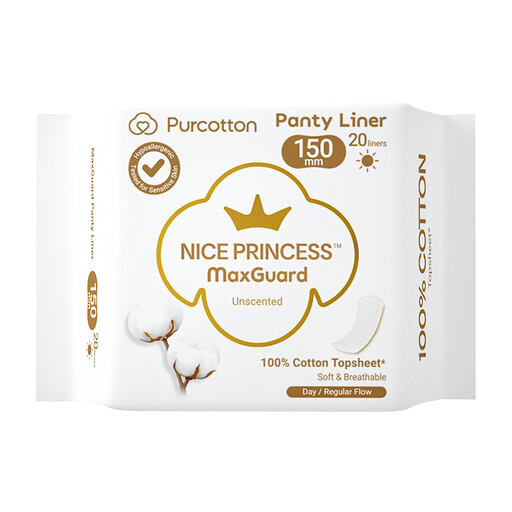
Why we chose it: The gold standard for those whose top priority is softness and preventing skin reactions. Here, the composition relies entirely on pure cotton for the gentlest contact.
It goes beyond a simple "hypoallergenic" claim by guaranteeing a topsheet and wings made of 100% cotton. The formula is also free from fragrance, fluorescent whitening agents, and formaldehyde.
The 100% natural cotton contact offers maximum softness and breathability, minimising the risk of discomfort even for the most reactive skin.
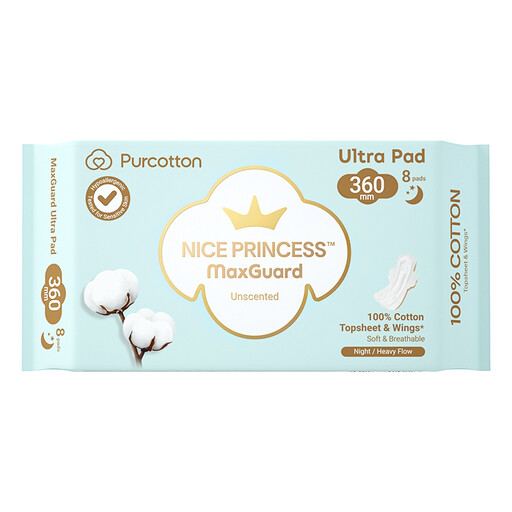
Why we chose it: Designed for those who need maximum protection overnight or for very heavy flows, without compromising on skin health. It successfully combines very high absorbency with skin-friendly materials.
This product proves that high absorbency doesn't have to mean plastic and discomfort. Its 360mm length ensures optimal leak protection while maintaining a 100% cotton topsheet.
It combines long-lasting protection, ideal for overnight use, with all the benefits of 100% cotton contact: hypoallergenic and breathable.
We have selected a full range of products that meet our strict selection criteria and current safety standards.
An organic sanitary pad must contain a defined percentage of materials from organic farming (most often, cotton). The term "eco-friendly" is broader: it can refer to the use of biodegradable materials, a more virtuous manufacturing process (like TCF bleaching), or even recycled packaging. The ideal choice? A product that combines both, with certifications to prove it.
Absolutely. Absorbency doesn't depend on being eco-friendly, but on the performance of the absorbent core. This core is usually made of wood cellulose (pulp) and super-absorbent polymers (SAP). Reputable eco-friendly brands use FSC certified cellulose and plant-based (or offset) SAPs, offering absorbency that is comparable, or even superior, to conventional pads.
Even if it's partially biodegradable, a pad should never, ever be flushed down the toilet. It could clog pipes, as its absorbent core takes a long time to break down. The correct method is to wrap it in its pouch or some paper, then throw it in the general household waste bin. Only the cardboard packaging can go into the recycling bin.