
Livraison le jour même ou le lendemain

Qualité garantie

Débloquez vos offres de bienvenue: Livraison GRATUITE | Jusqu'à -80 % | 30 jours d'essai gratuits à JoyPlus
Téléchargez l'application
As a parent, your baby's well-being is your top priority. Choosing a diaper is not a decision to be taken lightly?: it's in direct contact with their delicate skin, 24/7. With an overwhelming number of options available, it can be difficult to navigate the maze of marketing claims and understand the actual composition of the products.
This guide is here to provide clear, objective guidance for choosing eco-friendly baby diapers that combine skin-friendliness, performance, and environmental commitment. We'll review the essential selection criteria and offer a curated list of products to help you make an informed decision.
To make the right choice, you just need to focus on a few key points. Here are the three criteria you should never overlook.
Transparency about the composition is the first hallmark of a trustworthy brand. For healthy baby diapers, prioritise models that clearly state?:
Independent labels provide an extra layer of assurance regarding a brand's commitments. Here are the certifications to know?:
An eco-friendly diaper must be effective. Absorbency is a non-negotiable criterion for keeping your baby's bottom dry and preventing leaks. Quality hypoallergenic diapers must also ensure optimal comfort, with soft fasteners and reliable leak guards that adapt to the baby's shape and movements.
Based on these criteria, we have analysed several products on the market. Here is our selection from the brand Love & Green, which is renowned for its commitment to healthier, more natural compositions.
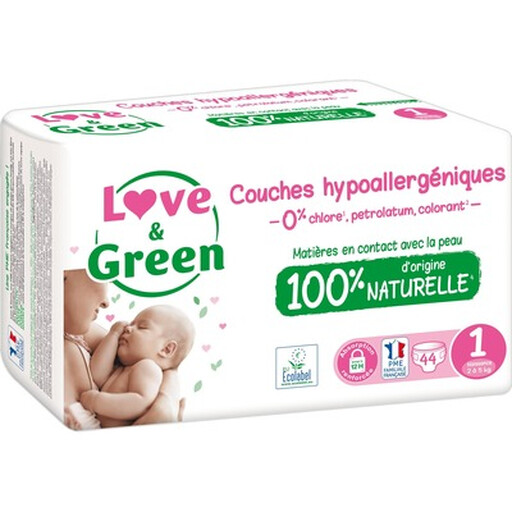
Why it stands out?? Specifically designed for newborns, these diapers feature a special umbilical cord cutout. This is a welcome feature that protects this sensitive area and makes care easier, without ever bothering the baby. Their composition includes 61% natural-origin materials, a remarkable figure for this category.
Key features?:
Who is this product for?? For parents of newborns (from 2 to 5 kg) looking for an ultra-soft, certified solution that is perfectly suited for the first days of life.
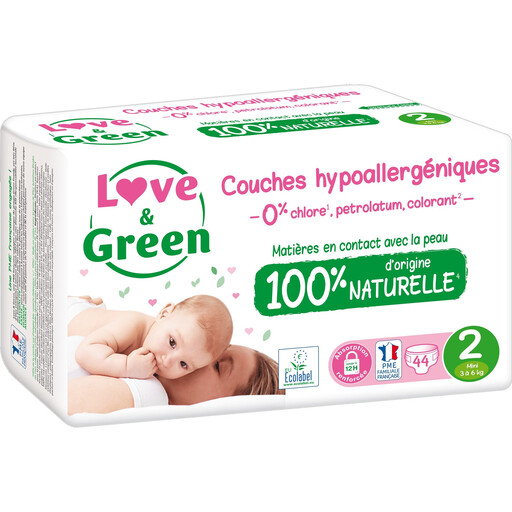
Why it stands out?? This size 2 diaper builds on the brand's success, with the proportion of bio-based materials increasing to 65%. It offers an excellent balance between the softness essential for infants and the absorbency required for babies who are starting to move around more.
Key features?:
Who is this product for?? For parents of babies weighing between 3 and 6 kg who want to continue with a natural and hypoallergenic option after the first few weeks.
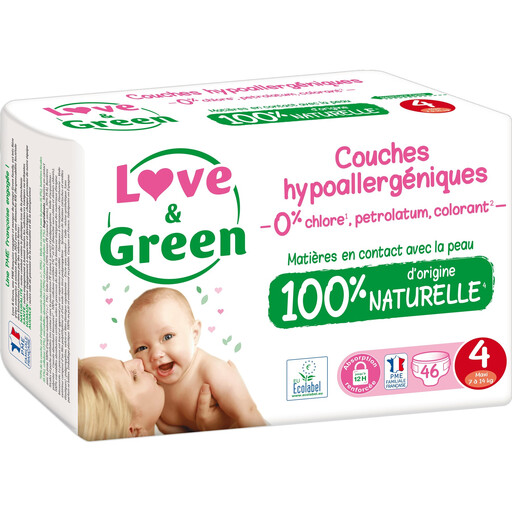
Why it stands out?? With 70% natural-origin materials, this size 4 diaper is one of the most advanced in the range in terms of eco-design. It is designed to support older, more active babies, ensuring maximum absorption and a reliable fit. Furthermore, reviews for Love & Green diapers confirm their reliability for this age group.
Key features?:
Who is this product for?? For parents of babies from 7 to 14 kg who want to make no compromises between a healthy composition, their child's comfort, and foolproof leak protection.
The choice of a diaper is highly personal?: it depends on the body shape and sensitivity of each child. To compare other brands or explore complementary care products, feel free to browse our dedicated category.
? Discover our selection of Baby & Toddler Food
The main difference lies in the materials. Natural baby diapers incorporate a significant portion of renewable, plant-based raw materials (wood pulp, corn starch, sugarcane), whereas conventional diapers rely almost exclusively on petroleum-derived plastics. Their manufacturing process is also more environmentally friendly (e.g., TCF chlorine-free bleaching), and they systematically exclude additives like perfumes or lotions.
Absolutely. The technology has evolved tremendously. Modern eco-friendly diapers feature high-performance absorbent cores made of certified cellulose and super-absorbent microbeads (sometimes also from natural origins). Their effectiveness is entirely comparable to that of conventional diapers, provided you choose the right size and change the baby regularly. You can also rely on performance certifications as a good indicator.
The term "hypoallergenic" means the product has been formulated to minimise the risk of allergies. To be certain, check two things?: the absence of known allergens (perfume, lotion, latex, the 26 substances listed by the EU) in the composition, and the presence of dermatological labels, like Dermatest, which validates the product's tolerance on the most sensitive skin.