Who are these crispbreads for?

Households looking to boost their fibre intake

For breakfast, snacks or savoury Easter toppings, you may be looking for a wholegrain recipe and comparing fibre content. Manger Bouger recommends choosing wholegrain or semi-wholegrain starchy foods when they are made from cereals.

Shoppers who check the ingredients

If someone in your household needs to avoid an ingredient, check the cereals listed and any ‘may contain’ warnings before choosing a recipe. The crispbreads mentioned here don’t all have the same ingredients, so check the packaging of the product you buy.

Households planning their Easter shop

You may be comparing pack sizes and checking whether your chosen product is available at your local shop, for Drive collection or for delivery. A retailer’s product listing doesn’t guarantee the same options everywhere.

What should you look for first?

When choosing wholegrain crispbreads for Easter, start with what matters most to your household, then check the other details on the pack.

What to consider What to check Who is this for?
Fibre and wholegrains The type and proportion of wholegrain flours listed in the ingredients; fibre per 100 g across comparable crispbreads. If I’m putting together breakfasts or savoury toppings, I want the wholegrain recipe and its fibre content to be clearly stated. Around 50% of consumers would make this their priority.
Ingredients and allergens Highlighted ingredients and ‘may contain’ warnings on the pack you buy. If an ingredient isn’t suitable for my household, I need to be able to rule out the recipe before adding it to the Easter menu. This would be the top priority for around 30% of consumers.
Pack size and availability in store Net weight, number of packs and availability depending on the shop or collection option. When planning my Easter shop, I’m looking for a pack size that suits my household and a product available from my chosen retailer. Around 20% of consumers would prioritise these practical considerations.

Mistakes to avoid

  • Assuming the word ‘cereals’ means a product is high in fibre

    The product listings we checked show different figures: according to Auchan, LU wholegrain multigrain crispbread contains 5.1 g of fibre per 100 g, compared with 20 g for Wasa Complet and 26 g for Wasa Fibres. E.Leclerc lists 9.8 g per 100 g for its Epi d’Or wholewheat crispbread.

    Compare the ‘fibre’ line and ingredients of products in the same category, rather than relying on the name on the front of the pack.

  • Looking at fibre alone

    A recipe may also contain several ingredients you need to check. Auchan’s listing for Wasa Fibres includes rye, wheat, oats and sesame, among other ingredients; the LU crispbread listing gives a salt content of 1.56 g per 100 g.

    Check the ingredients, ‘may contain’ warnings and nutrition information together. If you have an allergy, check the pack you actually buy.

  • Comparing different pack sizes

    A 250 g box and a 275 g pack don’t contain the same amount of crispbread. Collection and delivery options may also vary by retailer and shop.

    Check the net weight and local availability before making your choice for the Easter shop.

Brands to know

Carrefour Extra

Carrefour Extra Wholegrain Multigrain Crispbreads come in a 250 g box.

  • Carrefour says this recipe contains 56% wholegrain rye flour and 37% wholegrain wheat flour.
  • The product listing warns that it may contain traces of milk. Check the pack label if this affects your household.

Epi d’Or

E.Leclerc’s Marque Repère range includes crunchy wholewheat crispbreads in a 250 g box.

  • For this product, E.Leclerc lists 9.8 g of fibre and 1.0 g of salt per 100 g.
  • Check availability with the E.Leclerc store where you plan to shop.

Wasa

Complet and Fibres are two rye crispbreads that should be compared separately.

  • Auchan’s listings give Wasa Complet 20 g of fibre per 100 g and Wasa Fibres 26 g per 100 g.
  • Ingredients and ‘may contain’ warnings differ between products. Check the salt content too: both listings give 1.2 g per 100 g.

LU

LU wholegrain multigrain crispbread brings several cereals together in one recipe.

  • This product may suit households looking for a multigrain crispbread rather than one made primarily with rye.
  • Auchan lists 5.1 g of fibre and 1.56 g of salt per 100 g. The listing also mentions milk and possible traces of soya and sesame.

Bridor

Bridor’s French catalogue features bakery breads, including a seeded and multigrain baguettine.

  • If you’re choosing packaged wholegrain crispbreads, start with a specific product and its label rather than relying on the details of a different bread in the catalogue.

A rye crispbread to consider

This Joybuy selection features a rye crispbread to consider for Easter toppings. Check the recipe against the ingredients your household can eat.
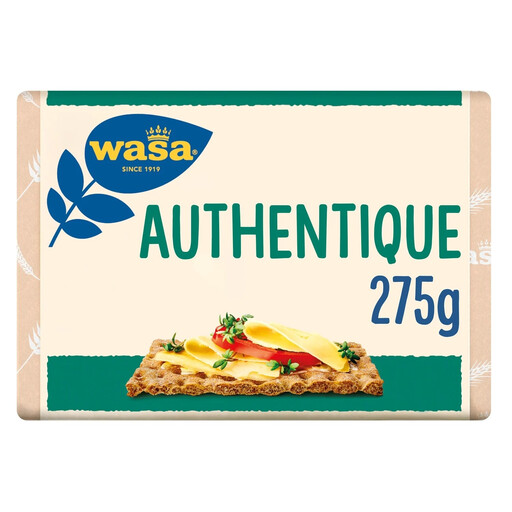
WASA Authentique rye crispbreads, 275 g pack

WASA Authentique rye crispbreads, 275 g

A rye crispbread to consider if you’re looking for a base for your Easter toppings. The pack contains 275 g. Check the ingredients list, nutrition information and ‘may contain’ warnings before choosing it.

The Joybuy product listing recommends storing the crispbreads in an airtight container after opening to keep them crisp.

View on Joybuy

Frequently asked questions

Does ‘multigrain’ crispbread always contain mostly wholegrains?

No. Check the ingredients and the proportions of wholegrain flours, where these are given. For example, Carrefour states that its Carrefour Extra Wholegrain Multigrain Crispbreads contain 56% wholegrain rye flour and 37% wholegrain wheat flour. You can’t assume another recipe has the same proportions based on its name alone.

How can I compare the fibre content of two crispbreads?

Check the fibre per 100 g in the nutrition information for comparable products, then look at the ingredients. If you’re changing your eating habits, Manger Bouger recommends gradually introducing foods that are higher in fibre.

What should I check if sesame, milk or soya is a concern for my household?

Check the ingredients and ‘may contain’ warnings on the pack you buy, even if you’ve already looked at a product listing online. For prepacked foods sold in France, the DGCCRF says allergenic ingredients must be emphasised in the ingredients list.

Is Nutri-Score enough to help me choose wholegrain crispbreads?

No. Check the ingredients and nutrition information too, including fibre, sugars and salt per 100 g, as well as allergens. One indicator alone can’t tell you whether a recipe is right for your household.

How do I keep crispbreads crunchy after opening?

Always follow the instructions on the pack first. For WASA Authentique, the Joybuy product listing recommends storing the crispbreads in an airtight container after opening to keep them crisp.