
Livraison le jour même ou le lendemain

Qualité garantie

Débloquez vos offres de bienvenue: Livraison GRATUITE | Jusqu'à -80 % | 30 jours d'essai gratuits à JoyPlus
Téléchargez l'application
A duvet might seem simple to choose… until that first freezing night, those sweaty wake-ups in the middle of summer, or the impossible wash because it won’t fit in the drum. The filling, the weight and the dimensions all play a direct role in your everyday comfort.
Before you start comparing prices, it’s worth keeping three common pitfalls in mind:
For a winter duvet, go for a filling that’s dense enough and a construction that minimises cold spots. Models with 15 tog, like some microfibre duvets, are aimed at those who want plenty of warmth. However, how warm it feels also depends on your bedroom temperature and your bedding.
A summer duvet should stay light and allow air to circulate. Models made from hollow silicone polyester with 250 g/m² are generally intended for rooms where the temperature reaches around 20 °C, according to the relevant product specs. A lightweight model can also work well in spring or in a well-heated bedroom.
A 4-season duvet is a good option if your bedroom temperature changes a lot throughout the year. Just make sure it’s actually two separate duvets that can be used independently, not just a single model with a middling weight.
Some product pages mention certifications such as STANDARD 100 by OEKO-TEX, CertiPUR, Sanitized or ISO 9001. These don’t all cover the same things, so take the time to check exactly what each one means and the conditions stated by the seller.
The duvet size should match your mattress, but also the amount of overhang you want on the sides. Here are some common sizes:
Measure your mattress before buying and check that the duvet will fit your cover. Too short, and it lets cold air in at the sides; too big, and it may bunch up and become harder to wash.
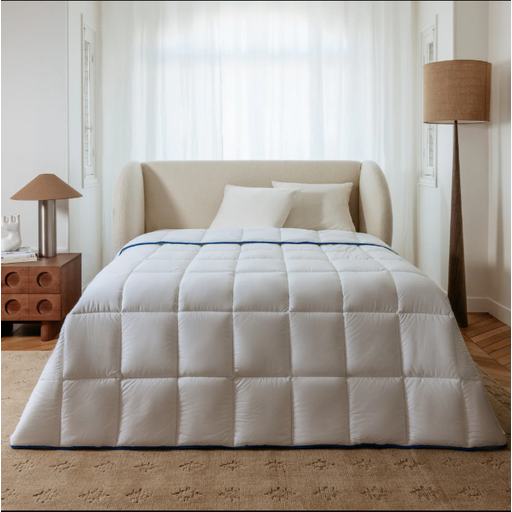
Why this suits this profile: Its 140 x 200 cm size fits a single bed, and the composition is easy to understand for a first purchase: a 100% cotton percale cover with a 400 g/m² polyester filling.
The 400 g/m² weight and the 40 °C wash temperature let you assess the warmth and care requirements properly, rather than relying on a vague marketing promise.
400 g/m² hollow silicone polyester filling, cotton percale cover and certifications listed on the product page, including OEKO-TEX and CertiPUR.

Why this suits this profile: This 200 x 200 cm model is aimed at those looking for a summer duvet in duck feathers and down, with a cotton cover and a filling stated at 200 g/m².
The weight is clearly stated, so you can tell a lightweight duvet apart from one designed for cold nights. The claimed certifications should still be checked in detail before purchase.
Filling stated as 90% feathers and 10% down, 200 x 200 cm size and a cover described as dust mite resistant.

Why this suits this profile: Its 220 x 240 cm size generously covers a double bed, while the natural filling is described as suitable for cold nights and rooms that aren’t well heated.
The composition — 90% feathers and 10% down —, the box-stitch construction and the washing instructions are all provided, making it easier to compare objectively.
220 x 240 cm size, cotton sateen cover and filling distributed in stitched squares. After washing, a low-temperature tumble dry is recommended.
Always follow the manufacturer’s instructions. A natural duvet can sometimes be washed at 40 °C, but it must then be dried thoroughly at a low temperature to prevent any residual moisture from settling in. Synthetic models may also need a large-capacity washing machine, especially in 200 x 200 cm or 220 x 240 cm sizes.
Air your duvet regularly, avoid compressing it for long periods, and only store it when it’s completely dry. Its lifespan depends on the filling, how often you wash it and the protection you use. A good duvet cover keeps it cleaner and means you can space out the heavy-duty washes.
Go for a breathable duvet that isn’t too thick, with a cotton cover or a design that helps air circulate. A summer duvet in hollow polyester or a lightweight 200 g/m² model could work, depending on your bedroom temperature. How it feels is very personal: look at the materials and the weight rather than relying solely on a “cool” label.
For a 140 cm double bed, a 200 x 200 cm duvet can work well. A 220 x 240 cm model will give you more overhang on the sides. The right choice depends on your mattress depth, how many people are sleeping and how much coverage you want.
Check the label before doing anything. Choose a suitable cycle, don’t overload the drum and make sure it dries completely. For larger sizes, you may need a large-capacity washing machine or a dry cleaner.