
Livraison le jour même ou le lendemain

Qualité garantie

Débloquez vos offres de bienvenue: Livraison GRATUITE | Jusqu'à -80 % | 30 jours d'essai gratuits à JoyPlus
Téléchargez l'application
Buying a duvet seems simple… until it turns out to be too warm, too light, unsuitable for the bed or difficult to care for. Product descriptions often highlight softness, loft or an “all-season” design, without always providing the information needed to compare different models.
Before ordering a duvet, three mistakes come up time and again:
When choosing a summer duvet, look at its filling weight, the filling construction and the room’s usual temperature. Models weighing around 250 g/m² and filled with hollow fibres are generally designed to remain lightweight and encourage air circulation. The 140x200 cm cotton and polyester summer duvet featured in this selection is recommended for rooms at 20 °C and above, with a stated thickness of 3 cm.
In winter, a higher filling weight generally provides greater insulation. The winter duvet in 140x200 cm featured below has a siliconised hollow-fibre filling of 400 g/m², with a stated thickness of 5 cm. Concrete details like these are far more useful than simply describing a duvet as “warm” or “ultra-soft”.
Perceived warmth also depends on your pyjamas, duvet cover, humidity levels and your own sensitivity. A properly heated bedroom does not necessarily require a highly insulating duvet.
Start by measuring the mattress, then check how much overhang you want at the sides. For a single bed, 140x200 duvet and 135x200 cm sizes are the most common. A 140x200 cm duvet may also suit some wider single beds, provided you take the mattress height and the look you want into account.
The 200x200 duvet size is suitable for a wider bed or for anyone who wants more freedom of movement. Be careful with commercial descriptions: a 200x200 duvet cover protects a filling of the same dimensions, but it does not replace the duvet itself.
Also check exactly what is included in the parcel. Some sets combine a duvet filling with a pillowcase, while a bed linen set may contain only a duvet cover and one or more pillowcases. The product descriptions below make the distinction clear.
A cotton duvet appeals thanks to the natural feel of its outer cover and its good breathability. Cotton percale has a close weave and generally feels cool against the skin. A polyester duvet is often chosen for its lightness, consistent finish and easier care.
Certifications also deserve careful attention. STANDARD 100 by OEKO-TEX relates to the presence of certain substances in textiles, according to the criteria of the standard used. CertiPUR applies to requirements concerning certain foams and filling materials. These labels are not a medical guarantee and do not replace checking the product composition.
For washing, follow the care label. The MORPHEA models featured state that they can be washed at 40 °C in a machine with a capacity of at least 12 kg, without bleach, ironing or dry cleaning. A bulky duvet may therefore need to be taken to a launderette.
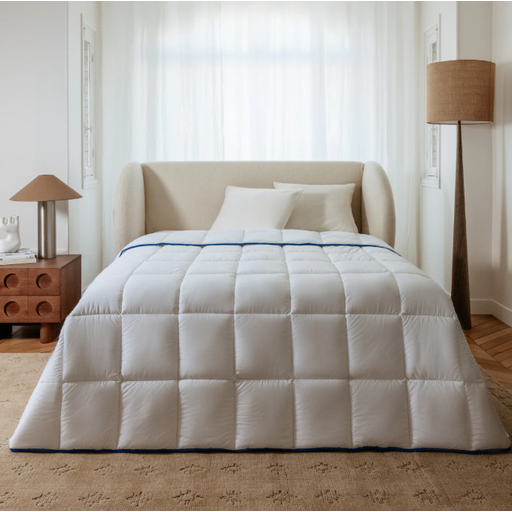
Why this choice suits this profile : Its single-bed size and 250 g/m² filling weight provide a lightweight duvet suitable for a room at 20 °C and above.
The recommended temperature, filling weight, dimensions and 40 °C washing instructions are clearly stated. There is no need to settle for a vague promise of comfort.
A 100% cotton percale cover, a 250 g/m² polyester filling and the certifications listed in the product description.

Why this choice suits this profile : This double-bed model combines a cotton sateen cover, stated as having 129 threads/cm², with a filling made up of 90% duck down and 10% feathers.
The filling composition and available sizes are clearly detailed. You can check the material before buying, rather than relying solely on the word “natural”.
A 200x200 cm size, stitching designed to keep the filling in place and care at up to 40 °C according to the product description.
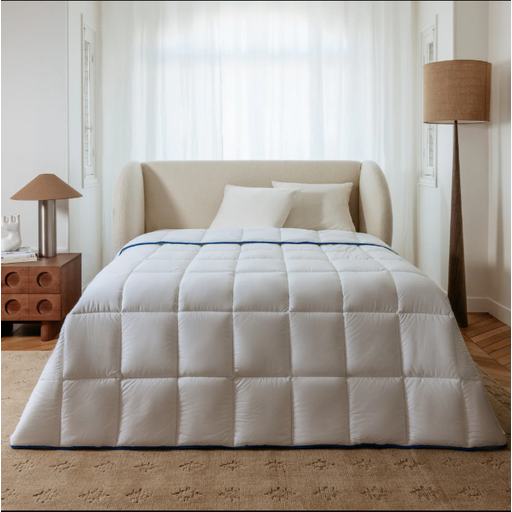
Why this choice suits this profile : Its 400 g/m² filling and stated 40 °C washing instructions meet the needs of a cool bedroom or regular use.
The filling weight and recommended washing-machine capacity are specified. You can therefore plan ahead for caring for this bulky duvet.
A 100% cotton percale cover, siliconised hollow polyester fibres and 140x200 cm dimensions.
If your duvet filling is still in good condition, a duvet cover can sometimes be enough to give your bed a fresh new look. Microfibre models often feature a zip fastening and can be washed at low temperatures. Simply check that their dimensions match those of the duvet exactly.
A bed set may include a duvet cover and one or more pillowcases. Some 140x200 cm sets, for example, include a 65x65 cm pillowcase, while 155x220 cm models are often sold with two 80x80 cm pillowcases. The contents vary from one product reference to another.
The Berenice set, made from 100% cotton, is available in 140x200 cm with a 63x63 cm pillowcase, as well as in larger double-bed sizes. For a guest bedroom or a simple change of décor, polyester sets are a practical option, provided you check the washing temperature and whether the duvet filling is included.
Choose a lightweight summer duvet, with a moderate filling weight and a breathable cover. In a room at 20 °C or above, a model weighing around 250 g/m² can be a good starting point. However, your sensitivity to heat remains the most personal factor.
It depends on the type of filling, how often it is used, ventilation and washing. Replace your duvet if it permanently loses its evenness, if the filling forms clumps or if the cover is damaged. Air it regularly and follow the care instructions.
This term should be treated with caution. Check the composition, listed certifications and washing recommendations. A textile certification relates to a specific standard and is not a personalised medical guarantee. If you have a particular sensitivity, seek advice from a healthcare professional.