
Livraison le jour même ou le lendemain

Qualité garantie

Débloquez vos offres de bienvenue: Livraison GRATUITE | Jusqu'à -80 % | 30 jours d'essai gratuits à JoyPlus
Téléchargez l'application
Choosing a new duvet can quickly become a daunting task. Between promises of perfect nights and opaque technical jargon, it's easy to end up with buyer's remorse. The goal isn't to find the "perfect" duvet, but rather the one that precisely matches your sleeping habits, your bedroom's temperature, and your expectations for maintenance.
As a Product Expert at Joybuy, my mission is to help you see things more clearly. Let's forget the marketing and focus on the facts. Here are the common pitfalls to avoid and the essential criteria for making the right choice.
Before diving into specific models, it's best to know the common mistakes that will cost you in both comfort and money.
To avoid these pitfalls, focus on three key criteria that make all the difference.
Fill weight, expressed in grams per square meter (g/m?), measures the density of the filling. It's the most reliable indicator for determining a duvet's warmth level.
The choice of filling has a direct impact on your duvet's comfort, weight, maintenance, and thermal properties.
A duvet that's too small will let in cold air, while one that's too large will be cumbersome. As a general rule, we recommend choosing a duvet with an overhang of 30 to 50 cm (12 to 20 inches) on each side of the bed.
Here are a few options that meet specific needs, taking into account the criteria we've just discussed.
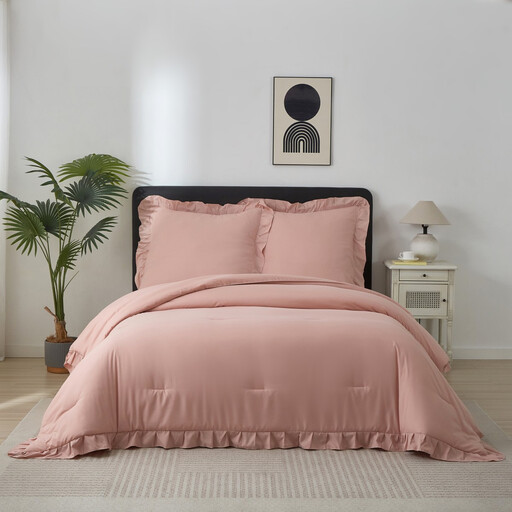
The ideal all-in-one solution for those who want to combine style and simplicity. The ruffle design adds an effortless romantic and elegant touch to the bedroom, and the integrated comforter set concept simplifies life.
No more maintenance headaches! Made from polyester microfiber, this set is machine washable at low temperatures, making daily care a breeze.
Its main advantage? It's a complete and lightweight decorative solution, perfect for year-round use in a moderately tempered room. Its fabric is both soft and breathable.
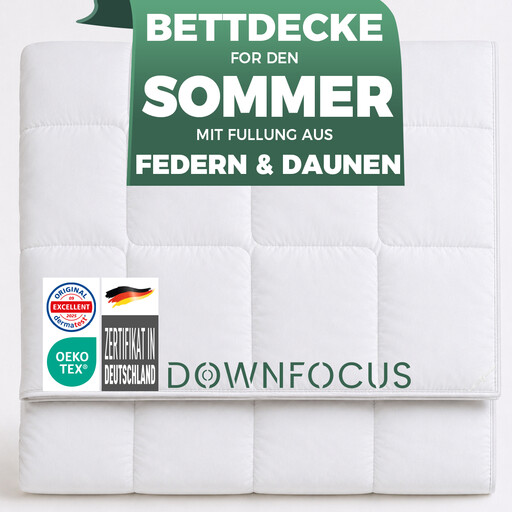
Perfect for devotees of natural materials looking for a duvet suited for summer nights. This summer duvet made of feather and down offers all the breathability and lightness of a natural fill.
It avoids the "universal" duvet trap by specializing in summer with a fill weight of 200 g/m?. No more overheating in the middle of the night! Its tightly woven cotton shell acts as a natural barrier against dust mites, making it suitable for allergy sufferers.
The Oeko-Tex (no harmful substances) and RDS (animal welfare) certifications are a guarantee of quality and ethics. The 90% feather and 10% down filling ensures an excellent balance between comfort and thermoregulation.
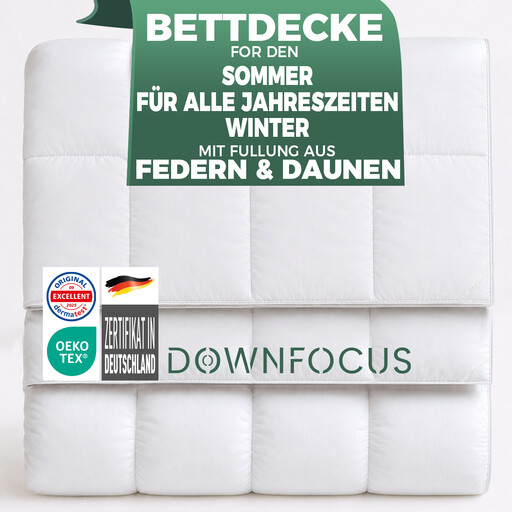
The perfect solution for anyone seeking versatility and a smart investment. No more overflowing closets! This 4-seasons duvet model adapts to all temperatures thanks to its two detachable parts.
It cleverly sidesteps the single-fill-weight trap. It consists of a summer duvet (200 g/m?) and a mid-season duvet (450 g/m?). Used separately or together (totaling 650 g/m?), they cover all your needs throughout the year.
Its modularity is its greatest asset—a real space-saver. Like the summer model, it boasts Oeko-Tex and RDS certifications, and its tightly woven cotton shell makes it hypoallergenic.
Explore our complete selection of products, all approved according to our quality and safety criteria.
1. How do I machine wash a duvet without damaging it? First, check your machine's capacity: it must be able to hold the duvet without compressing it. Use a delicate cycle at a low temperature (usually 30°C or 40°C / 86°F or 104°F) and a mild detergent. For down duvets, add a few tennis balls to the drum during the drying cycle (on low heat) to restore the fill's loft and prevent clumping.
2. What is the average lifespan of a duvet? A good quality synthetic duvet can last between 5 and 7 years. A natural duvet (feather and down), if well-maintained, can last up to 10 years. The secret? Shake and air it out regularly to maintain its loft and freshness.
3. Is a hypoallergenic duvet really necessary? For people with dust mite allergies, it's an essential criterion. Synthetic microfiber duvets are naturally hypoallergenic. For natural duvets, a very tightly woven cover (like cotton percale) and an anti-dust mite treatment offer excellent protection. The Oeko-Tex Standard 100 certification guarantees the absence of any harmful substances, ensuring healthy contact with the skin.