
Livraison le jour même ou le lendemain

Qualité garantie

Débloquez vos offres de bienvenue: Livraison GRATUITE | Jusqu'à -80 % | 30 jours d'essai gratuits à JoyPlus
Téléchargez l'application
Choosing a new duvet? Think it's a minor detail? Think again. This is a purchase that directly impacts the quality of your sleep for years to come. But faced with a sea of options, it's easy to make a mistake—one that leads to restless nights and a purchase you'll bitterly regret. As experts, our mission is to help you navigate the choices and make a truly informed decision.
Before you dive in, watch out for these three classic pitfalls:
To avoid these pitfalls, simply focus on a few key criteria. They will help you find the perfect model for your sleep profile and environment.
The weight, expressed in grams per square metre (gsm), is the most reliable indicator of warmth. The rule is simple: the higher the gsm, the warmer the duvet.
The type of filling directly affects your duvet's comfort, ease of care, and hypoallergenic properties.
A duvet that's too small lets in draughts, while one that's too large can become cumbersome. The golden rule: allow for an overhang of at least 20 to 40 cm on each side of the bed.
To help you see how these criteria translate in practice, here are a few models that meet specific needs.
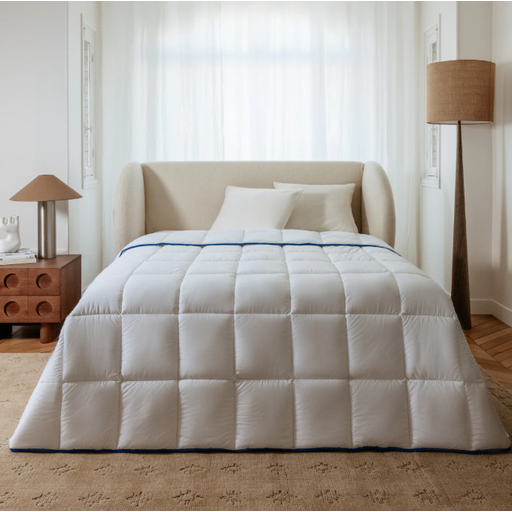
Editor's Take: This is the perfect duvet for those who tend to get hot at night or live in a well-insulated flat. Its 200x200 cm size is very versatile: ideal for a single bed if you like to wrap yourself up, or for a standard double bed.
Its purpose is clear and honest. Its 250 gsm weight is calibrated for mild nights, preventing any risk of overheating. The certifications (OEKO-TEX, Certipur) are a guarantee of a healthy product.
Its cotton percale shell (91 threads/cm?) provides remarkable softness and excellent breathability. Its synthetic filling makes it both easy to care for and hypoallergenic.

Editor's Take: The solution for those who are always cold or for bedrooms that are hard to heat in winter. Its composition of duck feather and down provides intense, comforting warmth without ever feeling heavy.
This is a winter duvet that fully embraces its role. There's no compromise on warmth here. Its baffle-box stitching ensures the filling is perfectly distributed, eliminating the "cold spots" typical of low-end models.
The natural filling (90% feathers, 10% down) offers impressive thermoregulation: it keeps you very warm while allowing your body to breathe, preventing perspiration. The organic cotton sateen shell is the icing on the cake for softness.
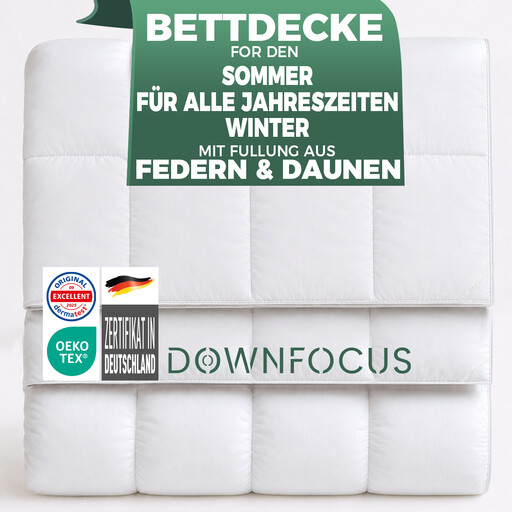
Editor's Take: For those who want a truly effective all-in-one solution without sacrificing comfort. This clever 2-in-1 system allows you to switch from a summer duvet to a deep-winter version simply by clipping the two parts together.
It reinvents the "one-size-fits-all" duvet concept with exemplary modularity. You essentially get three duvets in one: a summer version (200 gsm), a mid-season one (450 gsm), and both combined to face the winter (650 gsm).
Unbeatable flexibility. The RDS (which guarantees animal welfare) and OEKO-TEX certifications make it a choice that is as high-quality as it is responsible. Bonus: the tightly woven cotton shell creates a natural barrier against dust mites.
We have curated a complete selection of products that meet our quality criteria and current standards.
Ideally, once or twice a year. For synthetic duvets, a machine cycle at 40°C is sufficient. Be sure to use a large-capacity washing machine (12 kg or more) to avoid compressing the filling. For a natural duvet, professional dry cleaning is the safest option to preserve its loft.
Absolutely, especially for those sensitive to dust mites. A hypoallergenic duvet has a synthetic filling, which is an inhospitable environment for these tiny creatures. Its tightly woven shell also acts as a physical barrier. The STANDARD 100 by OEKO-TEX label is the final guarantee, certifying the absence of any unwanted chemical substances.
It all depends on its quality and how it's cared for. On average, a synthetic duvet lasts about 5 years, compared to nearly 10 years for a well-maintained natural duvet. Has your duvet lost its loft, is the filling clumping, or does it no longer keep you as warm as it used to? That's the sign it's time for a replacement.