What should you check before choosing?
Start with your home’s layout, then compare appliances in the mode you’ll actually use.
| Priority |
What to check |
Your needs |
| Steam and odours |
Find out whether the air will be expelled outside or filtered and returned to the kitchen. Compare airflow in the intended mode: UFC-Que Choisir’s test measures it with a charcoal filter in recirculation mode and without one in ducted mode. |
I cook often and want to know what happens to air containing steam and odours, rather than comparing advertised airflow figures alone. |
| Duct and home |
For ducted extraction, check that there’s a route dedicated exclusively to the cooker hood. Before considering any work, check whether an outlet is feasible and review the requirements of your tenancy, leasehold or home. |
I’m interested in an external outlet, but first I need to establish whether it’s possible in my kitchen. |
| Recirculation |
Confirm that the exact cooker hood model supports recirculation. Check which kit is compatible, which filters are needed and what maintenance is required. Bosch, for example, specifies that its kits aren’t universal. |
Without a usable duct, I’m looking for a cooker hood with filtration components that are compatible with the model I choose. |
| Noise |
Check the noise level at the speed you’d normally use, not just at maximum power. Make sure the figures apply to the installation mode you’re considering. |
In an open-plan kitchen, I want to cook without constantly interrupting conversations in the living room. |
| Existing ventilation |
Check whether your kitchen has a boost setting. ADEME says this can increase ventilation while cooking or when steam is produced; UFC-Que Choisir advises against connecting a cooker hood to a mechanical ventilation system (VMC). |
If my kitchen already has a boost setting, I want to know when to use it without mistaking it for a cooker hood duct. |
| Airing the room without a cooker hood |
If installing a cooker hood isn’t suitable, consider ways to air the room and use the existing ventilation. Don’t treat these measures as capturing grease and steam above the hob. |
I need to manage the air while cooking without assuming that I can install a cooker hood in my home. |
Which cooker hoods should you consider on Joybuy?
These wall-mounted or under-cabinet cooker hoods are listed as offering ducted and recirculation options. Before choosing, check the installation, filters and mode that can actually be used in your kitchen for each model.
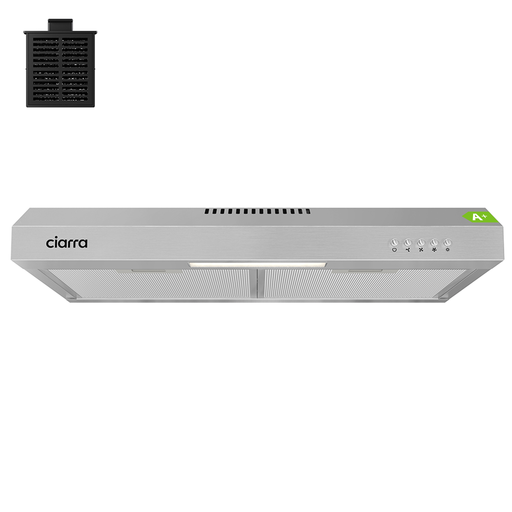 Image unavailable
Ciarra Slimline 60 cm, stainless steel
Worth considering for a kitchen where an under-cabinet installation is planned: ducted and recirculation modes are listed, along with charcoal filter code CBCF009. Check the manual for installation instructions, filter compatibility and specifications for the mode you choose.
View on Joybuy
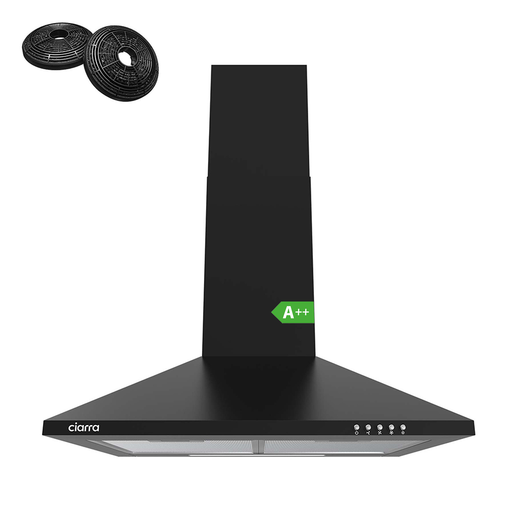 Image unavailable
Ciarra wall-mounted 60 cm, black
This wall-mounted cooker hood is listed as offering ducted and recirculation modes, with push-button controls. To choose between the two set-ups, check which filters are compatible and the airflow and noise figures for the mode you plan to use.
View on Joybuy
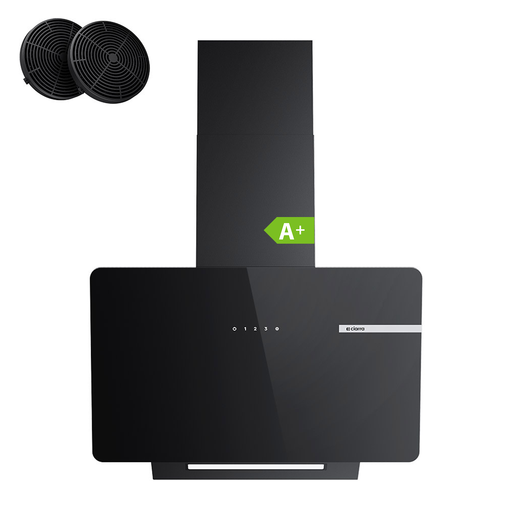 Image unavailable
Ciarra wall-mounted 60 cm, black glass and LED lighting
This wall-mounted model is listed for ducted or recirculation use. Charcoal filter CBCF055*2 is mentioned: check that it’s compatible with this variant and included in the box, then check the airflow and noise levels for your chosen mode.
View on Joybuy
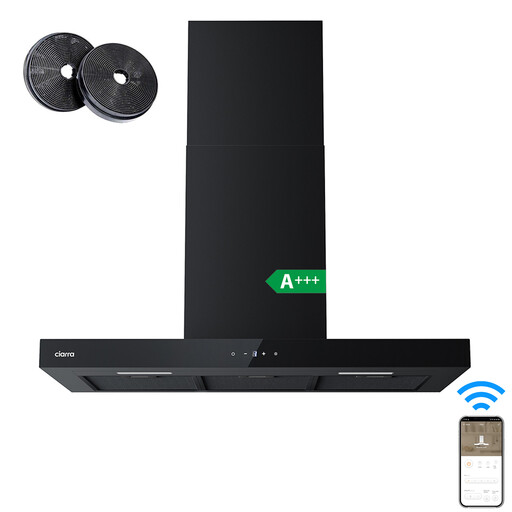 Image unavailable
Ciarra wall-mounted 90 cm, Wi-Fi, advertised airflow 650 m³/h
Check that this 90 cm model will fit the space available on your wall. Ducted and recirculation modes are listed, along with charcoal filters CBCF003; the advertised maximum airflow of 650 m³/h doesn’t, on its own, indicate performance in either mode.
View on Joybuy
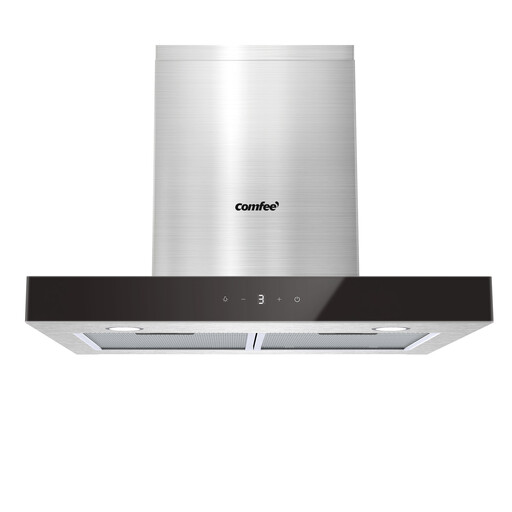 Image unavailable
Comfee TSHM77SS-60, 60 cm T-shaped cooker hood
This wall-mounted cooker hood is listed as offering ducted and recirculation modes, with a maximum advertised airflow of 650 m³/h. If you plan to use recirculation, confirm which type of charcoal filter is compatible and whether it’s included. Also check the specifications for this mode and the installation dimensions.
View on Joybuy
Frequently asked questions
Does a recirculating cooker hood vent steam outside?
No. As Bosch explains, it filters the air it draws in and returns it to the kitchen, whereas a ducted cooker hood expels air outside. If your cooking produces a lot of steam, bear this difference in mind and also consider how to air the room and use its ventilation.
Can you connect a cooker hood to a VMC or chimney?
No. UFC-Que Choisir says a cooker hood’s exhaust route must be used exclusively for that purpose and rules out connecting it to a VMC or chimney flue. If you’re unsure what an existing duct is for, have it checked before planning the installation.
Does a convertible cooker hood come with a recirculation kit?
Don’t assume the kit and filters are included: check the box contents for the model you’ve chosen. Bosch says its recirculation kits must match the cooker hood’s E-Nr product code; Elica notes that not all its extractor hood models can be converted.
How should you plan for filter maintenance?
Before buying, check the model’s manual and the filters’ product codes. Bosch distinguishes between the metal filter and the charcoal filter used in recirculation mode; replacement or regeneration requirements depend on the filter in question.
Can a boost setting on your ventilation replace a cooker hood?
Not automatically. ADEME says switching the kitchen ventilation to boost can increase airflow while cooking or when steam is produced. This function is part of your home’s ventilation system; it isn’t a duct to connect a cooker hood to, as UFC-Que Choisir points out.


