A kitchen without a usable outside duct
If you can’t install a dedicated duct leading outside, consider a recirculating cooker hood. You’ll need a charcoal filter that’s compatible with the model, and you’ll need to keep it maintained.


Start by considering your home: a ducted cooker hood needs its own duct leading outside, while a recirculating hood filters the air before releasing it back into the kitchen. If both installations are possible, compare performance in the mode you plan to use. Then check the space available, filter compatibility and the maintenance required.
If you can’t install a dedicated duct leading outside, consider a recirculating cooker hood. You’ll need a charcoal filter that’s compatible with the model, and you’ll need to keep it maintained.
If your main concern is cooking smells and vapour, consider a ducted hood if it’s possible to install a dedicated duct. Then compare models’ performance in this setup rather than assuming how well a hood will work based on its style alone.
If you’re replacing a hood or fitting one into a cabinet, the cut-out dimensions, available depth and access to the filters matter just as much as the operating mode. An integrated cooker hood must fit the existing or planned cabinet.
Ducted extraction and recirculation are designed for two different installation options. Choosing between a wall-mounted and an integrated cooker hood comes next: its shape alone doesn’t determine how it works.
Consider this: if your home already has a dedicated duct to the outside, or one can be installed.
Bear in mind: the duct route, any building work and any applicable permissions must be sorted out before installation.
Consider this: if there’s no usable dedicated outside duct, or you don’t want to install one.
Bear in mind: the air is returned to the room after filtration, and the charcoal filter needs maintenance according to its specific model.
| Criteria | What to check | Who this matters to |
|---|---|---|
| Suitability for your home | Check whether there’s a dedicated outside duct, and find out what permissions apply before planning any work. If there’s no usable duct, check whether the model can be set up for recirculation. | If the layout of my home could determine which operating mode is possible, I want to know before choosing a cooker hood; around 36% of consumers put this compatibility first. |
| Extraction while cooking | Compare performance in the mode you plan to use. UFC-Que Choisir measures airflow with a charcoal filter in recirculation mode and without one in ducted mode. | When I cook often, reducing smells, grease and steam while cooking matters more than an easy installation; this is the top priority for around 29% of consumers. |
| Filter maintenance | For recirculation, check which charcoal filter is compatible and whether it needs replacing or regenerating. In both modes, remember to maintain the grease filter. | I’d rather know what maintenance is involved and how often filters need replacing before choosing a model; around 21% of consumers make maintenance their main criterion. |
| Fitting into your kitchen | For an integrated cooker hood, check the cabinet and cut-out dimensions against the model’s instructions. For a wall-mounted hood, check the available space and installation clearances. | With a wall cabinet already in place, I mainly want a hood that will fit without restricting access to the filters; fitting into the kitchen is the priority for around 14% of consumers. |
An outlet to the outside may involve work on the building’s exterior or, in a flat, on communal areas. According to ANIL, work affecting communal areas or building equipment must be decided by the general meeting of co-owners; changes to the external appearance may also require prior planning permission.
Ask for the duct route to be confirmed. If you live in a flat, check the co-ownership rules and speak to the building manager, then contact your local council to find out what permissions apply to your project.
Creating an opening, installing a duct or changing the plans may involve extra work before the cooker hood can be fitted.
UFC-Que Choisir states that a ducted cooker hood must have its own dedicated outlet and must not be connected to mechanical ventilation or a chimney.
If you don’t have a usable dedicated outlet to the outside, consider recirculation with a charcoal filter and, if needed, a kit that’s compatible with your chosen hood.
Recirculation requires a suitable charcoal filter. Bosch notes in particular that its recirculation kits aren’t universal and must match the hood model.
Before buying, check the model number, the compatible filter reference and its maintenance instructions. Also check whether you’ll need to buy the installation kit separately.
The width of the front panel alone doesn’t tell you whether a model will fit in a wall cabinet: the cut-out, depth and access to the filters matter too.
Measure the cabinet and compare its dimensions, as well as the installation clearances, with the instructions for the exact model.
If the cut-out isn’t suitable, you may need to modify or replace the cabinet.
These brands offer examples of configurations and parts to check for a specific model; their inclusion here doesn’t indicate that every model is available.
Depending on the model, Bosch offers cooker hoods for ducted extraction or recirculation, as well as kits designed for the latter.
Elica offers standard and regenerable charcoal filters for some cooker hoods operating in recirculation mode.
Novy offers, among other options, telescopic cooker hoods and models that fit into a cabinet or housing.
These Ciarra cooker hoods include wall-mounted models, models designed to fit under a cabinet and an integrated model. They’re listed as suitable for recirculation. For each one, check which filter it needs and whether you have enough space. If you choose ducted extraction, make sure a dedicated outside duct can be installed.
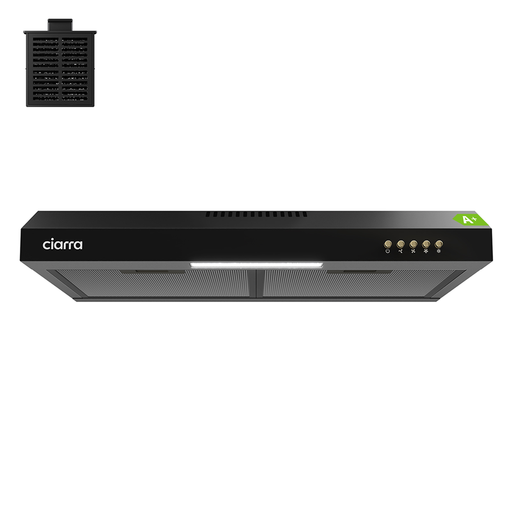 Image unavailable
Worth considering for a kitchen where the hood needs to fit under a cabinet. Check that the dimensions of 596 × 440 × 85 mm suit the space and planned installation.
This model can be used for ducted extraction or recirculation with a CBCF009 charcoal filter. Check its performance in the mode you plan to use.
Image unavailable
Its angled, wall-mounted design is suited to a kitchen with an appropriate space above the hob. Check the dimensions and installation clearances in the instructions.
This model can be used for ducted extraction or recirculation with two CBCF055 charcoal filters. The maximum stated airflow of 580 m³/h isn’t specified by mode, so compare performance for your planned installation.
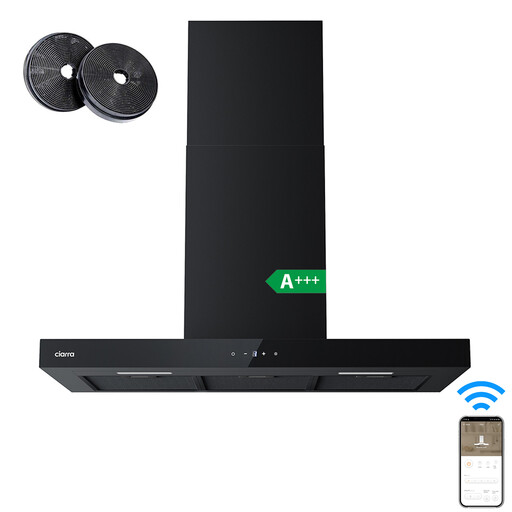 Image unavailable
Consider this model if you have space for a 90 cm wall-mounted cooker hood; measure the available area before choosing this size.
This model supports recirculation with two CBCF003 charcoal filters or connection to an outside duct. Its maximum stated airflow of 650 m³/h isn’t specified for either mode.
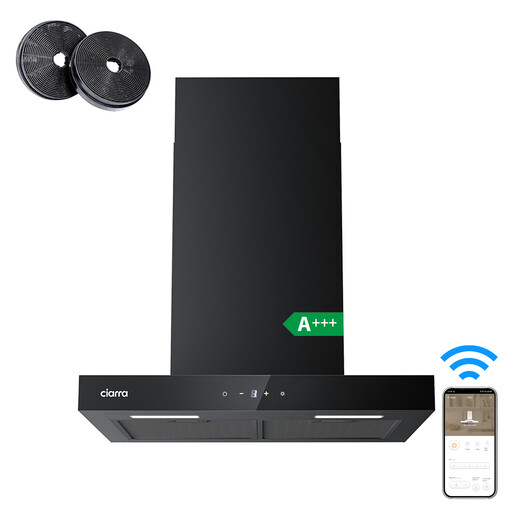 Image unavailable
This 60 cm option is worth considering for a wall space of this width, once you’ve checked the measurements and installation clearances.
It supports recirculation with two CBCF003 charcoal filters or ducted extraction. The maximum stated airflow of 650 m³/h doesn’t specify the relevant installation mode.
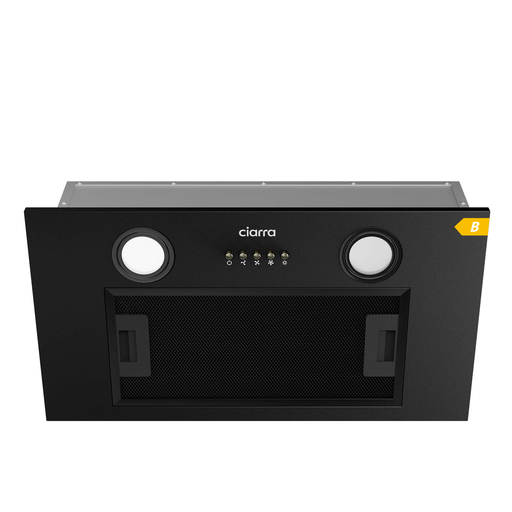 Image unavailable
If you’re fitting a hood into a wall cabinet, compare its dimensions and cut-out with this model’s measurements of 520 × 280 × 130 mm.
This model supports ducted extraction or recirculation. For recirculation, the CBCF005 charcoal filter is listed as sold separately, so check it’s compatible before choosing this setup.
It may be possible, depending on the building’s layout and the permissions that apply to your project, but you can’t decide based on the cooker hood alone. ANIL states that work affecting communal areas or building equipment must be decided by the general meeting of co-owners, and that changes to the external appearance may require prior planning permission. Before ordering a ducted hood, check the co-ownership rules and speak to the building manager and your local council.
No. UFC-Que Choisir states that the hood’s extraction duct must be used exclusively for that purpose and prohibits these connections. If there’s no usable dedicated outside duct, consider a recirculating setup rather than using an existing duct for another purpose.
Yes, recirculation requires a charcoal filter that’s compatible with the hood. Also check whether a specific kit is needed. Bosch, for example, states that its kits aren’t universal and compatibility depends on the model reference.
It depends on the model and how it’s installed: an integrated design doesn’t automatically support both modes. Check the instructions for compatible configurations and built-in dimensions. Depending on the mode you choose, you’ll also need to check the route for a dedicated duct or the reference of the required charcoal filter.