
Livraison le jour même ou le lendemain

Qualité garantie

Débloquez vos offres de bienvenue: Livraison GRATUITE | Jusqu'à -80 % | 30 jours d'essai gratuits à JoyPlus
Téléchargez l'application
Choosing the right p?té for your cat can quickly become overwhelming. The packaging promises the world, but the actual ingredients are often far less appealing. As a Product Expert at Joybuy, my mission is to help you decode the labels. Let's analyse the pitfalls to avoid and the essential criteria for finding the duck p?té for cats that will truly meet your feline's needs.
Pet food marketing is full of flattering—and often misleading—claims. Here are three points to keep in mind before you head to the checkout.
To make the right choice, let's get back to basics. Here are the three things to check on every label.
The cat is an obligate carnivore. Its diet must therefore be based on a high intake of animal protein. A quality meat-rich cat food will have a meat and high-quality offal (heart, liver, gizzard) content of over 60%, and ideally over 70%. The source must be crystal clear: the word "duck" should be listed with its exact percentage in the recipe. This is your guarantee that you're not paying for water and fillers.
Choosing a grain-free wet cat food is an excellent rule of thumb, especially for felines with sensitive digestion. The absence of gluten and grains limits the risk of intolerance. Likewise, a recipe without added sugars is a true sign of quality that respects a cat's natural diet. A natural cat p?té worthy of the name contains only the essentials: meat, a little broth, a touch of vegetables or fruit for fibre, and essential vitamins and minerals.
Packaging is more than just a detail: it directly affects the product's freshness and your daily routine. The duck freshness pouch for cats is often a favourite for its convenience. It provides a single serving, which guarantees maximum freshness at every meal and reduces waste. Cans, which are more economical in larger sizes, require strict storage in the refrigerator (for a maximum of 24 hours) after opening.
To put theory into practice, here are a few products that meet our criteria and are suited to different types of cats (and owners!).
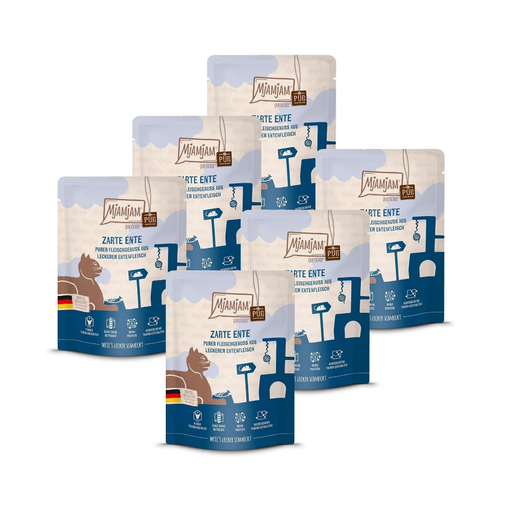
Why we chose it: Perfect for owners who want a clean, single-protein recipe, which is often recommended for cats with food sensitivities. The formula is built around a single meat source for maximum digestibility.
The ingredient list is crystal clear: 70% duck meat, heart, and liver. No vague by-products or hidden percentages.
A single-protein recipe with a very high meat content, free from grains and added sugars. The assurance of a healthy and simple diet.
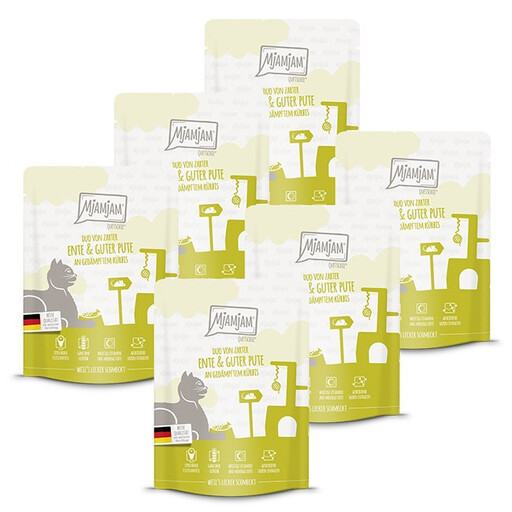
Why we chose it: For owners who like to vary their cat's meals. The MjAMjAM Duo range combines two meats for a more gourmet recipe, while maintaining an impeccable composition.
The recipe is guaranteed grain-free and has no added sugars. The percentages of each meat are stated in black and white (56% turkey, 14% duck), for total transparency.
The combination of two meats (turkey, duck) and a vegetable (squash) for a complete and flavourful recipe that will delight even the most discerning palates.
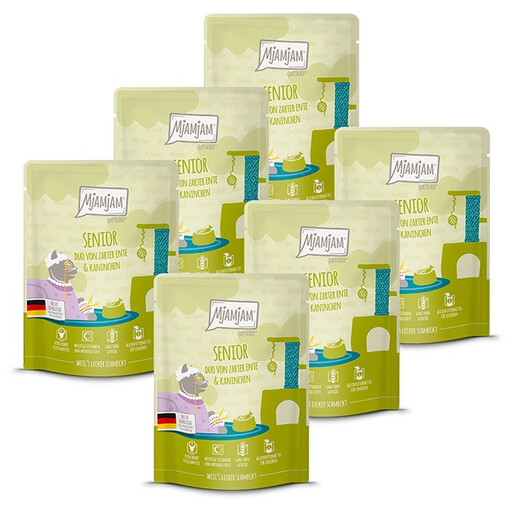
Why we chose it: This **senior cat p?té** has been specially formulated for the needs of older cats, with ingredients chosen to support their vitality and joints.
The formula stays true to the brand's principles: grain-free and rich in meat (56% duck, 14% rabbit), to avoid overloading a digestive system that becomes more sensitive with age.
Enriched with salmon oil, chicory, and green-lipped mussel, this recipe provides targeted nutrients for seniors without compromising on taste.
Discover our complete selection of products that meet our strict quality criteria and current regulations.
Once the pouch or can is opened, the p?té should be stored in the refrigerator in an airtight container. It is advisable to use it within 24 hours to guarantee its freshness and preserve its nutritional qualities. Remember to take it out a few minutes before serving to let it return to room temperature: cats rarely enjoy a meal straight from the fridge!
The daily portion depends on your cat's weight, age, and activity level, as well as the caloric density of the p?té. As a guide, an adult cat weighing 3 to 5 kg consumes between 200 and 400 grams of wet food per day. This portion should, of course, be adjusted if you practice mixed feeding (p?té + kibble). The most reliable method is to follow the recommendations on the packaging.
A grain-free wet food diet is closer to a cat's natural diet and is therefore very well tolerated by most of them. It is particularly recommended for cats prone to digestive or skin sensitivities. For the vast majority of healthy felines, it's an excellent dietary foundation. In the case of a diagnosed medical condition (allergies, kidney problems, etc.), your veterinarian's advice is essential to approve your pet's diet.