
Livraison le jour même ou le lendemain

Qualité garantie

Débloquez vos offres de bienvenue: Livraison GRATUITE | Jusqu'à -80 % | 30 jours d'essai gratuits à JoyPlus
Téléchargez l'application
A duck feather and down duvet can provide a soft, comfortable feel, good breathability and easily adjustable warmth. However, product specifications require careful reading. Down percentage, fill weight, dimensions, treatments and hygiene claims can all increase the price without making a meaningful difference in everyday use.
Here are the key criteria to review before placing an order, along with a selection suited to the main types of sleepers in France.
Down is lightweight and lofty. Feathers, on the other hand, provide more structure but are heavier and can sometimes be felt through the cover. A duvet made from 90% feathers and 10% down therefore does not offer the same comfort as a model filled predominantly with down.
The percentage does not tell the whole story, however. Check whether it refers to the total fill weight, review the detailed composition and confirm how the filling is distributed throughout the compartments.
A warm winter duvet is designed for rooms with limited heating, homes that are difficult to warm or people who feel the cold particularly easily. In a bedroom kept at a high temperature, it can quickly become too enveloping.
For greater flexibility, a 4-season down duvet or a 2-in-1 summer/all-season duvet allows you to use a lightweight layer and a warmer layer separately, or combine them when temperatures drop. The DOWNFOCUS combination featured in this selection includes a 200 g/m² summer filling and a 450 g/m² all-season model, according to the product listing.
A tightly woven cotton cover can create a physical barrier against particles and dust mites, but it does not replace regular care. Hypoallergenic duvet and dust-mite-resistant duvet claims should be considered alongside the certification cited, washing recommendations and exact composition.
Certifications such as OEKO-TEX Standard 100, CertiPUR, Sanitized and other labels shown on a product listing refer to different standards. Take the time to review the certificate details and its scope of application.
Expressed in grams per square metre, fill weight indicates how much filling has been used. On its own, it is not enough to determine how warm a duvet will be: loft and down content also matter.
Square or compartment quilting keeps the filling in place and helps prevent the formation of areas with less coverage. This is an important detail to check on any natural feather duvet.
The 90% feathers, 10% down specification describes a filling that prioritises structure and support. A organic cotton cover, such as the one advertised on several MORPHEA models, may appeal for its soft feel and breathability. Fabric density, sometimes expressed in threads per cm², indicates how tightly the fabric is woven, but it is not sufficient on its own to assess comfort.
If you have sensitive skin, check the treatments applied, textile labels and care recommendations. A dense cover can help limit the migration of small particles, provided the bedding is aired and maintained regularly.
The ideal size depends on the dimensions of the mattress, the height of the bed and the desired overhang:
Measure your mattress before ordering. For two people, a duvet that is too small can lead to tug-of-war over the covers and compromise comfort during the night.
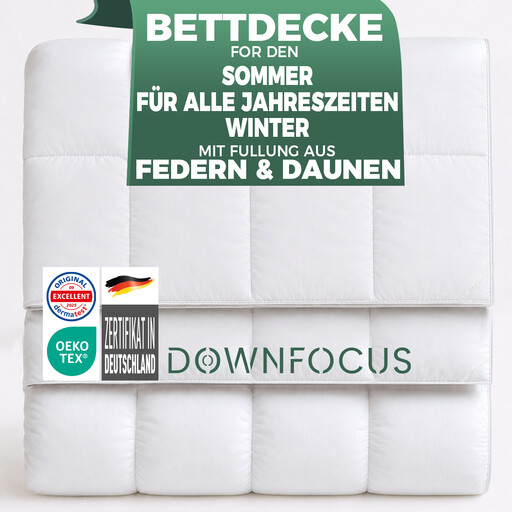
Why it is a good fit: a compact option for alternating between mild and cooler nights without buying two separate duvets.
The 2-in-1 design avoids having to choose a single duvet that is too warm for summer or too light for winter. The two stated fill weights are clearly differentiated.
135 × 200 cm dimensions, 200 g/m² and 450 g/m² layers, and OEKO-TEX and RDS certifications listed on the product page.
Why it is a good fit: its square format suits couples looking for evenly distributed coverage on a double bed.
The modular design adapts coverage to changing temperatures instead of relying on a single thickness all year round.
200 × 200 cm format, stated 200 g/m² and 450 g/m² fillings, and an OEKO-TEX-certified cover according to the product page.

Why it is a good fit: its size and stated warmth are suited to large beds and bedrooms with limited heating in winter.
The “warm” rating is best reserved for winter or colder rooms rather than a bedroom heated throughout the year.
Stated composition of 90% feathers and 10% down, organic cotton cover, square quilting and washing up to 40 °C according to the product page.
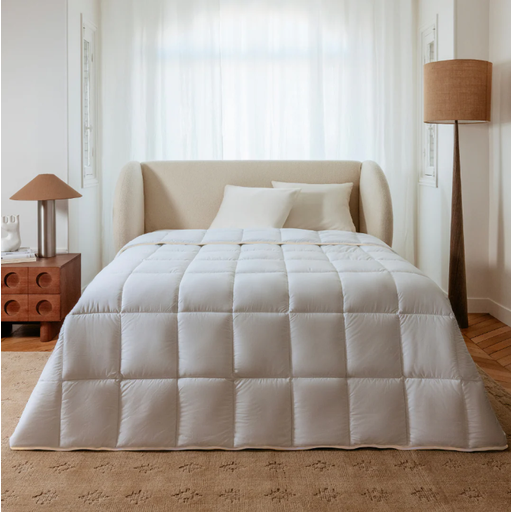
Why it is a good fit: its generous dimensions provide ample overhang, while its all-season design suits bedrooms where temperatures fluctuate.
A lightweight duvet helps prevent overheating during sleep. However, check your bed dimensions and the available space in your washing machine before buying.
240 × 260 cm format, square quilting, stated composition of 90% feathers and 10% down, and care at 40 °C according to the product page.
Browse an updated selection of duvets and pillows to compare dimensions, warmth levels and compositions.
A duck feather and down duvet should be aired regularly, but not left exposed to moisture for extended periods. Shake it gently to redistribute the filling and use a cover that can be washed easily.
Several models in this selection specify machine washing at a maximum of 40 °C, gentle drying or professional cleaning. For larger sizes, make sure your washing machine and tumble dryer have sufficient capacity. Incomplete drying can trap moisture and damage the filling.
People with allergies should distinguish sensitivity to dust mites from an allergy to animal proteins. A treated or tightly woven cover may help limit certain allergens, but it is by no means a medical guarantee. If in doubt, seek advice from a healthcare professional.
A duck feather pillow can complete the set. The MORPHEA Drimz model, measuring 60 × 60 cm, lists a composition of 90% feathers and 10% down, a 100% cotton cover and a thickness of 20 cm. Sold individually, it also requires regular care.
The 220 × 240 cm format suits many double beds and provides a generous overhang. The 240 × 260 cm size is better suited to larger beds or couples who want more room. Always compare the mattress width and bed-base height before choosing.
Yes, provided its fill weight remains moderate and the bedroom is not too warm. A light summer duvet of around 200 g/m² can be used on its own. For coverage across several seasons, a 2-in-1 model makes it easy to adjust the thickness.
It depends on the quality of the cover, how often the duvet is aired and whether the care instructions are followed. A protective cover, thorough drying and off-season storage in a breathable bag all help preserve the loft of the filling.