
Livraison le jour même ou le lendemain

Qualité garantie

Débloquez vos offres de bienvenue: Livraison GRATUITE | Jusqu'à -80 % | 30 jours d'essai gratuits à JoyPlus
Téléchargez l'application
A duck feather duvet can offer a good balance between structure, loft and temperature regulation. But product listings sometimes line up enticing promises without giving you the information you actually need to compare models properly. To choose a duvet suited to British winters, summer nights or a cooler bedroom, it's best to focus on the composition, fill weight, dimensions and care instructions.
Down is made up of fine clusters that create a cosy, enveloping feel and excellent insulation. Feathers, which are more structured, provide greater support and can feel slightly firmer to the touch. A duvet made from 90% feathers and 10% down will therefore behave very differently from one that is mostly filled with down.
You need to examine the percentage in detail, rather than relying solely on the marketing name. The feel depends directly on the blend: a duck down duvet will generally be softer, whereas a duck feather duvet will offer more support.
A lightweight "all-season" duvet can work well in a properly heated bedroom, but it won't necessarily replace a warm winter duvet in a cold room. On the other hand, a very thick model may become stifling as soon as the nights turn milder.
The fill weight is a good point of comparison. The DOWNFOCUS 2-in-1 models, for example, combine a summer duvet at 200 g/m² and an all-season duvet at 450 g/m². The two parts can be used separately or joined together depending on the temperature.
A poorly distributed natural filling creates cold spots and loses its loft more quickly. Box quilting or stitched-through squares help to stop the filling from shifting. You should also check the washing temperature, drying conditions and whether the duvet can be professionally cleaned.
A duvet that can be washed at 40 °C should not, however, be dried at a high temperature. Gentle drying and regular airing help to preserve its loft and structure.
To choose a breathable natural duvet, look at the filling and the outer fabric separately. Cotton sateen or a tightly woven cotton can offer a soft feel while limiting the passage of filling particles. The MORPHEA models shown here feature a cover in organic cotton sateen with 129 threads per cm².
The presence of feathers does, however, give the duvet a more pronounced structure. If you're after a very light feel, compare the feather-to-down ratio, the total weight and the fill weight: the word "natural" alone isn't enough.
Claims such as OEKO-TEX Standard 100, CertiPUR, Sanitised, ISO 9001, RDS or Downpass should be checked on the specific product page. They don't all mean the same thing: some relate to substances in the textiles, while others cover traceability, manufacturing processes or animal welfare.
A duvet described as anti-dust mite or hypoallergenic is not a medical guarantee. When the listing mentions a barrier against dust mites or suitability for sensitive skin, this is a feature claimed by the brand. If you have a diagnosed allergy, these indications should be weighed against advice from a healthcare professional.
The right size depends on your mattress width, bed depth and how much overhang you want. Here are the most common sizes:
Measure your mattress before ordering and make sure your duvet cover matches the size you choose exactly.
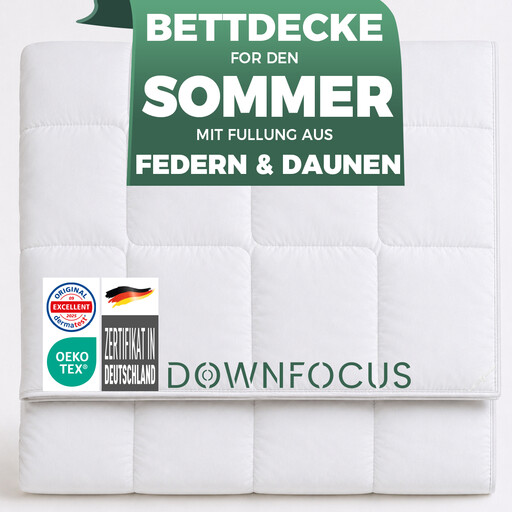
Why this choice suits this profile: With its summer fill weight of 200 g/m², this duvet lets you discover duck feather and down filling without jumping straight to a thick winter model.
The fill weight is clearly stated, which stops you from mistaking a summer feather and down duvet for a warm winter one.
200 x 200 cm size, filling stated as 90% feathers and 10% down, OEKO-TEX certification indicated by the brand.
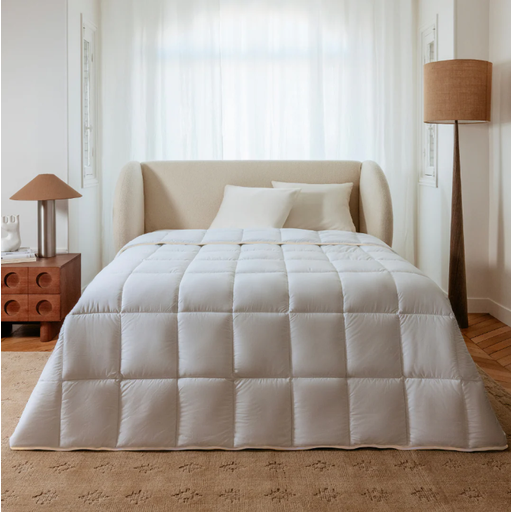
Why this choice suits this profile: This large size combines a cotton sateen cover, box quilting and a stated all-season use.
The regular quilting limits filling migration and reduces the risk of developing less-covered areas.
240 x 260 cm size, cotton sateen stated at 129 threads per cm², washable up to 40 °C according to the listing.
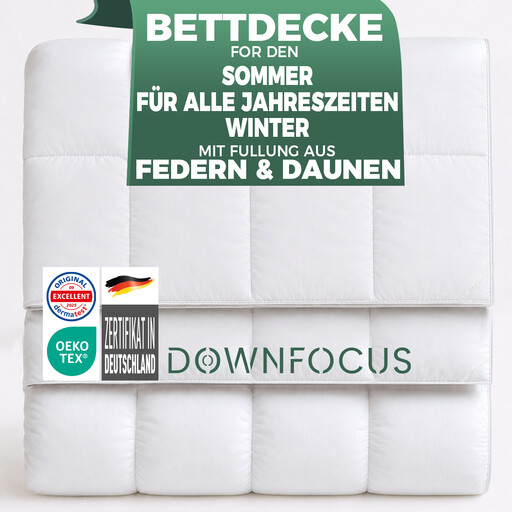
Why this choice suits this profile: Its modular design lets you adapt the cover to temperature differences between a heated bedroom, mid-season and warm nights.
The fill weights of 200 g/m² and 450 g/m² are separate, so you avoid sleeping under a duvet that's too warm all year round.
Two elements that can be used separately or together, tightly woven cotton cover and certifications stated by the brand.
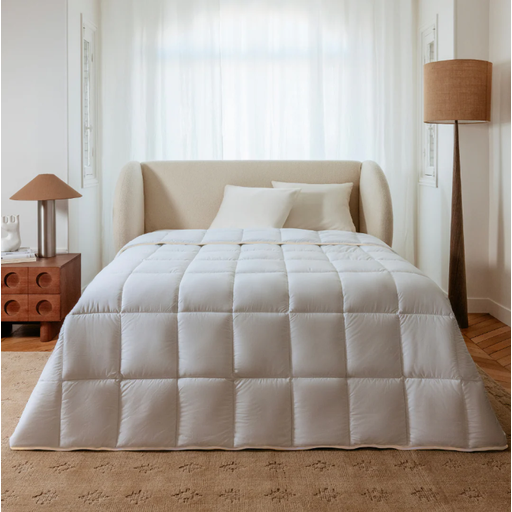
Why this choice suits this profile: Its double size and stated warmth level are well suited to cooler bedrooms and people who feel the cold easily.
The composition and winter use are specified, which makes it easier to compare with a lightweight all-season duvet.
220 x 240 cm size, filling stated as 90% feathers and 10% down, washable up to 40 °C according to the listing.
We've put together a comprehensive, real-time updated list of products that fully meet these strict selection criteria and European safety regulations.
Air the duvet regularly, give it a gentle shake and use a suitable duvet cover. The listing for the MORPHEA models recommends washing once or twice a year, at a maximum of 40 °C, followed by a gentle tumble dry. If you can't dry it fully at home, professional cleaning is an option.
Avoid storing a duvet that is still damp or compressed for a long period. A breathable storage bag protects the fabric without trapping too much moisture. The lifespan then depends on the quality of the cover, how often you wash it and how well you air it.
Yes, some models are designed for winter, but their warmth level depends on the fill weight, the feather-to-down ratio and your bedroom temperature. For a cold room, compare a warm winter duvet with an all-season or modular model.
The 200 x 200 cm, 220 x 240 cm and 240 x 260 cm sizes suit different needs. Measure your mattress and allow enough overhang on the sides. For a large bed or a couple who move around a lot, a wider size can help prevent you from losing cover during the night.
Claims such as "hypoallergenic" or "anti-dust mite" should be treated as features stated by the brand, linked to the treatments or certifications shown on the listing. They are not a substitute for medical advice. If you have sensitivities, also check the cover, the care recommendations and whether you can use a washable protective cover.