
Same-day & Next-day Delivery

Quality Guaranteed

Unlock Your Welcome Offers: FREE Delivery | Up to 80% OFF | Free 30-day JoyPlus trial
Download the APP
Winter is approaching, and with it, the desire to snuggle into a warm cocoon for cosy nights. A warm duck feather duvet is synonymous with absolute comfort. Yet, when faced with a jungle of technical terms and marketing claims, making the right choice can quickly become a headache. A poor purchase results not only in shivering nights but also in a wasted investment. To avoid making a mistake, it's best to know the pitfalls to avoid.
The 3 mistakes to avoid when buying a natural duvet:
To make an informed choice, focus on these few technical points. They are what guarantee the performance and longevity of your future duvet.
The natural fill is the cornerstone of insulation. To choose well, you must first understand its composition:
For a winter duvet, aim for a minimum of 30% down. The highest-performing models go up to 90% down, or even more.
Be careful, a high fill weight, expressed in grams per square metre (g/m?), doesn't necessarily mean superior warmth. Thanks to the insulating power of down, a 250 g/m? duck down duvet can be much warmer than a 400 g/m? feather duvet.
Natural fillings are also renowned for their excellent thermoregulating capacity. Unlike synthetic materials, they wick away moisture very effectively. The result: you stay warm without ever sweating, even with two people under the duvet.
The duvet's casing, or percale, plays an equally essential role in comfort and durability.
To help you see more clearly, here are a few options that meet different needs and profiles.
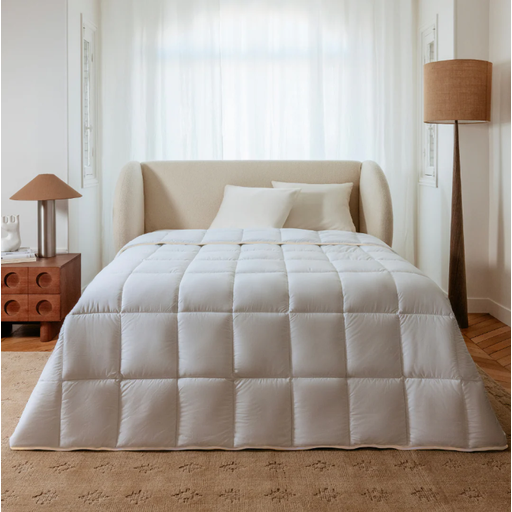
Why we love it: Designed for polar nights or cool bedrooms, this duvet goes all-in on its ultra-insulating natural fill. Its generous dimensions are perfect for a double bed, creating an effective barrier against cold draughts.
Its baffle-box construction ensures a perfect distribution of the filling, eliminating the risk of cold spots. With 90% down to 10% feathers, it offers maximum thermal insulation without the weight of a low-end duvet.
Its organic cotton sateen casing (129 threads/cm?) and its OEKO-TEX and Sanitized labels make it a healthy and durable choice, ideal for sensitive skin.
Why we love it: The 220x240 cm size is the standard for a double bed (140x190 cm), with a generous drape on each side. No more fighting over the covers! Everyone stays warm all night long. Its thermoregulating capacity is a real plus for couples.
This model is treated to be anti-dust mite, which immediately removes any doubt about allergies. The Sanitized label ensures a healthier sleeping environment, a criterion too often overlooked during a first purchase.
The perfect balance between down (for softness) and feathers (for springiness) offers an enveloping comfort that adapts to all sleepers.
Why we love it: Perfect for a single bed or a first apartment, this 140x200 cm duvet makes all the benefits of a natural fill accessible. It's the best way to get quality without breaking the bank.
Even at this price, no compromises are made on manufacturing quality: the box stitching and cotton casing are present to ensure performance and durability.
It carries the same certifications (OEKO-TEX, Sanitized) as the larger models. A safe and healthy purchase, right from day one.
Want to explore other fill technologies? Our complete selection is here to guide you.
If a natural fill isn't your only consideration, take a look at our full range of duvets. All our models meet very strict selection and safety criteria.
1. How do I care for a duck feather duvet to make it last? Proper maintenance is the key to its longevity. Wash it once or twice a year, no more, in a large-capacity machine (12 kg minimum) on a delicate cycle at 40°C maximum. Tumble drying is essential: use a low temperature with dryer balls (or tennis balls) to help the filling regain its full loft. Also, remember to air it out regularly.
2. Is a feather duvet a risk for people with allergies? This is a persistent myth. The allergy is almost never due to the feathers themselves, but to the dust mites that can live in them. Quality natural duvets, like those in our selection, undergo anti-dust mite treatments and are certified OEKO-TEX Standard 100 (free of harmful substances). Furthermore, their tightly woven casing acts as an impassable physical barrier.
3. What size duvet should I choose for my bed? For optimal comfort, the duvet should hang over the mattress by 30 to 40 cm on each side. Here are some simple guidelines: