
Livraison le jour même ou le lendemain

Qualité garantie

Débloquez vos offres de bienvenue: Livraison GRATUITE | Jusqu'à -80 % | 30 jours d'essai gratuits à JoyPlus
Téléchargez l'application
Buying a new set of coloured markers should be a moment of pure joy, filled with the promise of future creations. Yet, the reality is often far less exciting: tips that fray after a few strokes, ink that bleeds through and ruins the next page, or dull colours that look nothing like the cap. These disappointments can turn a small creative pleasure into a complete waste of money.
Before you fall for a new marker set, it's best to know how to see through the marketing ploys and focus on the features that truly matter. This guide gives you the keys to identify the essential technical criteria and find the perfect set for your projects, whether you're into drawing, lettering, or just looking to organise your notes.
The market is flooded with markers, each with more enticing promises than the last. To make the right choice, you need to look beyond the sheer number of colours. Here are the three key factors you should never overlook.
The main selling point of dual-tip markers is, of course, their versatility. However, not all combinations are created equal, nor do they meet the same needs.
The type of ink is crucial: it determines not only the colour rendering but also the compatibility with your paper and your intended use.
For peace of mind, especially when children are present, safety is a non-negotiable criterion.
Rather than searching for a one-size-fits-all marker that doesn't exist, it's better to choose a set tailored to your user profile.
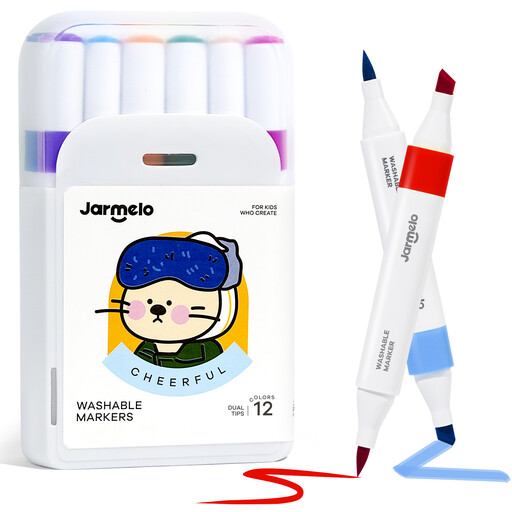
Why we chose it: Ideal for getting started with drawing or lettering with a versatile kit that won't break the bank. The bonus: a practical storage case to keep your supplies tidy.
Its water-based ink, which the manufacturer claims is 90% washable, minimises disasters on clothes or skin. Its tips are designed to last and prevent the frustrating premature fraying.
The combination of a brush tip and a chisel tip offers ideal versatility for colouring and first attempts at calligraphy.
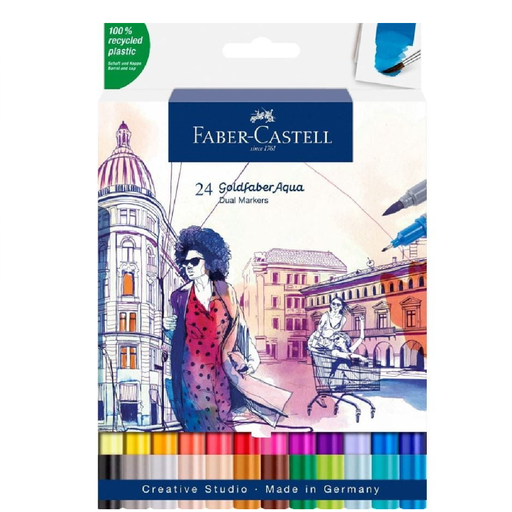
Why we chose it: For artists and experienced hobbyists who demand rich pigmentation and the ability to create watercolour effects. A true portable studio for illustration and *mixed media* projects.
Its water-based ink is formulated to not bleed through most papers, even when activated with water. The tips (a soft brush and a 0.6 mm fine tip) are robust and ensure precise line control.
Fully water-soluble, its ink allows for incredibly smooth gradients and colour blends. Eco-friendly bonus: the barrel and caps are made from 100% recycled plastic.
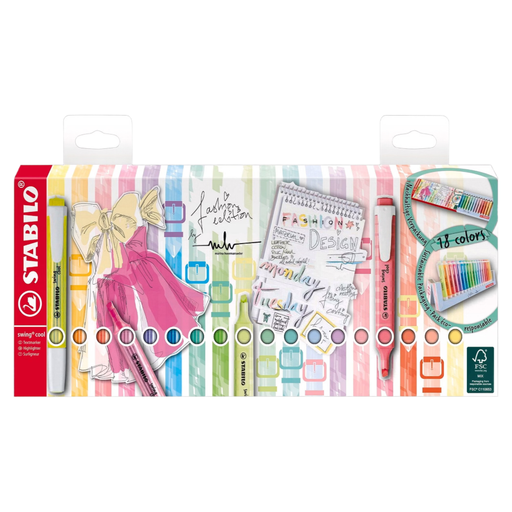
Why we chose it: The perfect companion for organising, note-taking, and decorating journals. Its wide range of pastel and neon shades is ideal for creating colour codes that are as clear as they are beautiful.
Stabilo's anti-dry-out technology allows it to be left uncapped for up to 4 hours without drying out. Its water-based ink is designed to prevent smudging and minimise bleed-through on the back of the page.
Its chisel tip offers two line widths (1 and 4 mm), perfect for highlighting entire passages or underlining keywords with great precision. Its pen-style format with a clip makes it ultra-portable.
We have curated a complete selection of products that meet our selection criteria and current safety regulations.
The golden rule: always recap them tightly after each use. An audible "click" usually confirms that the marker is properly sealed. For dual-tip models, horizontal storage is recommended. This allows the ink to flow evenly to both tips and prevents one from drying out prematurely.
Technically, yes, but the result will be far from optimal. To achieve beautiful gradient and blending effects, it is highly recommended to use watercolour paper (with a weight of over 200 g/m?) or a mixed-media paper. On standard printer paper (80 g/m?), the water is likely to cause the sheet to buckle and the ink to bleed through.
It all depends on your use case.