
Livraison le jour même ou le lendemain

Qualité garantie

Débloquez vos offres de bienvenue: Livraison GRATUITE | Jusqu'à -80 % | 30 jours d'essai gratuits à JoyPlus
Téléchargez l'application
Dual-colour silk PLA filament has revolutionized 3D printing, making it possible to create objects with a brilliant, shimmering finish and a head-turning, colour-shifting visual effect. But be warned: not all filaments are created equal. For makers and enthusiasts looking to bring decorative pieces, figurines, or cosplay accessories to life with a truly premium look, choosing the right spool is crucial. The wrong choice can be a recipe for failed prints, dull colours, and a waste of time and money.
This guide breaks down the essential criteria and helps you avoid common pitfalls, ensuring your creations stand out for their quality and aesthetic appeal.
Marketing for shiny 3D printing filament can sometimes be misleading. Here are the most common disappointments and our advice on how to anticipate them.
To ensure you get successful prints with a stunning visual effect, check these three technical points before you checkout.
The secret to a true dual-colour PLA lies in co-extrusion, a process where two distinctly coloured filaments are fused into a single strand. The quality of this fusion is paramount.
This is THE reliability factor for your prints. A quality filament must have a very strict dimensional tolerance.
Silk PLA contains additives that give it its shine but also alter its printing parameters compared to standard PLA.
Instead of a random list, we've matched each filament to a user profile to help you find the perfect spool for your projects.
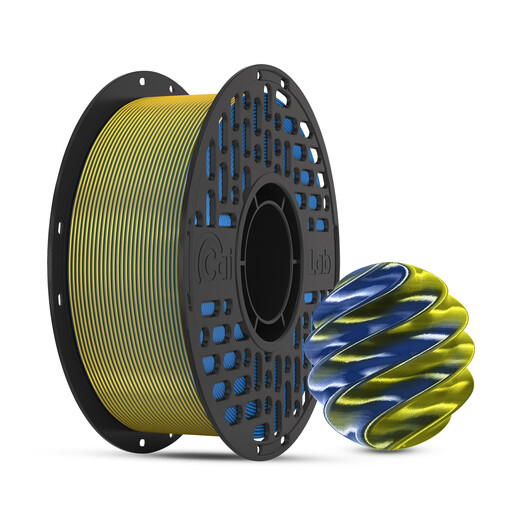
Why we love it: Perfect for creators who want to bring decorative pieces (vases, sculptures) with high visual impact to life. The blue and gold combination offers a striking contrast and a luxurious look that enhances both geometric and organic shapes.
CaiLab's co-extrusion process ensures clean colour separation—goodbye to the "muddy" effect! The result is a true dual-colour finish that shifts with the light, not just a basic plastic shine.
High colour contrast for a spectacular visual effect. The material formulation guarantees an intense, lasting shine across the entire surface of the printed object.
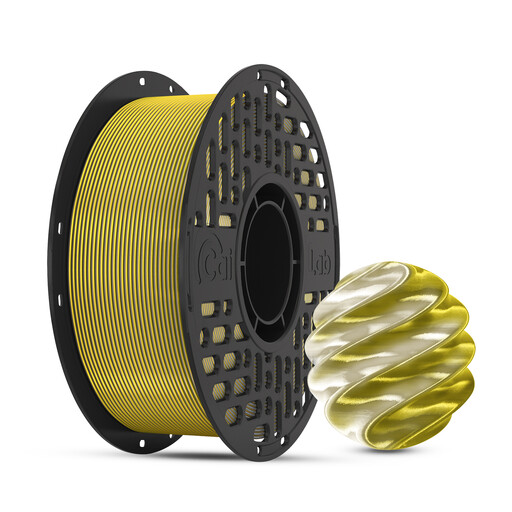
Why we love it: Essential for cosplay accessories (armour, swords) and miniatures that require a metallic look. The gold and silver combination simulates polished metal, and the silky finish effectively hides layer lines, reducing the need for post-processing.
Its very strict dimensional tolerance prevents nozzle clogging, a critical issue for the long, complex prints typical of cosplay. Reliability is guaranteed.
An ultra-smooth surface finish that significantly reduces the need for sanding. The dual-colour metallic effect adds depth and realism to props and models.
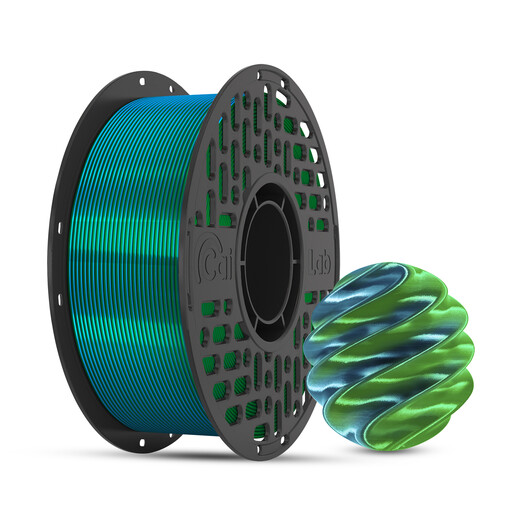
Why we love it: For those who love to go off the beaten path with unique visual effects. The blue and green combination creates an iridescent finish reminiscent of scarab beetles or deep-sea life. An excellent choice for dream-like objects, jewellery, or abstract creations.
The quality of the pigments ensures vibrant, well-defined colours in the final print, a far cry from the washed-out shades that fail to deliver on their promise.
An original colour combination for projects that truly stand out. The iridescent effect is subtle and shifting, adding a touch of magic to every creation.
Discover our full selection of filaments that meet our quality criteria and safety standards.
1. What is the ideal printing temperature for dual-colour silk PLA? It's generally between 200 and 230°C. We recommend starting with the manufacturer's recommendations and then printing a temperature tower to fine-tune the optimal setting for your machine. A precise setting is key to getting the most out of your shiny 3D printing filament.
2. How can I prevent the colours from blending into a dull finish? It all depends on the geometry of your model and, of course, the quality of the filament. To maximise the effect, orient your model in the slicer so that curved surfaces or sharp edges play with the light from different angles. Using a quality filament with controlled co-extrusion, like those from CaiLab, is obviously crucial.
3. How many objects can you print with a 1 kg spool of PLA? It all depends on the size and infill density of your prints. A standard 1 kg spool of PLA contains about 330 metres of filament. As an example, a 15 cm figurine with 20% infill will use between 50 and 100 grams of material. This means you can print between 10 and 20 objects of that size with a single spool.