What to check before buying
Start by deciding where your laundry will dry, then compare appliances based on your laundry volume, the room’s humidity and installation requirements.
| Priority |
What to check |
Your needs |
| Humidity and ventilation |
For an airer, choose a large, well-ventilated room or one fitted with a mechanical ventilation extraction vent. Check that the dehumidifier is suitable for the room size and has an appropriately sized tank or drainage system. |
I want to dry laundry without turning a small, poorly ventilated room into a permanent drying area. |
| Electricity consumption |
Compare the A to G energy rating, Eco programme consumption and capacity on the energy label. UFC-Que Choisir distinguishes heat-pump models by their low consumption, while conventional condenser models can dry more quickly. |
If mechanical drying is necessary, I want to keep consumption down during regular cycles. |
| Capacity, footprint and noise |
Match the capacity in kg to your actual loads. Compare the dimensions, the Eco programme’s noise emissions and whether there is a tank or condensate drainage connection. |
The appliance must fit into my home and remain acceptable to use at the times I need it. |
| Maintenance |
Identify the lint filter, condenser maintenance requirements and condensate tank management. Also check the repairability and spare-parts information in the model documentation. |
I prefer a maintenance routine that fits around my schedule, without overlooking anything needed for proper operation. |
Joybuy products for indoor drying
These Joybuy options cover mechanical drying with a tumble dryer and using a dehumidifier alongside an indoor airer.
 Image unavailable
Hotpoint CHD84MWBSEE 8 kg heat-pump tumble dryer
For frequent laundry when you want to avoid leaving an airer in the room for long periods.
Stated 8 kg capacity, heat-pump technology, advertised noise level of 64 dB and the option of direct condensate connection.
Energy class C is stated; compare the energy label, dimensions, Eco programme consumption and whether the drain hose can be connected before buying.
Joybuy
 Image unavailable
Electrolux EDH1018CD GentleCare 8 kg tumble dryer
An 8 kg option for organising the drying of a household laundry load without relying on a permanent airer.
Water collection tank, advertised OptiSense humidity sensors, reversible door and dimensions of 60 × 65 × 85 cm.
Energy class E and annual consumption of 235 kWh are stated. Check the current energy label, drying technology, direct drainage and maintenance requirements in the model documentation.
Joybuy
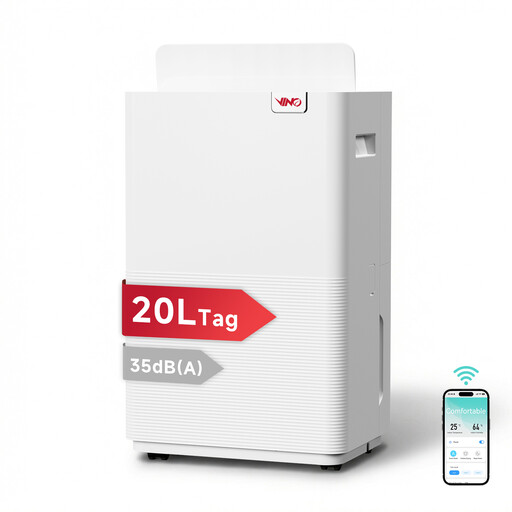 Image unavailable
VINO 20 L smart dehumidifier
To consider alongside an airer in a suitable room, helping to manage local humidity without replacing ventilation or mechanical ventilation.
Advertised laundry mode, 2.5 L tank or continuous drainage, stated operation from 5 to 32 °C and advertised coverage of up to 40 m².
20 L per day is stated at 30 °C and 80% relative humidity. Check the noise level in the mode you use and whether the appliance is suitable for your room.
Joybuy
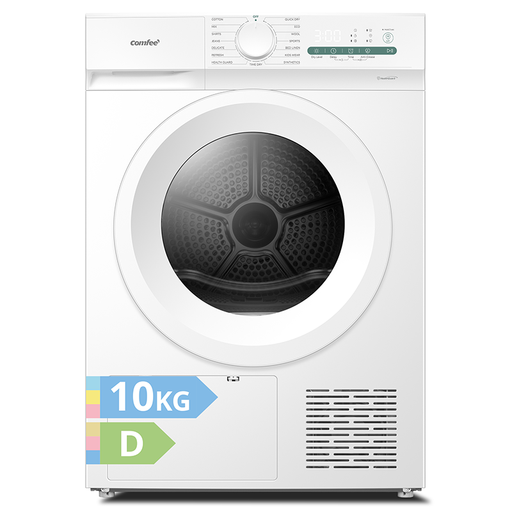 Image unavailable
Comfee CD10EHP05W-HR 10 kg heat-pump tumble dryer
This capacity may suit households that dry large volumes of laundry or household linens.
Stated 10 kg capacity, heat-pump technology, three adjustable drying levels, a double-layer lint filter and an advertised refresh cycle.
Energy class D is stated. Check the noise level, dimensions, Eco programme consumption and condensate management; a 10 kg capacity may be excessive for smaller typical loads.
Joybuy
 Image unavailable
Comfee CD08EHP05W-HR 8 kg heat-pump tumble dryer
An 8 kg capacity suited to regularly drying a typical household load.
Stated heat-pump technology, three adjustable drying levels, special programmes, refresh cycle, double-layer filter and advertised LED display.
Energy class D is stated. Check the noise level, dimensions, Eco programme consumption, direct drainage and filter maintenance instructions.
Joybuy
Frequently asked questions
Can a dehumidifier replace mechanical ventilation for drying laundry?
No. It can complement airer drying in a room, but ADEME explains that mechanical ventilation continuously removes moisture and pollutants from the home; a dehumidifier does not create this outlet to the outside.
Where should you put an airer when there is no outdoor space?
Choose a large, well-ventilated room or one with a mechanical ventilation extraction vent. ADEME’s Q-WASH study recommends these arrangements for indoor drying rather than using a small, enclosed room over a long period.
Which figures should you compare on a tumble dryer’s energy label?
At a minimum, compare the A to G energy rating, Eco programme consumption, rated capacity and noise emissions. Since 1 July 2025, the European Union has applied a revised label to domestic tumble dryers.
Is a large-capacity washing machine necessarily better for indoor drying?
No. The capacity should match the amount of laundry you actually wash, helping you avoid running more cycles with a drum that is not full enough. ADEME states that a 7 kg washing machine is usually sufficient and recommends checking spin efficiency and noise on the energy label.
Is a vented tumble dryer suitable for a home without outdoor space?
Generally, it is not the most suitable option, as a vented tumble dryer needs an opening to the outside to expel hot, humid air through a duct. Condenser models collect the extracted water in a tank or send it to a drain, depending on the model.


