If you have the space and regularly dry full loads, two separate appliances avoid the reduced drying capacity and lengthy cycles associated with washer-dryers. In a small home, a washer-dryer can still be a sensible solution, provided each load is adjusted to its drying capacity. For laundry hung indoors, spin performance and room ventilation remain key.
Which households is it for?
Households that often hang laundry to dry indoors
You mainly want to shorten drying times without allowing damp laundry to become a lasting source of indoor humidity. ADEME recommends choosing a spin efficiency rating of class A when laundry needs to dry quickly indoors, in a well-ventilated room or one fitted with a mechanical ventilation extraction vent.
People living in small homes without room for two appliances
You need to wash and dry clothes without allocating space to a separate tumble dryer. A washer-dryer may be suitable, provided you are happy with a lower drying capacity than washing capacity and potentially long cycles.
Households with a heavy laundry schedule
When towels, bedding or several loads need to be washed one after another, drying can slow down your routine. Consider two separate appliances if capacity and the ability to start a new wash while another load is drying matter more than saving space.
What to look for
Start by deciding where your laundry will finish drying, then compare the genuinely usable capacity, energy label and installation requirements of the model you are considering.
| Priority |
What to check |
Your needs |
| Humidity and ventilation |
Compare the spin efficiency class on the label. If your laundry will stay on an airer, plan to use a large, well-ventilated room or one with a mechanical ventilation extraction vent. |
I want to limit the time damp laundry remains indoors. ADEME states that class A spin performance is particularly useful when laundry needs to dry quickly indoors. |
| Washing and drying frequency |
Check the washing and drying capacities separately, as well as the duration of the combined programme. With two appliances, make sure the available space allows you to transfer loads and use both machines. |
I do not want one completed load to hold up the next because the machine is still being used for drying. A washer-dryer requires you to organise each load around its drying limit. |
| Understanding the energy label |
Compare tumble dryers carrying the same A to G label. Look at the kWh per 100 Eco cycles, Eco capacity, duration and noise level; for condenser dryers, also check the condensation efficiency class. |
I want to compare appliances on a consistent basis, without treating an old A+++ rating as equivalent to a letter on the new scale. Since 1 July 2025, tumble dryers have used a new energy label. |
| Noise, size and usable capacity |
Measure the width, height and depth, including the required clearances. Compare the noise level and load limits of the programmes you will actually use. |
My appliance needs to fit into the home without becoming a nuisance near living areas. The rated capacity does not automatically apply to synthetic, delicate or woollen fabrics. |
Mistakes to avoid
-
Looking only at the washing capacity of a washer-dryer
A machine may wash a heavier load than it can dry. A full wash load may therefore require you to remove some laundry before drying, run a second cycle or use an airer.
Always compare both capacities in kg for the relevant programme and build your routine around the drying capacity.
-
Treating an old A+++ rating as equivalent to a current A rating
Tumble dryers have used an A to G scale since 1 July 2025. A visual comparison between old and new labels can therefore be misleading.
Compare appliances carrying the new label and check the kWh per 100 Eco cycles, capacity, duration, noise level and condensation efficiency class where applicable.
-
Assuming an indoor airer is a hassle-free solution
According to the Q-WASH study cited by ADEME, air-drying laundry is a significant source of indoor humidity. A high spin speed does not replace proper air exchange in the room.
Dry laundry in a large, well-ventilated room or one fitted with a mechanical ventilation extraction vent, and check that the existing ventilation is working properly.
-
Choosing a drum that is too large for your actual loads
An unsuitable capacity can lead to unnecessary energy consumption or more frequent cycles. Load limits also vary depending on the programmes and fabrics.
Choose a drum size based on your household, fabrics and washing frequency. Check the maximum loads for the programmes you use rather than relying solely on the headline figure in the product specifications.
Brands to compare in this category
Bosch
UFC-Que Choisir included the Bosch WGE02201FR and WGE03207FR front-loading washing machines in its comparison, with capacities of 7 to 8 kg and 1 200 rpm, according to the source.
- These models provide useful points of comparison for a household looking for a washing machine to support indoor drying.
- Check the label, dimensions, noise level and spin efficiency of the specific model: these features cannot be assumed across the entire range.
Miele
The Miele WCA132WCS and WED385 WCS washing machines are included in UFC-Que Choisir’s comparison protocol.
- The cited protocol measures washing, rinsing, spinning, duration, noise and ease of use for the models concerned, among other factors.
- Compare the results and specifications model by model, without applying these observations to all Miele washing machines.
Hisense
UFC-Que Choisir lists the Hisense WF3S9043BB3 washing machine among the models recently added to its comparison.
- Its inclusion in the comparison makes it a brand worth considering when buying a washing machine for an indoor-drying routine.
- Check the spin performance, noise level and programme capacities of the model you choose, as these vary between models.
Joybuy options
Joybuy options for households looking either for a separate tumble dryer or a washer-dryer to manage regular laundry drying at home.
 Image unavailable
Hotpoint CHD84MWBSEE 8 kg heat pump tumble dryer
Worth considering for a household with space for a separate tumble dryer that wants to keep the washing machine free while drying.
8 kg capacity, heat pump technology, energy class C and a quoted noise level of 64 dB.
Check the dimensions, installation clearances, stacking compatibility and label information for the model before buying.
Joybuy
 Image unavailable
Samsung WD11DG6B85BEU3 washer-dryer 11 kg / 6 kg
This two-in-one solution is suitable when there is not enough space to install two appliances.
11 kg washing capacity and 6 kg drying capacity, 1 400 rpm spin speed, B spin efficiency class and dimensions of 60 × 85 × 60 cm.
The wash-and-dry programme is quoted at 7 h 32: a full washing load must be reduced before drying to stay within the 6 kg limit.
Joybuy
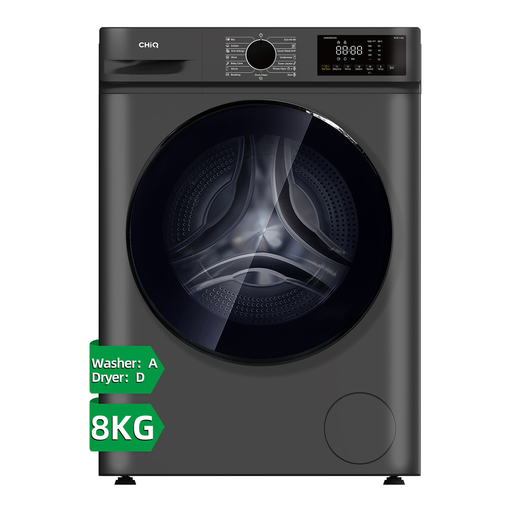 Image unavailable
CHiQ JW85882HG washer-dryer 8 kg / 5 kg
An option for a small home that needs to combine washing and drying in a single appliance.
8 kg washing capacity and 5 kg drying capacity, quoted depth of 520 mm, BLDC motor and quoted spin speed of 1 400 rpm.
An 8 kg wash load may require some laundry to be removed before drying; consult the manual for clearances, noise levels and consumption data.
Joybuy
 Image unavailable
Comfee CD08EHP05W-HR 8 kg heat pump tumble dryer
Worth considering if an independent 8 kg drying appliance can be installed in your home.
Heat pump technology, 8 kg capacity, energy class D, three drying levels and a quoted double-layer filter.
Check the label for kWh per 100 Eco cycles, duration, condensation efficiency class, dimensions and noise level.
Joybuy
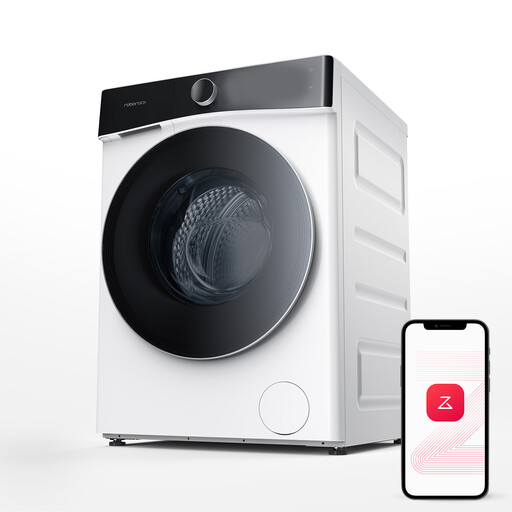 Image unavailable
Roborock Zeo Lite washer-dryer 10 kg / 6 kg
This washer-dryer is designed for homes where one appliance needs to handle both washing and drying.
Quoted capacity of 10 kg for washing and 6 kg for drying, low-temperature Zeo-Cycle technology, 27 programmes and app control.
The drying load remains limited to 6 kg; check the dimensions, cycle durations, spin performance, noise level and consumption for your routine.
Joybuy
Frequently asked questions
Can a washer-dryer dry the entire load that has just been washed?
Not necessarily. UFC-Que Choisir states that a washer-dryer’s drying capacity is lower than its washing capacity. Load it according to the drying limit from the outset, or remove some laundry before starting the function.
Which washing machine specification matters if laundry finishes on an indoor airer?
Spin efficiency class is a good place to start, as it appears on the energy label. ADEME recommends choosing class A when laundry needs to dry quickly indoors or go into a tumble dryer afterwards, while maintaining suitable ventilation in the room.
How do you compare the energy use of two tumble dryers with the new label?
Compare appliances carrying the A to G label and look at the kWh per 100 Eco cycles, Eco capacity, duration and noise level. Do not assume that an old A+++ rating is automatically equivalent or superior to a letter on the new scale.
Is a heat pump tumble dryer worthwhile for regular use?
It may be worthwhile if drying electricity consumption is an important factor in your decision. Guide Topten states that condenser dryers fitted with a heat pump are the most energy-efficient of the technologies it lists. Also check the exact model’s capacity, noise level, dimensions and maintenance requirements.


