How do you compare the options?
Heat pump tumble dryer
Worth considering: if you do laundry frequently and can keep an appliance set up without it getting in the way.
What to bear in mind: you’ll need a power supply, a suitable space and a way to collect or drain the water, depending on the model you choose.
Dehumidifier with an airer
Worth considering: if you’ll continue drying clothes on an airer and would also like to remove moisture from the room.
What to bear in mind: your laundry will still take up space, and the appliance won’t replace proper ventilation.
Vertical airer
Worth considering: if you have enough height to make the most of vertical storage and keep floor space to a minimum.
What to bear in mind: your laundry will still dry in the room, which needs to be suitable for this and have enough space to move around.
To compare these options in a flat without outdoor drying space, start with what matters most to you, then check the installation and practical requirements.
| Your priority |
What to check |
Who this matters to |
| Freeing up the room |
Tumble dryer capacity compared with your usual loads; the dimensions and clearance needed for installation. |
If I do laundry frequently, I want to avoid having a loaded airer in the living room or hallway for ages. Around 30% of consumers put this need first. |
| Managing moisture |
Room ventilation; for a dehumidifier, the conditions used to measure extraction and whether the water can be emptied or drained. |
If I dry clothes on an airer, I want to account for the moisture released into the room without overlooking an ongoing ventilation problem. This is a priority for around 40% of consumers. |
| Saving space |
The floor space and height needed for the airer when open; its folded dimensions and the space to move around the laundry. |
In a small room, I need to be able to move around while my clothes are drying, then put the airer away once they’re dry. Around 30% of consumers prioritise this. |
The spin cycle is worth considering before choosing drying equipment: ADEME recommends checking its effectiveness when laundry needs to dry indoors or in a tumble dryer.
Brands to know for these uses
The features below apply to the ranges or models mentioned, not to every product from each brand.
Bosch
Freestanding heat pump tumble dryers, including models with 8 and 9 kg capacities.
- For the WQG13500FR, Bosch lists a 9 kg capacity, dimensions of 842 × 598 × 613 mm and a noise level of 62 dB(A). These are useful details to check against your available space.
- These dimensions and noise levels are for the WQG13500FR; check the specifications of the model you’re actually considering.
Miele
Condenser and heat pump tumble dryers in a range of capacities, with stacking options available for compatible appliances.
- Depending on the installation, Miele describes collecting water in a tank or draining it away through a hose.
- Stacking requires compatible equipment; check the kit and installation requirements for the models in question.
De’Longhi
The Tasciugo dehumidifier range can help when drying laundry on an airer.
- For the DEP212, De’Longhi lists a laundry mode, humidistat, 4 l tank and continuous drainage option.
- The stated extraction rate of 12 l/24 h for this model is measured at 30 °C and 80% relative humidity; it won’t predict how much moisture it will extract in a room with different conditions.
Leifheit
Floor airers and tower airers to consider when space and storage are key to your decision.
- For the Classic Tower 450, Leifheit lists a footprint of 69 × 69 cm, four levels and a flat-folding design.
- The stated drying length alone won’t tell you how long clothes will take to dry or how much room you’ll need around a loaded airer.
Products for three different needs
These products cover the three options discussed here: drying laundry on a vertical airer, installing a tumble dryer, or pairing a dehumidifier with an airer. Compare each option with the dimensions of your room and the way you dry your laundry at home.
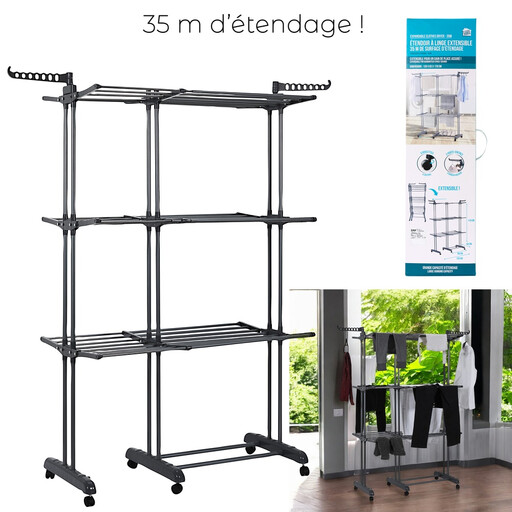 Image unavailable
35 m three-tier extendable airer
For drying laundry indoors when storage space between loads matters. The stated drying length is 35 m; check the dimensions when open and folded, as well as the space around the airer when it’s loaded.
View on Joybuy
 Image unavailable
Hotpoint CHD84MWBSEE, 8 kg heat pump tumble dryer
Worth considering if you want to dry your laundry without leaving an airer in the room and have space for a permanently installed appliance. It has a stated capacity of 8 kg and an energy rating of C. Measure the space and check the noise level and water management requirements for your installation.
View on Joybuy
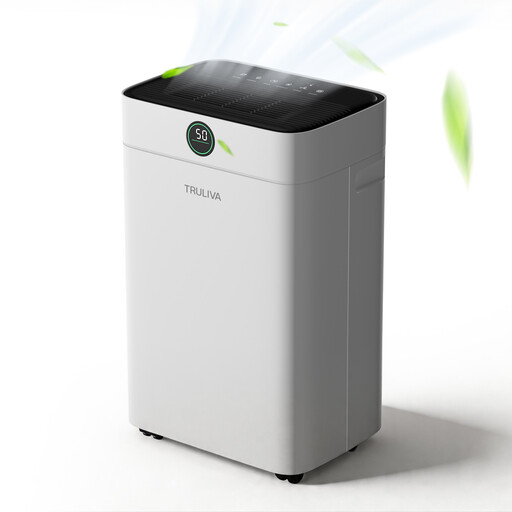 Image unavailable
TRULIVA 25L/Day dehumidifier with laundry mode
Pair it with an airer if you’d also like to remove moisture while your clothes dry. The product has a stated 2.8 l tank and continuous drainage hose; its stated extraction rate of 25 l per day is measured at 95 °F and 90% relative humidity. Check the noise level for the room you plan to use it in: it won’t replace either the airer or ventilation.
View on Joybuy
 Image unavailable
Comfee CD08EHP05W-HR, 8 kg heat pump tumble dryer
For regular laundry loads if you have space to keep a tumble dryer set up in your flat. This model is listed with an 8 kg capacity and a D energy rating; check its dimensions, noise level and how it collects or drains water before deciding where to put it.
View on Joybuy
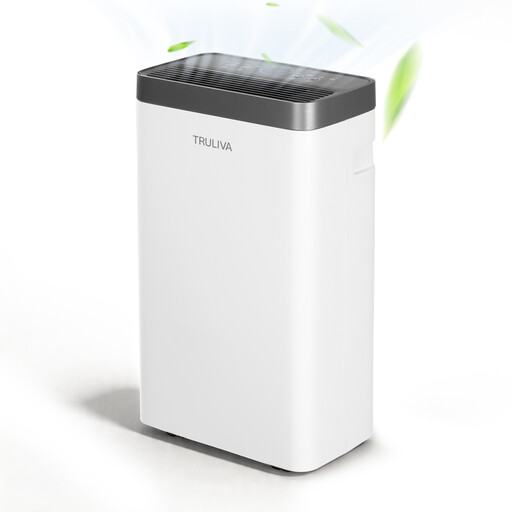 Image unavailable
TRULIVA AP10-2012EE dehumidifier with laundry mode
Use it alongside an airer if managing moisture is an important part of your decision. The product is listed with a 24-hour timer and continuous drainage; check the model’s adjustable humidity range and noise level before using it near a living space. It does not replace ventilation.
View on Joybuy
Frequently asked questions
Does a dehumidifier replace ventilating the room?
No. It can help when you’re drying clothes on an airer, but it doesn’t replace proper ventilation. For air-drying laundry, the Q-WASH study published by ADEME recommends a large, well-ventilated room or one fitted with a mechanical extract ventilation outlet.
What should you measure before installing a tumble dryer in a flat?
Measure the space and the clearance needed to open the door, then compare these with the dimensions of the model you’ve chosen. Also check its capacity, noise level and how the water will be collected or drained. Miele describes installations with a tank or drain, depending on the set-up.
Can you compare two dehumidifiers by their litres per day?
Yes, as long as the figures are given for equivalent temperatures and relative humidity levels. For example, De’Longhi gives the DEP212 a rating of 12 l/24 h at 30 °C and 80% relative humidity. This may not reflect how much it will extract in your flat.
Is a vertical airer suitable for a small flat?
It can be, provided its height, footprint when loaded and storage requirements leave the room usable. Leifheit lists a footprint of 69 × 69 cm for the Classic Tower 450; also check there’s room to move around the airer and that the drying area is well ventilated.


