If you can set aside a suitable room for drying laundry indoors, start by choosing an airer that genuinely fits the space. An effective spin cycle and, depending on your needs, a dehumidifier can also help. If you do laundry frequently or need more predictable drying times, consider a heat-pump condenser tumble dryer, provided you can install it, manage the collected water and keep it maintained. ADEME points out that air-drying laundry indoors adds a lot of moisture to your home, so the space available isn’t the only factor to consider.
Who are these solutions suitable for?
Renters who dry laundry in a small room
If an airer is your main solution, first consider the room’s drying conditions and how much space the airer takes up. ADEME highlights the moisture produced when laundry is dried indoors. A portable dehumidifier also needs somewhere to go, and you’ll need a way to deal with the water it collects.
Households that do laundry frequently
If you regularly need to dry several loads, a dedicated appliance may be worth considering, provided its capacity, dimensions, noise level and maintenance requirements suit your home. According to the European Commission, a condenser tumble dryer doesn’t need an air-exhaust duct leading outdoors. You’ll still need to collect or drain away the water, though.
People short on floor space
If you have a moderate amount of laundry but limited room to move around, compare the dimensions of a tower or folding airer when fully open, then check how much space you’ll need to store it. The drying-line length quoted by Leifheit for its models doesn’t tell you whether you’ll be able to move around the laundry.
Which criteria should you prioritise?
In a flat without a usable outdoor vent, separate the appliance that dries your laundry from the equipment that supports the process. The spin cycle comes before drying, while a dehumidifier can be used alongside an airer. A condenser tumble dryer is another option if it’s suitable for your home and regular use.
| Consideration |
What to check |
Who it matters to |
| Moisture from air-dried laundry |
For an airer, check the ventilation and size of the room. For a dehumidifier, look at the recommended room size and how to manage the tank or drainage. |
If I’m concerned about moisture when drying laundry in a room, I look first for suitable drying conditions. Around 31% of consumers prioritise this issue. |
| Space available |
Measure the available width, depth and height, then compare these with the equipment’s dimensions when open and stored away. |
If an airer blocks the way or is difficult to store, its overall size matters more to me than its drying-line length. Around 25% of consumers say this is their main concern. |
| How often you do laundry |
Check your washing machine’s spin-drying efficiency class. For a tumble dryer, compare its capacity and eco programme duration with your laundry routine. |
When I have back-to-back loads, I don’t want the next one to depend on an airer that’s still in use. Around 25% of consumers put this at the top of their list. |
| Electricity and maintenance |
For a powered appliance, compare the relevant energy consumption figures and check the instructions for information on the filters, condenser and water collection. |
If I can leave laundry to dry for longer, I may prefer an airer, which uses no electricity directly. Otherwise, the appliance’s maintenance requirements matter too. For around 19% of consumers, this is the deciding factor. |
ADEME recommends paying attention to spin-drying efficiency when laundry is going to be dried indoors or in a tumble dryer. However, a faster spin cycle doesn’t mean you can ignore garment care labels or forget to plan for the next stage of drying.
Mistakes to avoid
-
Choosing an airer based only on its drying-line length
A long drying line isn’t much help if the open tower blocks the way, is too tall for your space or is difficult to store.
Measure the available width, depth and height, then check the model’s dimensions when open and folded away.
-
Forgetting about the water from a condenser tumble dryer
Condensation means there’s no need for an outdoor air-exhaust duct, but the collected water still needs to go into a tank or, if the model allows it, down a drain.
Check the tumble dryer’s water collection system and make sure any potential connection is compatible with your plumbing.
Without a suitable connection, emptying the tank becomes a regular chore.
-
Overlooking maintenance when choosing an appliance
Bosch advises cleaning the filter in line with the appliance’s instructions. Electrolux notes that a blocked condenser can increase energy consumption and damage the tumble dryer.
Check the model’s instructions for maintenance of the filters, condenser and tank, even if it has an advertised automatic cleaning function.
-
Assuming a promise of fast drying means a guaranteed time
How well a dehumidifier works with an airer depends on factors such as the room conditions, the amount of laundry and the settings. A manufacturer’s claim doesn’t guarantee how long it will take in your home.
Use the stated capacity, recommended room size and drainage options to shortlist a model, but don’t assume these will tell you exactly when your laundry will be dry.
Brands to know for these solutions
These examples can help you spot features to compare on specific models; they don’t apply to every product in each brand’s range.
Bosch
Heat-pump tumble dryers for households considering a dedicated laundry-drying appliance.
- According to Bosch Électroménager France, the WQG2450SFR has a maximum capacity of 9 kg, measures 842 × 598 × 613 mm and features a self-cleaning condenser.
- These specifications apply to the WQG2450SFR, not the entire range. Check the model’s instructions for information on the filters and water management.
Beko
A range of heat-pump tumble dryers with capacities and features that vary by model.
- Beko describes its heat-pump tumble dryers as appliances that operate using a closed-loop system.
- Before choosing a model, compare its dimensions, noise level and energy consumption figures, and check how it collects the water.
Rowenta
Portable dehumidifiers to consider when you’re drying laundry indoors on an airer.
- Rowenta states that the DH5260F0 has a capacity of 16 L/day, a removable 3 L tank and a hose for continuous drainage.
- The stated capacity doesn’t guarantee a drying time or make the unit suitable for every room. Check the operating conditions and access to drainage.
Leifheit
Tower and folding airers for anyone who wants to dry laundry without using electricity directly.
- Leifheit states that the Classic Tower 340 has a floor footprint of 69 × 69 cm and a drying-line length of 34 m.
- These measurements apply to this specific model. You’ll still need to check its height, the space needed to move around it and the drying conditions in your room.
Joybuy products by solution
The products below cover four ways to approach indoor laundry drying: hanging laundry on an airer, using a dedicated tumble dryer, pairing an airer with a dehumidifier, or looking at your washing machine’s spin cycle before drying. Compare each model with the constraints of your room and your laundry routine.
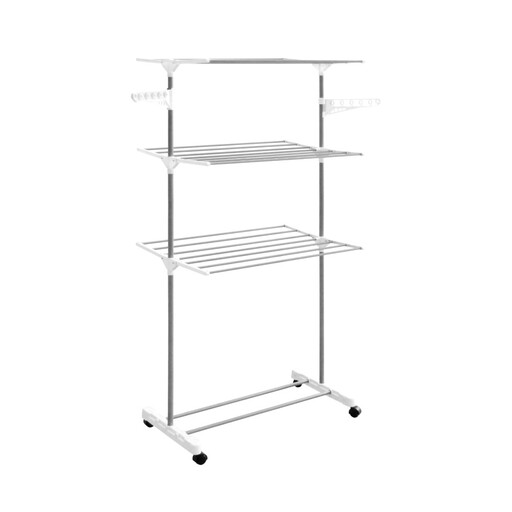 Image unavailable
JE CHERCHE UNE IDEE wheeled clothes airer
Worth considering if you have a suitable room for drying laundry and want to be able to move the airer around.
Check its dimensions when open and folded away, as well as the space you’ll need to move around it. As ADEME points out, drying laundry indoors adds moisture to the room.
View on Joybuy
 Image unavailable
Hotpoint CHD84MWBSEE, 8 kg heat-pump tumble dryer
Worth considering if you do enough laundry to justify a dedicated tumble dryer rather than relying on an airer that may be occupied for several days.
The product name indicates an 8 kg capacity and a C energy rating. Before deciding where to put it, check its dimensions, eco programme duration and energy consumption figures, as well as how the model collects or drains the water.
View on Joybuy
 Image unavailable
Comfee CD08EHP05W-HR, 8 kg heat-pump tumble dryer
Another dedicated appliance to consider if frequent laundry makes air-drying impractical.
The product name indicates an 8 kg capacity and a D energy rating. Check its dimensions and noise level, the duration and energy consumption of the programmes you’re interested in, and how it manages water. A claim of fast drying doesn’t guarantee a specific drying time.
View on Joybuy
 Image unavailable
TRULIVA dehumidifier, 25 L/day, with laundry mode
Worth considering alongside an airer if moisture in the room is your main concern.
The product states a capacity of 25 L/day at 95 °F and 90% relative humidity, and has a 2.8 L tank and a hose for continuous drainage. This capacity won’t predict the results in your home: check where you can place it, the clearance it needs around it and whether you can realistically drain the water.
View on Joybuy
 Image unavailable
Electrolux EW7FI259160V, washing machine, 9 kg, 1600 rpm
Worth considering if you plan to keep drying laundry indoors and want to compare the spin cycle before drying.
The product name indicates a 9 kg washing capacity and a maximum spin speed of 1600 rpm. Check the spin-drying efficiency class too: the maximum speed alone isn’t enough to compare results. A spin cycle doesn’t replace the need for space to dry your laundry or to manage moisture in the room.
View on Joybuy
Frequently asked questions
Can a tumble dryer work without an outdoor air vent?
Yes. According to the European Commission, a condenser tumble dryer doesn’t need an air-exhaust duct leading outdoors. However, check where the collected water goes, along with the dimensions, noise level and installation instructions for your chosen model. Vented tumble dryers have different requirements.
Do you always have to empty the tank on a tumble dryer or dehumidifier?
No, if the model supports continuous drainage and you have a compatible connection. Otherwise, you’ll need to empty the tank. Check whether each appliance comes with a hose or can be fitted with one, and make sure it’ll work in the space you have.
What should you compare between two heat-pump tumble dryers?
Compare energy consumption figures based on the same reference conditions, as well as capacity, eco programme duration, noise level and condensation efficiency. Also check the dimensions, water collection system and maintenance requirements: no single figure tells you everything about how an appliance will work in your flat.
Is a dehumidifier enough to dry laundry in any room?
No. A dehumidifier doesn’t automatically make every room suitable for drying laundry. ADEME recommends suitable drying conditions to limit indoor moisture, so check the room itself, along with the operating conditions and water management requirements of the dehumidifier you’re considering.


