Households with space for one appliance
If you only have room for one appliance to wash and dry your clothes, a washer-dryer could suit your needs. Compare its washing and drying capacities separately, as UFC-Que Choisir recommends.


If a suitable spin cycle and a well-ventilated room are enough to free up your airer between washes, you may not need to buy a tumble dryer. If you often dry large loads or need to reclaim your space quickly, compare the room available, drying capacity and cycle times. A washer-dryer avoids the need for a second appliance, while a separate tumble dryer needs its own dedicated space. ADEME and UFC-Que Choisir also highlight the importance of spin efficiency and ventilation when drying clothes indoors.
If you only have room for one appliance to wash and dry your clothes, a washer-dryer could suit your needs. Compare its washing and drying capacities separately, as UFC-Que Choisir recommends.
If your airer is still full when the next wash is due and you have room for a second appliance, compare the capacity, programme times and electricity consumption of the options you’re considering.
If you’d rather not add another appliance, check how effectively your washing machine spins clothes and whether you can dry them in a suitable, well-ventilated room. ADEME and UFC-Que Choisir cover these factors when discussing indoor drying.
Worth considering: if you have a sufficiently large, well-ventilated room where you can dry clothes without holding up your next wash.
Bear in mind: an airer takes up room, and drying clothes indoors releases moisture into the space. ADEME recommends taking spin efficiency into account.
Worth considering: if you only have space for one appliance and your usual load fits the drying capacity.
Bear in mind: drying capacity differs from washing capacity. A full wash-and-dry cycle may take longer than using a separate tumble dryer, and water consumption varies by model. UFC-Que Choisir explains these limitations in detail.
Worth considering: if you have a separate space for an appliance and regularly dry clothes you don’t want to leave on the airer.
Bear in mind: condensation means there’s no need for an external exhaust hose, but you’ll need to allow space for the appliance and manage the condensed water. For similar use, these models generally take longer to dry clothes than conventional condenser tumble dryers, but use less electricity, according to UFC-Que Choisir.
Worth considering: if drying time is a key factor and the model’s instructions say it’s suitable for your room.
Bear in mind: these models generally dry clothes faster than heat pump models, but use more electricity for similar use, according to UFC-Que Choisir. EU rules that came into force on 1 July 2025 for new appliances placed on the market limit this option; appliances placed on the market before this date are not automatically affected.
Before choosing, check that the appliance’s dimensions and capacity suit your room, then compare programmes that match your usual laundry loads.
| What matters | What to check | Who it affects |
|---|---|---|
| Space taken up | Dimensions, door clearance, space for connections, and the separately stated washing and drying capacities. | If I can only dedicate one space to an appliance, I want to know whether my usual load can also be dried; around 33% of consumers prioritise saving space. |
| Humidity and room availability | Whether you can dry clothes in a well-ventilated room, and how often damp laundry takes up the space. | When the airer gets in the way of using the room between washes, I want to reclaim the space without overlooking ventilation; around 27% of consumers prioritise drying time and having the room free. |
| Cycle consumption | The label for the exact model and consumption figures for the same type of programme; for a washer-dryer, also check the wash-and-dry cycle. | If I want to limit the resources used for drying, I compare equivalent programmes; around 20% of consumers put consumption first. |
| Capacity and time | The load that can be dried, in kilograms, the programme time for that load, and whether you can start another wash while the clothes are drying. | If washes follow one another and the loads are large, I check how much can be dried in one cycle; around 20% of consumers prioritise getting through their laundry quickly. |
The maximum drying load may be lower than the washing load. For example, Electrolux lists an 8 kg washing capacity and a 4 kg drying capacity for the EW8W3816BI model.
Check the drying capacity and full-cycle time against the size of your usual laundry loads.
If your wash load exceeds the drying capacity, you’ll need to split it or run an extra cycle.
Condensation collects the water without venting humid air through an external hose, but installation requirements vary by model.
Before buying, check the manual for the dimensions, installation requirements and how the condensed water is collected or drained.
Make sure you have enough space and follow the maintenance instructions for the model you choose.
Consumption and cycle times depend on the technology and programme. An older energy label rating cannot be compared directly with a current one.
Compare figures for the exact model, using programmes and loads of the same type. For a washer-dryer, distinguish between figures for washing alone and those for the wash-and-dry cycle.
Depending on the technology and programme, drying uses electricity, and some washer-dryers also use water during the drying cycle.
The models with published specifications include a heat pump tumble dryer and a washing machine. They’re two different options, depending on whether you air-dry clothes or use a dedicated appliance.
The built-in EW8W3816BI washer-dryer is an example of a combined solution for a single space.
The D0H11030 is a heat pump tumble dryer with published specifications and a stated capacity of 10 kg.
This Joybuy selection includes separate condenser and heat pump tumble dryers, as well as a washer-dryer, so you can compare capacity, space requirements and cycle considerations.
 Image unavailable
This separate tumble dryer could suit you if you want to free up your airer and have a suitable space for an appliance.
Condenser; stated capacity of 8 kg; energy rating E; stated noise level of 66 dB(A).
Stated dimensions: 60 × 65 × 85 cm; reversible door listed.
 Image unavailable
This separate heat pump model is worth considering if you have a dedicated space for it and want to free up your airer.
Stated capacity of 8 kg; energy rating C; stated noise level of 64 dB.
Easy Cleaning 2-in-1 filter; direct connection of the drain hose listed as an option.
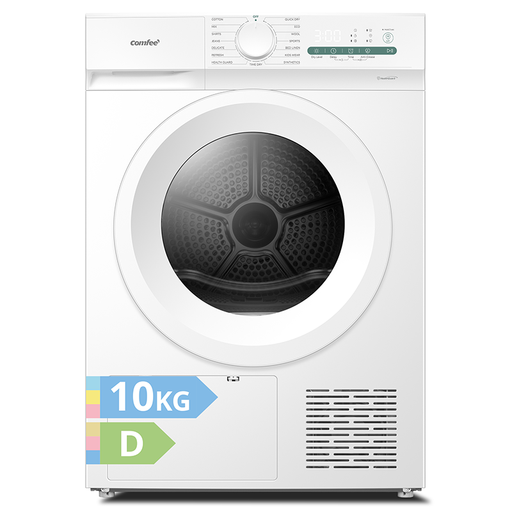 Image unavailable
Its stated capacity may appeal to households looking to dry larger loads, provided they have a suitable space for the appliance.
Heat pump tumble dryer; stated capacity of 10 kg; energy rating D.
Refresh programme, LED display and dual-layer lint filter listed.
 Image unavailable
This separate model could suit you if you’re looking for a stated capacity of 8 kg and can set aside space for drying.
Heat pump tumble dryer; stated capacity of 8 kg; energy rating D.
Refresh programme, LED display and dual-layer lint filter listed.
 Image unavailable
This washer-dryer could suit you if you need just one appliance, as long as the load you want to dry fits its drying capacity.
Stated capacity of 11 kg for washing and 6 kg for drying; condenser drying; energy rating A listed for washing.
Stated dimensions: 60 × 85 × 60 cm. A full washing load exceeds the stated drying capacity, so it cannot all be dried in one cycle.
If you can dry clothes in a sufficiently large, well-ventilated room and they don’t hold up your next wash, start by checking how effectively your washing machine spins clothes. ADEME notes that air-drying clothes indoors releases moisture and recommends taking spin efficiency into account. These points aren’t a diagnosis of your home.
No. Depending on the model, condensed water is collected in a tank or sent to a drain, so there’s no need for an external exhaust hose. However, check the installation, airflow and connection requirements in the manual for the model you choose. A vented tumble dryer, by contrast, expels humid air outside.
Follow the instructions for the model you’ve bought. For Samsung washing machines, the instructions published by Samsung France include removing the transit bolts, adjusting the feet and connecting the water supply. These instructions don’t replace those for another brand or a washer-dryer.
Compare information for the same type of appliance and cycle, without treating letters from different scales as equivalent. According to the European Commission, the A to G label has applied to tumble dryers since 1 July 2025, and to washing machines and washer-dryers since 1 March 2021.
For goods bought by a consumer from a trader, the legal guarantee of conformity applies to new and second-hand goods, among others. The French Ministry of the Economy states that you have two years to exercise this right. When you buy a new appliance, free take-back on a ‘one-for-one’ basis applies to an equivalent used appliance; the DGCCRF recommends checking how this works in practice.