If you can hang your washing in a suitably large, well-ventilated room or one with appropriate extraction, start there: ADEME points out that air-drying adds a lot of moisture to your home. If you do laundry frequently and want a more regular drying routine, consider a tumble dryer, taking into account the space it needs and its maintenance. A dehumidifier can help while you air-dry clothes, but it doesn’t replace ventilation or investigating the cause of persistent damp patches.
Who are these options for?
People who dry their washing in a flat
If you mainly use a clothes airer, the question is where to put it without allowing moisture to build up in a poorly ventilated room. ADEME recommends using a large, well-ventilated room or one with appropriate extraction; France Rénov’ also highlights the importance of air circulation in a flat.
Households with frequent or large loads of washing
If you do several loads in a row or regularly wash bedding, check the tumble dryer’s capacity, where it will fit in your home, how noisy it is and how the water will be drained. An effective spin cycle on your washing machine can also help your washing dry faster, according to ADEME.
People living in a persistently damp room
You could use a dehumidifier while drying your washing, provided the room still has working ventilation. If damp patches appear or return on the walls, France Rénov’ recommends finding out what is causing them rather than relying solely on a portable appliance.
What sets these options apart?
Airer in a suitable room
Best for: you have a large, well-ventilated room or one with appropriate extraction, as recommended by ADEME.
Bear in mind: your washing takes up space while it dries and releases moisture into the air indoors.
Heat pump tumble dryer
Worth considering if: you often dry large loads and have the space to install and maintain the appliance.
Bear in mind: it needs a permanent spot and uses electricity; Beko says its cycles can be longer than those of other types of tumble dryer.
Dehumidifier as an extra
Worth considering if: you’ll continue to air-dry your washing in a ventilated room and want to remove some of the moisture from the air.
Bear in mind: it won’t dry your washing instead of an airer, and it won’t fix poor ventilation or persistent damp on the walls.
| What matters |
What to check |
Who is it for? |
| Damp and ventilation |
Air circulation, extraction and any signs of damp. |
I want to dry my washing indoors without ignoring persistent damp in the room; around 36% of consumers would put this concern first. |
| Drying speed |
Tumble dryer capacity, the duration of the programme you’re considering and how effectively your washing machine spins. |
When I do frequent or large loads, I mainly need dry washing at a regular pace; this would be the priority for around 29% of consumers. |
| Electricity use |
The energy label and energy consumption for the reference cycle if you choose a tumble dryer. |
I’d rather limit the electricity used for drying, while making sure I have a suitable room if I use an airer; around 21% of consumers would put this need ahead of the others. |
| Space and maintenance |
Dimensions, clearances specified in the instructions, water drainage and access to parts that need maintenance. |
In an already occupied home, I need to be able to install and use the appliance without blocking access; this would be the main concern for around 14% of consumers. |
What should you watch out for?
-
Relying on a dehumidifier to deal with persistently damp walls
Collecting water in a tank doesn’t tell you why damp patches are appearing on the walls. France Rénov’ recommends finding out what is causing them.
Use a dehumidifier as an extra while drying your washing. If damp patches persist or return, get the cause investigated.
-
Choosing a tumble dryer before checking where it will go
According to Beko, a vented model needs ducting and an opening to the outside. For other types, you’ll still need to check how the water is handled, the dimensions and the maintenance requirements.
Measure the space and read the installation instructions for the model you’re considering before choosing a type.
-
Assuming the litres per day figure is guaranteed in your home
De’Longhi gives a figure of 30 l/24 h for its DD230P at 30 °C and 80% relative humidity. This figure applies under those conditions, not in every room.
Compare the conditions behind the stated capacity, then check that the tank, drainage and noise level will suit your setup.
-
Forgetting about the spin cycle and access for maintenance
ADEME links an effective spin cycle with faster drying. Beko also recommends regular maintenance of the components in its heat pump tumble dryers.
Check your washing machine’s spin cycle and make sure you’ll still be able to access the parts that need maintenance once the tumble dryer is installed.
Brands to consider
Bosch
A brand to consider when comparing the specifications of a particular heat pump tumble dryer.
- Bosch lists a 9 kg capacity and dimensions of 842 × 598 × 613 mm for the WQG2450SFR.
- These specifications apply to the WQG2450SFR; they don’t describe every Bosch tumble dryer.
Beko
Worth considering when comparing the installation requirements of different types of tumble dryer.
- Beko explains that a vented tumble dryer needs an opening to the outside.
- According to Beko, a heat pump model may have longer cycles and needs regular maintenance.
Miele
Worth considering when the tumble dryer’s capacity and how it handles collected water affect where it can be installed.
- Miele describes options that collect water in a tank or drain it away, depending on the appliance.
- Check the capacity and drainage options available on the model you’re considering.
De’Longhi
Worth considering for a dehumidifier to use while drying washing on an airer.
- De’Longhi lists a humidistat and continuous drainage by pump and hose for the DD230P.
- The stated capacity of 30 l/24 h for this model applies at 30 °C and 80% relative humidity; it doesn’t indicate the results you’ll get in every home.
Joybuy products for indoor drying
These dehumidifiers can be used alongside an airer in a ventilated room; these tumble dryers offer the option of machine-drying your washing. For each appliance, check that the model’s specifications suit your space and how you plan to manage the water.
 Image unavailable
VINO 20L Smart Wi-Fi dehumidifier
Designed to help while your washing dries on an airer, rather than replace the room’s ventilation.
The product name lists Auto, Dry and Sleep modes, as well as a 2.5 L tank. Check the noise level for the mode you plan to use.
View on Joybuy
 Image unavailable
Hotpoint CHD84MWBSEE 8 kg heat pump tumble dryer
Worth considering for regular machine-drying of loads if you have a suitable space.
The product name lists an 8 kg capacity and a C energy rating. Compare the dimensions, energy use and reference cycle duration before deciding.
View on Joybuy
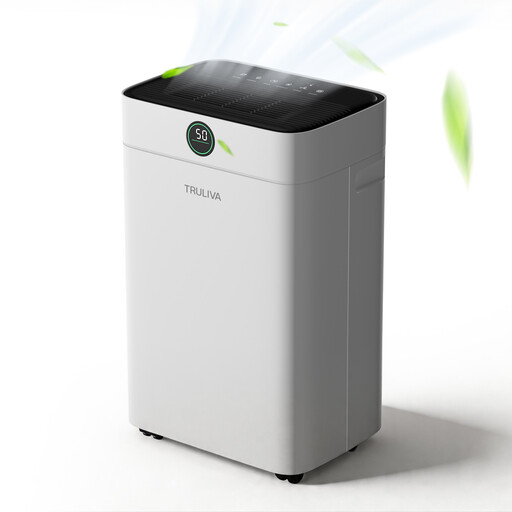 Image unavailable
TRULIVA 25L/Day dehumidifier with laundry mode
Designed to collect moisture while your washing dries on an airer, without interrupting the room’s ventilation.
The product name lists a 2.8 L tank and a continuous drainage hose. The stated capacity of 25 L/day depends on the test conditions; also check the noise level in the mode you’ll use.
View on Joybuy
 Image unavailable
Comfee CD08EHP05W-HR 8 kg heat pump tumble dryer
An option for machine-drying to compare with the size of your loads and the space available.
The product name lists an 8 kg capacity and a D energy rating. Before installation, confirm the dimensions, drainage options, energy use and programme duration for this model.
View on Joybuy
 Image unavailable
Electrolux EDH1018CD GentleCare 8 kg condenser tumble dryer
Worth considering if you want to machine-dry your washing and can plan for handling the collected water.
The product name lists an 8 kg capacity and OptiSense sensors. Check the reference cycle’s energy use, the dimensions and the drainage options to make sure they suit your setup.
View on Joybuy
Frequently asked questions
Can a dehumidifier replace ventilation?
No. It can collect moisture while your washing dries, but it doesn’t replace ventilation or circulate fresh air. If damp patches persist on the walls, France Rénov’ recommends finding out what is causing them.
Can you install a vented tumble dryer without an opening to the outside?
That isn’t how this type of appliance works, according to Beko: the moist air needs to be carried through ducting to an opening outside. Check the model’s instructions and the room layout before choosing one.
Where should you put an airer indoors?
ADEME recommends using a large, well-ventilated room or one with appropriate extraction. Keep air inlets and extraction vents clear, and don’t switch off mechanical ventilation.
What should you compare when assessing a tumble dryer’s energy use?
Compare the energy consumption shown on the energy label for the reference cycle, taking into account the cycle’s capacity and duration. ADEME recommends using the label rather than relying on a general promise of energy savings.
What maintenance do these appliances need?
Follow the instructions for the model you choose. A tumble dryer needs maintenance, particularly for parts that collect fluff and water, while a dehumidifier’s tank or drainage system and filter need attention. Make sure you’ll still be able to access these parts where you plan to put the appliance.


