Which households is it for?

Flat-dwelling households with frequent washing

You want to dry several loads a week without having an airer permanently set up, and you have space for two appliances. Capacity, noise, depth, energy consumption and room ventilation then become decisive factors.

Small homes limited to one appliance

You need to wash and dry within the footprint of a front-loading washing machine. A washer-dryer can meet this requirement, provided you accept that its drying capacity is lower than its washing capacity and that cycles may take longer.

Households that prefer an airer

You want to limit your use of an electric tumble dryer while keeping an organisation compatible with indoor humidity levels. Effective spinning, room size and properly functioning ventilation or extraction are therefore essential.

Buying priorities

Separate tumble dryer

Best for: drying large loads regularly when a second space is available.

Bear in mind: the depth, noise, maintenance and the need for a properly ventilated room.

Washer-dryer

Best for: flats where it is realistically possible to install only one appliance.

Bear in mind: you need to adjust the washing load to the drying capacity, which is often lower.

Airer and spinning

Best for: drying in a large, well-ventilated room or one fitted with a mechanical ventilation extraction vent.

Bear in mind: this arrangement is not suitable for a confined room or one already affected by condensation.

Priority What to check Your needs
Humidity and ventilation Choose a large, well-ventilated room or one fitted with mechanical ventilation extraction for an airer. Do not block air inlets or extraction vents. A condenser tumble dryer does not require a duct to the outside, but general ventilation should still be assessed. I want to dry laundry without concentrating humidity in a room that is already poorly ventilated.
Space required Measure the width, depth, height, doorway clearance and door opening. Also check the clearances needed for the filter, tank or connection for draining condensed water. I need to determine whether a 2-in-1 appliance genuinely makes up for the lack of space for a separate tumble dryer.
Capacity and washing routine Compare drying capacity in kilograms, not just washing capacity. With a washer-dryer, expect to remove some laundry when the wash load exceeds the drying limit. I want to avoid unexpected half-loads and extra cycles when washing towels, bedding or several loads in succession.
Energy consumption and duration For a separate tumble dryer, compare the A to G label, reference programme, noise level, capacity and duration. For a washer-dryer, read the washing and wash-and-dry data separately. I want to manage my electricity and water use without choosing based solely on the advertised programme duration.
Maintenance and fabrics Check access to the filter and tank, as well as the programmes suited to the fabrics you dry most often. The sensors and drying programmes should be checked for the exact model. I want to minimise handling and avoid running cycles that are unsuitable for my fabrics.

Mistakes to avoid

  • Assuming ventilation no longer matters when using an airer or condenser tumble dryer

    According to ADEME, air-drying laundry releases a significant amount of moisture into the indoor air. A room that is too small, faulty extraction or windows that remain permanently misted up can worsen condensation problems.

    Before increasing the frequency of indoor drying, check the air inlets and extraction vents without obstructing them. If condensation persists, also investigate the property’s ventilation or insulation.

  • Comparing a washer-dryer and a tumble dryer only by the space they occupy

    A washer-dryer’s drying capacity is lower than its washing capacity, and drying may take longer. UFC-Que Choisir also points out that drying in most models may involve significant water consumption.

    Compare drying capacities in kilograms, programme durations, wash-and-dry cycle consumption and actual depth. Estimate how many cycles you will need if you regularly wash bulky laundry.

  • Relying on an outdated energy scale or the word ‘energy-efficient’ alone

    Since July 2025, the energy labelling of household tumble dryers has used a scale from A to G. According to the relevant European regulation, this specific legislation does not apply to household washer-dryers.

    For a separate tumble dryer, read the current label and the information on noise, capacity and duration. For a washer-dryer, compare the data for washing and for the wash-and-dry cycle.

  • Buying without measuring the depth and maintenance access

    A width of 60 cm does not guarantee that the appliance will be easy to install or use. Depth, door opening and access to the filter or tank can affect whether it is suitable for a narrow space.

    Measure the space, access routes, door opening and access to sockets before buying. To stack two appliances, use only a configuration authorised in the manufacturers’ instructions.

Brands to consider

Bosch

Bosch offers models including the WTH8520SFR, a separate 8 kg heat-pump tumble dryer designed for households with a dedicated space.

  • For this model, Bosch states an 8 kg capacity, 62 dB(A), a water-drain hose, AutoDry and a 40-minute Express programme for small synthetic or lightweight loads.
  • The stated depth is 613 mm and the condenser is not self-cleaning according to the manufacturer’s product sheet, so check the available space and maintenance requirements.

Electrolux

The Electrolux EW9W1166RA is an example of a heat-pump washer-dryer for homes where only one appliance is practical.

  • The French product sheet states a 10 kg washing capacity and a 6 kg drying capacity, clearly identifying the load limit for a continuous cycle.
  • The stated maximum depth is 660 mm; washing and wash-and-dry data should be read separately according to your household’s usage.

Miele

The TEA525WP 8kg Active is an example of a separate 8 kg heat-pump tumble dryer with detailed maintenance information on its product sheet.

  • The product sheet mentions a condensed-water drainage kit and indicators for cleaning the filters and emptying the tank.
  • Miele states that the appliance has been tested to last 20 years; this brand claim does not guarantee the service life in every household. Check the dimensions, stated repairability and warranty terms.

Tumble dryers available on Joybuy

These Joybuy options are for a freestanding tumble dryer in a flat with an additional appliance space. Always check the dimensions, clearances and installation instructions before making your choice.

Hotpoint CHD84MWBSEE 8 kg white heat-pump tumble dryer

Hotpoint CHD84MWBSEE 8 kg heat-pump tumble dryer

Worth considering for regular loads if you can install a separate appliance.

Stated 8 kg capacity, declared noise level of 64 dB, accessible filter and the option of connecting directly to the condensed-water drain. Check the depth, door clearances and stacking requirements.

Joybuy
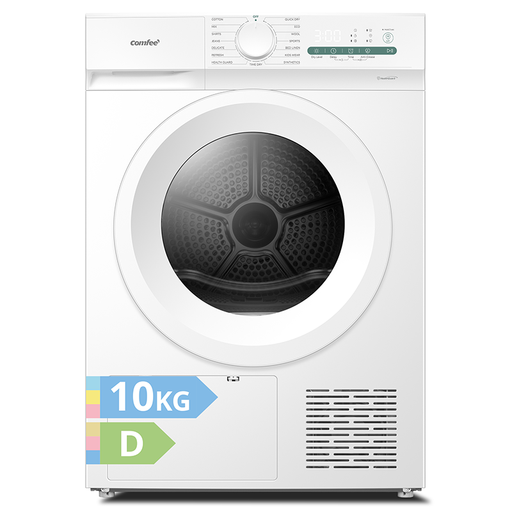
Comfee CD10EHP05W-HR 10 kg white heat-pump tumble dryer

Comfee CD10EHP05W-HR 10 kg heat-pump tumble dryer

This stated 10 kg capacity may suit large family loads, provided you have a suitable space available.

The product features a heat pump, three drying levels, a double-layer filter, a refresh programme and an LED display. Consult the specific instructions and confirm the dimensions before installation.

Joybuy

Comfee CD08EHP05W-HR 8 kg white heat-pump tumble dryer

Comfee CD08EHP05W-HR 8 kg heat-pump tumble dryer

An option for everyday household loads in a home that can accommodate a freestanding tumble dryer.

Stated 8 kg capacity, heat-pump technology, double-layer filter, adjustable drying levels, refresh programme and LED display. Check the depth, door opening and connection requirements.

Joybuy

Electrolux EDH1018CD GentleCare 8 kg white condenser tumble dryer

Electrolux EDH1018CD GentleCare 8 kg condenser tumble dryer

Worth considering for a typical household load and a space where door opening needs to be taken into account.

Stated 8 kg capacity, reversible door, OptiSense humidity sensors, declared noise level of 66 dB(A) and stated dimensions of 60 × 65 × 85 cm. Confirm the drying technology, current energy label and condensed-water drainage system.

Joybuy

Frequently asked questions

Does a condenser tumble dryer need to be connected to the outside?

No. A condenser tumble dryer, including a heat-pump model, can be installed without a connection to the outside, unlike a vented appliance. However, check the model’s instructions, keep air inlets and extraction vents clear, and avoid placing it in an area already affected by condensation.

Can I dry a full washer-dryer load without removing any laundry?

Only if the amount loaded does not exceed the stated drying capacity, which is usually lower than the washing capacity. For example, Electrolux states 10 kg for washing and 6 kg for drying on the EW9W1166RA; above this limit, remove some laundry before the drying cycle or plan for two cycles.

Can the label on a separate tumble dryer be used to compare it directly with a washer-dryer?

No. The European regulation on tumble-dryer energy labelling excludes household washer-dryers. Compare separate tumble dryers using their own labels and, for a washer-dryer, check the figures for washing and the wash-and-dry cycle.

When is an airer still a suitable option in a flat?

An airer can still be used in a large, well-ventilated room or one fitted with a mechanical ventilation extraction vent, as recommended by ADEME. If misting persists, or you notice mould, black marks or peeling coverings, also check that the property’s ventilation is working properly and being maintained.