Who are these solutions for?
The space available while your laundry dries and how well the air circulates in the room will guide your choice before you even start comparing appliances.
Households with room to set aside for an airer
If you can leave laundry to dry in a generously sized, well-ventilated room or one with mechanical ventilation extraction, consider using an airer before buying an appliance. This is the type of location ADEME recommends for indoor air-drying. You’ll also need to be happy with the laundry taking up that space while it dries.
Households looking to free up the space taken by laundry
A tumble dryer could meet this need if you can install one. Compare its capacity with your usual loads, then consider cycle times, energy consumption, where the appliance will go and how you’ll manage the condensed water.
Households keeping their airer
If moisture from drying laundry is occasionally a problem, you could consider using a dehumidifier alongside your airer. Make sure you have space for it, and bear in mind the noise and the need to empty the collected water. It is not a substitute for ventilation, which refreshes the air in your home.
What should you consider before choosing?
Start with the room where your laundry will dry, then weigh up how long it will be occupied against the installation and day-to-day requirements of each solution.
| Factor | What to check | Your needs |
|---|
| Humidity and ventilation |
If you’re using an airer, consider the size of the room, whether you can ventilate it and whether it has mechanical ventilation extraction. ADEME recommends a generously sized, well-ventilated room or one with this type of extraction. A dehumidifier does not refresh the air. |
I want to be able to hang out my laundry without overlooking the extra moisture it adds to the room. |
| Space and installation |
Measure the space and check the clearances specified for your chosen model. Depending on the appliance, allow room for an airer or dehumidifier, as well as a tank to empty or a drain connection. |
The room needs to remain usable while the laundry dries, and the appliance must be suitable for installation there. |
| Drying time |
Compare tumble dryer cycle times using similar loads and programmes. UFC-Que Choisir says that conventional condenser dryers generally have shorter cycles than heat pump models. For laundry dried on an airer, consider the washer’s actual spin-drying performance, not just its maximum stated spin speed. |
I need to get the space back at a pace that fits in with my laundry routine. |
| Electricity |
Compare energy consumption figures based on the same criteria and take into account how often you’ll use the appliance. According to UFC-Que Choisir, heat pump tumble dryers generally use less energy than conventional condenser models, but their cycles are usually longer. |
I’d rather consider the appliance’s repeated use than focus on just one of its features. |
| Maintenance and noise |
Check the manual for instructions on the filters, tank and, depending on the model, condenser or drain. If the appliance will run near a room you use, also check its noise level under the stated conditions. |
I can carry out the required maintenance, but noise and emptying the water matter in a small room. |
A few brands and models to consider
These examples highlight features to check on specific models; they are not representative of every product in each brand’s range.
Bosch
The WTN85V07FF condenser dryer is an example of why it’s worth checking dimensions and features on a model-by-model basis. Bosch says this model is no longer available.
- For the WTN85V07FF, Bosch lists dimensions of 842 × 598 × 613 mm and the AutoDry function.
- These features do not automatically apply to other Bosch models. The brand also provides filter-cleaning instructions, which you should check against the manual for the appliance you use.
Wood’s
The MDX20P dehumidifier is a useful example to consider when looking at how an appliance placed near a laundry-drying room handles water.
- In its review of the MDX20P, Les Numériques notes that it has a built-in pump and a 6 L tank.
- The same review mentions variable noise levels and the need to maintain the tank; these observations apply to the MDX20P.
Duux
The Bora 20L DXDH20 is worth considering if you’d find app control useful in your room.
- Les Numériques’ review highlights the Bora 20L DXDH20’s mobile app.
- It also notes the appliance’s weight and describes its Night mode as disappointing. Its stated features do not determine how long a load of laundry will take to dry.
Comfee
Les Numériques lists the Aqua Dry 12 among the dehumidifiers intended for smaller rooms.
- This model can be a useful starting point when considering an appliance for a smaller room.
- Check the dimensions and how to empty the water on the model you’re actually considering. The Aqua Dry 12 is not representative of other Comfee products.
De’Longhi
The AriaDry Multi DEXD216RF is a dehumidifier tested for use in a medium-sized room.
- Les Numériques describes the DEXD216RF as easy to use and notes its laundry mode.
- The review mentions a small tank and limited settings on this model; this does not necessarily apply to the whole range.
Tumble dryers and dehumidifiers available on Joybuy
These models let you explore two options for a flat without outdoor space: dry your laundry in a machine, or keep your airer and pair it with a dehumidifier. Check that you can install the appliance in your room before choosing.
 Image unavailable
Electrolux EDH1018CD GentleCare, 8 kg condenser tumble dryer
Worth considering if you’d rather dry your laundry in a machine than set aside space for an airer. The model name indicates an 8 kg capacity, propane refrigerant and OptiSense function. Check the dimensions and installation requirements for this model in your room.
View on Joybuy
 Image unavailable
Hotpoint CHD84MWBSEE, 8 kg heat pump tumble dryer
This 8 kg model is worth comparing if you have space for a heat pump tumble dryer. Its name indicates an energy rating of C. Also check the energy consumption and cycle time figures on the current label, then make sure you have the clearance needed for installation.
View on Joybuy
 Image unavailable
Comfee CD10EHP05W-HR, 10 kg heat pump tumble dryer
Its stated 10 kg capacity is worth comparing with the size of your usual loads and the space available. The model name indicates an energy rating of D. Compare its energy consumption and cycle times with other models on the same basis, and check the noise level if it will be near a living space.
View on Joybuy
 Image unavailable
Comfee CD08EHP05W-HR, 8 kg heat pump tumble dryer
This 8 kg model offers another capacity to consider for machine drying. Its name indicates an energy rating of D. Compare its energy consumption and cycle times with other models on the same basis, and check the noise level for the intended location.
View on Joybuy
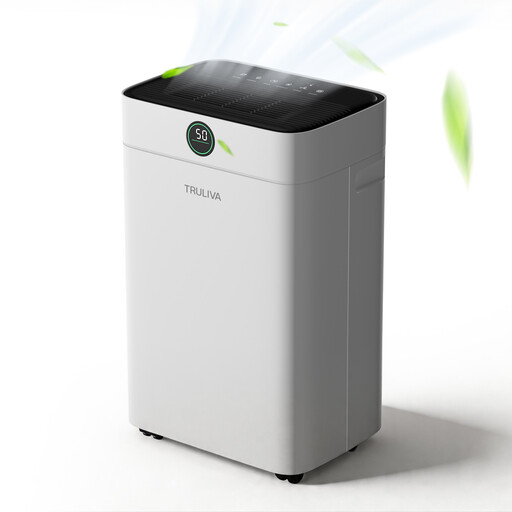 Image unavailable
TRULIVA, 25 L/day dehumidifier with laundry mode
Consider this alongside an airer, not as a replacement for ventilating the room. The product name lists an extraction capacity of 25 L/day, a 2.8 L tank and a continuous drainage hose. This stated capacity does not determine how long a load of laundry will take to dry. Plan where to put the appliance and how to drain the collected water.
View on Joybuy
Frequently asked questions
Should I buy an appliance before changing where I dry my laundry?
Not necessarily. For indoor air-drying, ADEME recommends a generously sized, well-ventilated room or one with mechanical ventilation extraction. So first consider where you could dry your laundry and how well the air circulates. This practical advice is not a survey of your home.
Does a condenser tumble dryer need an external air vent?
No. According to UFC-Que Choisir, condenser tumble dryers, including heat pump models, can be installed without an air exhaust duct to the outside. Even so, check the manual for your chosen model for guidance on space, clearance, room conditions and draining condensed water.
Can a dehumidifier replace ventilation while laundry is drying?
No. It can remove water from the air around your airer, but it does not refresh the air in your home. ADEME recommends considering ventilation to remove moisture. Think of a dehumidifier as an extra, and take into account its noise, the space it needs and how you’ll drain it.
How can I compare the energy consumption of two tumble dryers?
Compare consumption figures based on the same criteria, then consider how often you’ll run a cycle. The European Commission says tumble dryers placed on the market from 1 July 2025 use the A to G scale. Don’t compare an old A+++ rating directly with a rating on the new scale. Also check cycle times.
What maintenance does a tumble dryer need in a small home?
Follow the manual for your model to clean the fluff filters and manage the water tank, as well as the condenser if applicable and accessible. Bosch provides filter-cleaning instructions, but don’t assume a model has an automatic cleaning function unless it is specifically equipped with one.


