If you don’t have an external vent, rule out vented tumble dryers. A condenser dryer, with or without a heat pump, doesn’t need an external connection, as UFC-Que Choisir explains. If you dry clothes often, it’s worth paying particular attention to the energy consumption of a heat pump model. If you can only fit one appliance, consider a washer-dryer and check its drying capacity. In all cases, check the installation and maintenance requirements for the model you choose.
Who are these solutions for?
Renters without an external vent
A vented tumble dryer won’t meet your requirements. UFC-Que Choisir says that a condenser dryer, either standard or with a heat pump, can work without an external connection. However, the room still needs to be suitable for the model you choose.
Households that dry clothes frequently
If you use your dryer often, compare the energy consumption of specific models rather than looking at technology alone. A heat pump model can use less electricity than a standard condenser dryer, according to UFC-Que Choisir, but programmes and maintenance are also important factors.
People living in smaller homes
If there’s no room for two appliances, a washer-dryer could save space. However, as UFC-Que Choisir points out, its drying capacity is lower than its washing capacity. Check both figures before planning your laundry.
What should you look for?
Heat pump
Consider it: if you want a separate tumble dryer for regular use, don’t have an external vent and want to take electricity consumption into account.
Bear in mind: cycles may take longer than with a standard condenser dryer; the permitted room temperature varies by model.
Standard condenser dryer
Consider it: if you have room for a separate appliance and want to compare cycle times for specific models without installing a vent.
Bear in mind: UFC-Que Choisir says this technology uses more electricity than a heat pump tumble dryer.
Washer-dryer
Consider it: if there isn’t room for two appliances, even if they could be stacked.
Bear in mind: drying capacity is lower than washing capacity. You may need to remove some clothes from a large load before starting the drying cycle.
To decide between these options, start with the factor that will have the biggest impact on your day-to-day use, then check the manual and energy label for the models you’re considering.
| Factor |
What to check |
What matters to consumers |
| Installation without a vent |
Check the drying type, dimensions, and the temperature and clearance requirements in the manual. |
If I don’t have an external vent, I first need to find an appliance that’s suitable for my room. Around 33% of consumers put this compatibility first. |
| Electricity consumption |
Compare the figures on the energy labels for specific models on a like-for-like basis, as well as the length of the Eco programme. |
If I dry clothes regularly, the electricity used per cycle matters to me. This running cost is the main priority for around 27% of consumers. |
| Space and drying capacity |
Measure the space and allow for the door to open. For a washer-dryer, check the washing and drying capacities separately. |
If I can’t fit two appliances at home, I could consider a washer-dryer, provided its drying capacity is enough for my laundry. Lack of space is the main consideration for around 20% of consumers. |
| Noise and maintenance |
Check the stated noise level and what’s required to maintain the filters, condenser and water collection system. |
If my appliance is near a living area, I want to factor in noise and be able to maintain it without overlooking essential checks. Around 20% of consumers say ease of use is their main concern. |
Mistakes to avoid
-
Assuming that no vent means installation is straightforward
A condenser dryer doesn’t need an external vent, but its temperature and positioning requirements vary by model.
Measure the space, including room for the door to open, and read the manual for the exact model. For example, Electrolux specifies a temperature range of 5 °C to 35 °C for the EW6HI8155DD, but this range doesn’t apply to other models.
-
Choosing a standard condenser dryer without comparing energy consumption
UFC-Que Choisir says that a standard condenser tumble dryer uses more energy than a heat pump model. How much you use will depend on the specific models and cycles you compare.
Compare the energy label figures on a like-for-like basis and check how long the programmes you plan to use take.
-
Confusing washing capacity with drying capacity
A washer-dryer may require you to remove some clothes from a large load before drying. For example, Bosch states that the WNA13400FF can wash 8 kg, but can handle 5 kg for a continuous wash-and-dry cycle.
Compare your usual load with the drying capacity, not just the figure given for washing.
-
Putting off maintenance
Filters and, depending on the appliance, the condenser need to be checked as specified by the manufacturer. For relevant models, Electrolux recommends checking the condenser and its compartment at least once a month.
Before choosing a model, check the manual for cleaning instructions and how to access the parts that need maintenance.
Brands to consider
Bosch
Bosch’s French range includes models that let you compare a separate tumble dryer with a washer-dryer.
- Bosch describes the WQG24502FR as an 8 kg heat pump tumble dryer.
- For the WNA13400FF washer-dryer, the 8 kg washing capacity doesn’t match the 5 kg limit for a continuous wash-and-dry cycle.
Whirlpool
Its French range includes both heat pump and standard condenser models.
- The brand states that its 9 kg W7XD95WRFR heat pump model has a noise level of 58 dB.
- The stated consumption of 4.72 kWh per cycle for the FFTBCM118XBFR condenser model applies to this specific model, not the whole range.
Electrolux
Its model-specific information is useful when checking the installation space and maintenance requirements.
- Electrolux specifies an operating temperature range of 5 °C to 35 °C for the EW6HI8155DD heat pump tumble dryer.
- This range applies specifically to the EW6HI8155DD. Check the manual for the model you’re considering.
Miele
The TEA525WP is an example of the points to consider when installing a separate heat pump tumble dryer.
- For this model, Miele states an 8 kg capacity and an integrated kit for draining away condensation water.
- Installation options depend on the appliance and compatible accessories, so check that your planned setup is suitable.
Beko
The DCB816W gives you a standard condenser model to include when comparing drying technologies.
- Beko describes the DCB816W as a condenser tumble dryer.
- To check whether it’s suitable for your home, look at the specifications and installation requirements for the model on offer.
Tumble dryers to consider on Joybuy
These separate heat pump and condenser tumble dryers are designed for drying without an external vent. Before choosing, compare their capacity and installation requirements with the space you have available.
 Image unavailable
Hotpoint CHD84MWBSEE, 8 kg heat pump tumble dryer
Worth considering if you’re looking for a separate tumble dryer without an external vent, with capacity for loads of up to 8 kg.
This model is listed with an energy rating of C. Check the manual for its dimensions and the requirements for your room.
View on Joybuy
 Image unavailable
Comfee CD08EHP05W-HR, 8 kg heat pump tumble dryer
This separate heat pump model is worth considering if you need an appliance that works without an external vent and offers a stated capacity of 8 kg.
It is listed with an energy rating of D. Compare its energy label figures and check the manual for the installation requirements.
View on Joybuy
 Image unavailable
Electrolux EDH1018CD GentleCare, 8 kg condenser tumble dryer
If you’re considering a condenser tumble dryer that doesn’t need an external vent, this model has a stated capacity of 8 kg.
Compare its energy consumption with heat pump models on a like-for-like energy label basis, and check the manual for its specific installation requirements.
View on Joybuy
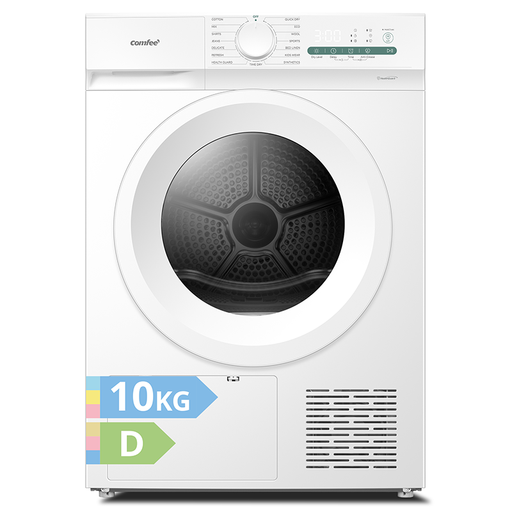 Image unavailable
Comfee CD10EHP05W-HR, heat pump tumble dryer
This separate heat pump tumble dryer is another option for drying clothes without an external vent.
It is listed with an energy rating of D. Check the capacity of the version on sale before comparing it with your usual loads, then consult the manual to make sure your planned location is suitable.
View on Joybuy
Frequently asked questions
Do you need an external vent to install a tumble dryer?
No, not if you choose a condenser tumble dryer, including a heat pump model: UFC-Que Choisir says it doesn’t need to be connected to the outside. A vented model, however, needs an external opening or a suitable vent.
Can you put a heat pump tumble dryer in a cold room?
Only if the room temperature is within the range specified for the model you’ve chosen. For example, Electrolux gives a range of 5 °C to 35 °C for the EW6HI8155DD. Check the manual for clearance and other installation requirements too.
Do you always have to empty the tank on a condenser tumble dryer?
Not necessarily. Some models let you drain the condensation water away instead. Check whether the model you’ve chosen supports a drain connection, whether the necessary parts are included and whether your setup can accommodate them.
Can an 8 kg washer-dryer dry 8 kg of laundry in one go?
Don’t assume so just from its washing capacity: UFC-Que Choisir points out that drying capacity is generally lower. For example, the Bosch WNA13400FF can wash up to 8 kg on a wash-only cycle, but handles 5 kg on a continuous wash-and-dry cycle.


