Which factors will determine your choice?
First, work out whether you can fit a single appliance on the floor or whether a compatible stacked set-up is an option. Then compare the amount of laundry you can actually dry, the usage data and the connections required for the model you’re considering.
Washer-dryer
Consider this: when there’s room for just one appliance on the floor for both washing and drying.
Bear in mind: you may need to reduce the load after washing before drying. UFC-Que Choisir highlights this difference in capacity.
Stacked washing machine and tumble dryer
Consider this: if there’s enough vertical space for two separate appliances.
Plan for: a stacking kit approved for your chosen appliances, and follow its fitting instructions.
Heat pump tumble dryer
Consider this: if you can install a separate appliance and energy consumption matters to you when using it frequently.
Check: its energy consumption data and dimensions, rather than assuming its performance based on the technology alone.
Standard condenser tumble dryer
Consider this: if you can install a separate tumble dryer and don’t have an external air vent.
Check: according to Whirlpool, whether condensed water can be plumbed in depends on the model; otherwise, you may need to empty the water tank.
| Factor |
What to check |
What matters to consumers |
| Space required |
Measure the width, height and depth, as well as the clearance needed to open the door. For a stacked set-up, check that the kit is compatible. |
When two appliances won’t fit side by side, my priority is to free up floor space; around 31 % of consumers put this need first. |
| Energy use and maintenance |
Compare the energy data for the relevant cycle, then check the cleaning instructions and how the water is handled. |
If I dry laundry often, I want to understand what each cycle involves in practice; this comes first for around 25 % of consumers. |
| Load and cycle time |
Check the washing and drying capacities separately in kg, along with the duration of the programmes you’re considering. |
After washing, I want to avoid taking some of the load out before drying; around 25 % of consumers prioritise capacity and turnaround time. |
| Installation |
Check the location, power supply, required connections and, if necessary, the stacking instructions. |
When an appliance needs to fit in a room with specific constraints, I need to confirm it can be installed there before choosing its technology; around 19 % of consumers put feasibility first. |
Appliances for indoor drying on Joybuy
This selection includes washer-dryers to reduce the number of machines on the floor, as well as separate tumble dryers to consider if you can install one. For each model, check how much space it needs and how much laundry you’ll actually be able to dry.
 Image unavailable
Samsung WD11DG6B85BEU3, 11 kg washing / 6 kg drying
Combines washing and drying in a single appliance on the floor. Its stated capacity is 11 kg for washing and 6 kg for drying, so you may need to reduce a full wash load before drying it.
Check the dimensions, connections and data for the wash-and-dry cycle that suits your needs.
View on Joybuy
 Image unavailable
Samsung WD10HG6U34BEU3, 10 kg washing / 6 kg drying, D rated
Another option for fitting washing and drying into one appliance on the floor, with a stated washing capacity of 10 kg and drying capacity of 6 kg. If you fill the drum for washing, bear the drying limit in mind before starting the programme.
Check the space available and consult the full-cycle data if duration and energy use are important to your decision.
View on Joybuy
 Image unavailable
Hotpoint CHD84MWBSEE, 8 kg heat pump tumble dryer, C rated
Dries laundry in a separate appliance, if you can make room for it or plan a compatible stacked set-up. Its stated capacity is 8 kg.
Check the model’s dimensions and energy consumption data. If you’re considering a direct drain connection, check the requirements first.
View on Joybuy
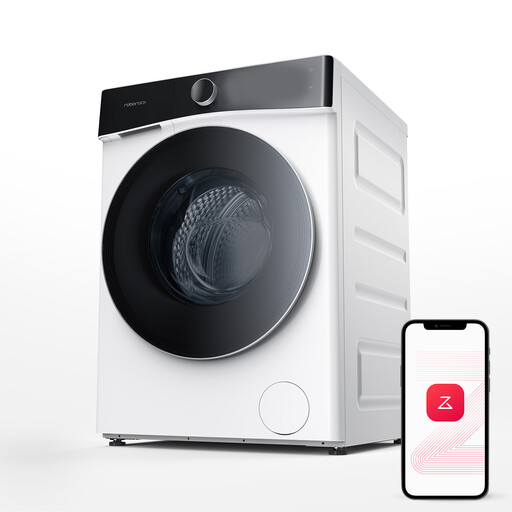 Image unavailable
Roborock Zeo Lite Zeo-Cycle, 10 kg washing / 6 kg drying
Combines washing and drying in one machine. Its stated capacities are 10 kg for washing and 6 kg for drying, so plan to reduce a full wash load before drying it.
Check the dimensions, programme times and energy consumption data relevant to your needs.
View on Joybuy
 Image unavailable
Electrolux EDH1018CD GentleCare OptiSense, 8 kg condenser tumble dryer
For drying laundry in a separate appliance when you can make room for it. Its stated capacity is 8 kg.
Check how much space it needs and consult the model’s manual to find out how to handle condensed water before deciding where to install it.
View on Joybuy
Frequently asked questions
Can a 9 kg washer-dryer dry 9 kg of laundry?
Not necessarily: washing and drying capacities are different. For example, the Whirlpool BI WDWG 96146 FR has a stated washing capacity of 9 kg and a drying capacity of 6 kg. Stick to the limit for the programme you choose, even if you’ve washed a full load.
Can I put a tumble dryer directly on top of my washing machine?
Don’t improvise when stacking appliances: use a kit that’s compatible with both machines and follow its instructions. For example, Electrolux describes a kit for certain front-loading appliances with a depth of 47 to 60 cm, with specific fixing requirements.
Does a condenser tumble dryer always need to be emptied by hand?
No, it depends on the model and how it’s installed. Whirlpool explains that some condenser tumble dryers can be connected to a drain. Check the manual to see whether this is an option and what accessory you’ll need.
Can I install a drying appliance in a bathroom?
This depends on the appliance and the room’s electrical installation. Promotelec specifies requirements including earthing, 30 mA residual-current protection and positioning for washing machines in bathrooms. Before installation, ask a qualified professional to confirm which requirements apply to your tumble dryer or washer-dryer.
Should I block an air vent to make room for the appliance?
No: don’t block any air inlets or outlets in your home. The French decree of 24 March 1982 on ventilation in homes requires general, continuous ventilation. Choose a location that allows air to circulate.


