If you don’t have an outside opening or vent, rule out vented tumble dryers: UFC-Que Choisir says that a condenser model can work without an outlet to the outside. If you have room for two appliances, compare condenser tumble dryers, including heat pump models, by their cycles and installation requirements. If you only have space for one appliance, a washer-dryer could suit you, as long as the load is within its drying capacity. An indoor airer is another option if you have a well-ventilated room, as recommended by Anses.
Who are these options for?
People without an outside vent
If you don’t have an opening to the outside or a ventilation duct, a vented tumble dryer won’t meet your installation requirements. UFC-Que Choisir distinguishes these appliances from condenser models, which don’t need an outlet to the outside.
Small homes with space for just one appliance
A washer-dryer combines both functions in one appliance. Before relying on it to complete a full cycle without your intervention, compare its washing and drying capacities: UFC-Que Choisir notes that its drying capacity is lower than its washing capacity.
Households that do laundry frequently
If you can install a separate tumble dryer, compare its capacity with your usual loads, then look at the model’s energy consumption, programme times and maintenance requirements.
How do the options compare?
Start with the space available and how much laundry you need to dry in one go. Then compare the figures for the cycles you’ll actually use.
| Priority |
What to check |
Depending on your needs |
| Installation |
Check the number of spaces available, the dimensions and the clearance required. UFC-Que Choisir says that condenser tumble dryers, including heat pump models, don’t need an outlet to the outside, unlike vented models. |
I don’t have an outside vent, so a vented appliance isn’t suitable. If I have space for just one appliance, I should consider a washer-dryer. If I have room for two appliances or a compatible stacking space, I can also compare separate appliances. |
| Capacity |
Compare the washing and drying capacities in kg, then compare the capacities of two separate appliances if you’re buying them individually. According to UFC-Que Choisir, a washer-dryer can dry less laundry than it can wash. |
If I want to wash and dry a load without removing any laundry, I need to keep it within the drying capacity of the programme I’ve chosen. If my loads are larger, I’ll need to split the drying between cycles. |
| Water and electricity |
Compare consumption figures for similar cycles, making sure you don’t confuse wash-only figures with wash-and-dry figures. UFC-Que Choisir’s testing measures water, electricity and cycle times for washer-dryers in relation to the weight of laundry dried. The European Commission says that their energy label shows energy consumption per 100 cycles. |
If I regularly use a machine to dry my laundry, I want to know how much energy the cycle I use consumes. A technology or energy class on its own won’t tell me everything about how I use the appliance. |
| Time and maintenance |
Check how long the programmes suitable for your fabrics take, along with the appliance’s maintenance instructions. UFC-Que Choisir notes that a washer-dryer takes longer to dry clothes than a conventional tumble dryer. |
When I’m doing several loads in a row, the time taken to complete a full cycle matters just as much as the space saved. I’ll also check what maintenance the model requires. |
| Drying on an airer |
Look for a well-ventilated room and enough space to hang your laundry. Anses recommends drying clothes outside if possible, or in a well-ventilated room, as damp conditions encourage mould growth. |
I can manage without a drying appliance if I have the time and a suitable space to hang my laundry, without letting damp build up in a closed room. |
What should you watch out for before buying?
-
Looking only at a two-in-one appliance’s washing capacity
UFC-Que Choisir says that a washer-dryer can wash a larger load than it can dry. So, after washing a full load, you may need to take some of the laundry out before drying it.
Compare both capacities in kg. To run the cycles one after the other without having to intervene, set the initial load to match the drying capacity of the programme you’ve chosen.
-
Choosing a tumble dryer based on its technology alone
You’ll still need to check the capacity, programme and consumption figures for the specific model to compare two appliances intended for the same use.
Check the label and product information for each model, especially its stated consumption, programme times, dimensions and maintenance instructions.
-
Planning to use an airer in a poorly ventilated room
Anses links indoor damp to mould growth, which can lead to respiratory or allergic problems.
Choose a well-ventilated spot and make sure your laundry can dry there without blocking air vents.
-
Forgetting what to do with your old appliance
When replacing a washing machine or tumble dryer, you’ll also need to decide what to do with the appliance you’re getting rid of.
In France, the Ministry for the Ecological Transition lists three options for electrical appliances: take them to a collection point or recycling centre, return them to a retailer, or donate them to a social and solidarity economy organisation.
Which brands should you consider?
These product ranges can help you start comparing, but the features of one model won’t necessarily apply to other appliances from the same brand.
Bosch
In France, Bosch offers heat pump tumble dryers, including models with capacities of 8 and 9 kg. These are worth considering if you have space for a separate appliance.
- Depending on the model, Bosch publishes energy figures per cycle and product information sheets that let you compare models individually.
- Check the dimensions, capacity and installation requirements of the model you choose.
Electrolux
The GentleCare 600 EW6HI5829SB is an example of Electrolux’s range of separate heat pump tumble dryers in France.
- For this specific model, Electrolux states a capacity of 8 kg and energy consumption of 97 kWh per 100 cycles.
- These figures don’t apply to other Electrolux models or the Electrolux model featured below. Check the product information and manual for the model you’re considering.
Haier
In France, Haier offers a stacked pair in its Couture Care Collection 11 CLC108GNU1 range, comprising a 10 kg washing machine and an 8 kg tumble dryer.
- This setup lets you consider two appliances if you have more height than width available.
- The capacity and installation method of this set don’t mean that any other pair can be stacked. Check the manuals and the stacking kit that matches the models you choose.
Which appliances can you browse on Joybuy?
This selection includes washer-dryers for homes with space for one appliance and separate condenser tumble dryers, including a heat pump model. Before choosing, check that each appliance fits your available space and the size of the load you need to dry.
 Image unavailable
Samsung WD10HG6U34BEU3 — 10 kg washing, 6 kg drying
This washer-dryer combines both functions in one appliance. To wash and then dry without removing any laundry, limit the load to its 6 kg drying capacity. Check the dimensions and wash-and-dry cycle figures before choosing.
View on Joybuy
 Image unavailable
Samsung WD11DG6B85BEU3 — 11 kg washing, 6 kg drying
This model combines washing and drying in one appliance. Its stated capacity is 11 kg for washing but 6 kg for drying, so use the latter figure when loading laundry for a complete cycle. Check the dimensions and the energy label for this exact model suffix.
View on Joybuy
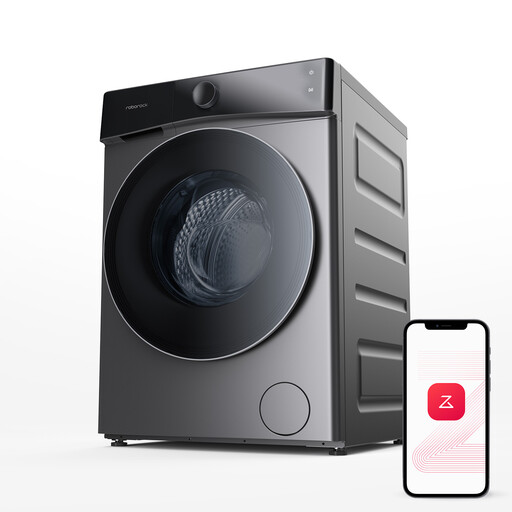 Image unavailable
Roborock Zeo Lite Gray — 10 kg washing, 6 kg drying
This washer-dryer has a 10 kg washing capacity and a 6 kg drying capacity. If you want to run both cycles without splitting the load, make sure you stay within the drying capacity. Also check its dimensions and the consumption figures for the cycles you’re interested in.
View on Joybuy
 Image unavailable
Electrolux EDH1018CD GentleCare — 8 kg condenser tumble dryer
This separate condenser tumble dryer is an option if you have space for a drying appliance that doesn’t need an outlet to the outside. It has a stated capacity of 8 kg. Check its dimensions, required installation clearances and the figures for the programme you plan to use.
View on Joybuy
 Image unavailable
Hotpoint CHD84MWBSEE — 8 kg heat pump tumble dryer
This separate heat pump model has a capacity of 8 kg. If you regularly use a tumble dryer, compare its energy consumption and programme times with those of the other appliances you’re considering. Also check the dimensions before deciding where to put it.
View on Joybuy
Frequently asked questions
Can you use a vented tumble dryer without an outside opening or vent?
No, not in this situation: UFC-Que Choisir says it needs an opening to the outside or a ventilation duct. If you want a separate tumble dryer, compare condenser models instead. You could also consider a washer-dryer or an airer, depending on how much space you have.
What should you compare on a washer-dryer’s energy label?
Look at the figures for wash-only cycles separately from those for wash-and-dry cycles. The European Commission says the label includes information such as an efficiency class and energy consumption per 100 cycles. Also check water use and the length of the cycle that matches how you plan to use it.
Can you dry a whole washed load in a washer-dryer?
Not necessarily: UFC-Que Choisir says the drying capacity is lower than the washing capacity. To run a complete cycle without removing any laundry, don’t exceed the drying capacity for the programme you’ve chosen.
Can a washer-dryer use water during the drying cycle?
Yes. Water use is worth checking for the model and cycle you’re considering. UFC-Que Choisir highlights this consumption as one of the drawbacks of washer-dryers, and its testing measures water, electricity and cycle times.
Can you dry clothes on an indoor airer?
Yes, if you can use a well-ventilated room. Anses recommends drying clothes outside where possible, or in a well-ventilated room, and points out that damp conditions encourage mould growth.


