Who is this choice for?

Households doing several loads in quick succession

If you often dry several loads, you’ll need to consider capacity, how cycles fit together and energy consumption. UFC-Que Choisir and the European Commission offer guidance to help you compare these criteria.

Households with space for just one machine

If there’s no room for a second appliance, a washer-dryer combines washing and drying. However, its drying capacity may limit how much laundry it can process without you removing some items. UFC-Que Choisir outlines this trade-off.

Households that dry clothes indoors

If you use a clothes airer, allow for the space it takes up and bear in mind the moisture released into your home. ADEME highlights the importance of ventilation to remove moisture.

Which criteria should you compare?

Heat pump tumble dryer

Worth considering: if you dry clothes often, have room for a separate appliance and can compare capacities and programme times.

The trade-off: UFC-Que Choisir generally finds these use less energy than conventional condenser models, while the latter often dry clothes more quickly.

Conventional condenser tumble dryer

Worth considering: if shorter cycles matter to you and a suitable model is available.

Check: compare the energy consumption and current A–G label for the specific model. UFC-Que Choisir says these models generally use more energy than heat pump models.

Washer-dryer

Worth considering: if you can’t install two appliances and are happy to adjust the load for drying.

The trade-off: UFC-Que Choisir points out that drying capacity is lower than washing capacity and programmes are generally longer.

Indoor clothes airer

Worth considering: if your timescales and available space allow you to dry laundry without an additional appliance.

Bear in mind: clothes release moisture into your home. ADEME recommends ventilation that continuously removes moisture.

What matters to you What to check Who it matters most to
Energy use when drying frequently Compare the technology, capacity and kWh per 100 cycles shown on the tumble dryer’s current energy label. If I dry clothes often, I want to limit electricity use without losing sight of cycle times; around 33% of consumers prioritise electricity consumption.
Available space Check the dimensions, door opening and filter access. For a washer-dryer, compare its washing and drying capacities. If I can’t set aside space for a second appliance, I’ll see whether a washer-dryer suits my home; around 27% of consumers make space their priority.
Fitting laundry loads in one after another Check the drying capacity and the length of the relevant programme. For a washer-dryer, see whether the load can be dried without any intervention. When loads follow one another, I want to know whether the clothes will be dry in time for the next load; around 27% of consumers prioritise fitting cycles together.
Drying without an appliance Consider the space needed for a clothes airer, how long you’re happy to wait and the room’s ventilation. If I’d rather not add another machine, I’ll check that I can dry clothes without the room being taken over for too long, and manage the moisture; around 13% of consumers prioritise this option.

Mistakes to avoid

  • Comparing an old A+++ rating directly with a current one

    The energy rating scale for tumble dryers has changed to A–G. Old ratings cannot be compared like for like with those on the new scale.

    To compare tumble dryers sold today, check their A–G labels and look in particular at kWh per 100 cycles and stated capacity. The European Commission says this scale has been displayed in shops and online since 1 July 2025.

  • Choosing a washer-dryer based only on its washing capacity

    Drying capacity is generally lower, so a full load of washed laundry may be more than the appliance can dry in one cycle.

    Check both capacities separately, as well as the full cycle time for the model you’re considering.

  • Choosing a conventional condenser tumble dryer solely for speed

    UFC-Que Choisir says these models generally dry clothes more quickly, but use more energy than heat pump models.

    Compare the stated cycle times and energy consumption for specific models, as well as their current energy labels.

  • Assuming a clothes airer is a hassle-free solution

    A clothes airer takes up space, and drying clothes indoors releases moisture into your home. ADEME highlights the role of ventilation in removing it.

    Plan where you’ll put the laundry and check that the room is properly ventilated.

Brands to consider

Bosch

The WQG245A0FR is an example of a separate heat pump tumble dryer.

  • Bosch lists a 9 kg capacity, dimensions of 842 × 598 × 613 mm and a self-cleaning condenser for this model.
  • These specifications apply to this particular model. Check its manual for maintenance and installation details.

LG

The F964X71WSTA is an example of a washer-dryer for homes with room for only one appliance.

  • LG lists a 9 kg washing capacity and a 6 kg drying capacity for this model.
  • When planning a complete cycle, bear in mind that drying capacity is lower than washing capacity.

Whirlpool

The FFT CM11 8XB FR is an example of a conventional condenser tumble dryer.

  • Whirlpool lists an 8 kg capacity and Easy Cleaning access for this model.
  • Check the model’s documentation and energy label before comparing it with current models.

Beko

The B5T48243W is worth comparing if you’re looking for a separate heat pump tumble dryer.

  • Beko identifies this model as a heat pump tumble dryer and provides its energy label and manual.
  • Compare the stated energy consumption of specific models rather than relying on general claims from the brand about savings.

Joybuy products

Options for drying laundry regularly at home: condenser or heat pump tumble dryers, as well as a washer-dryer when space is limited.

Electrolux EDH1018CD GentleCare condenser tumble dryer, 8 kg

Electrolux EDH1018CD GentleCare, 8 kg condenser tumble dryer

Worth considering if you’re looking for a separate tumble dryer for regular loads.

Stated capacity: 8 kg. The description mentions OptiSense, a water tank and dimensions of 60 × 65 × 85 cm.

Joybuy

Hotpoint CHD84MWBSEE heat pump tumble dryer, 8 kg, white

Hotpoint CHD84MWBSEE, 8 kg heat pump tumble dryer, white

Worth considering if you’re looking for a separate heat pump tumble dryer for regular laundry loads.

Stated capacity: 8 kg. The description mentions a 2-in-1 Easy Cleaning filter, a delay start and the option of direct connection to a drain.

Joybuy
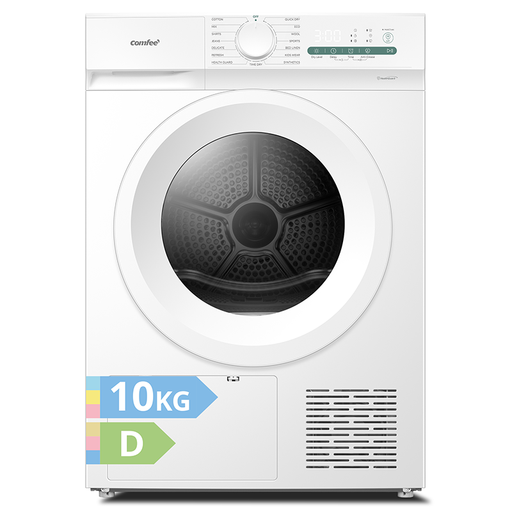
Comfee’ CD10EHP05W-HR heat pump tumble dryer, 10 kg

Comfee’ CD10EHP05W-HR, 10 kg heat pump tumble dryer

Worth considering if you’re looking for a separate tumble dryer for regular loads.

Stated capacity: 10 kg. The title mentions a UV light, a Refresh programme, rapid drying and an LED display.

Joybuy

Comfee CD08EHP05W-HR heat pump tumble dryer, 8 kg

Comfee CD08EHP05W-HR, 8 kg heat pump tumble dryer

Worth considering if you’re looking for a separate heat pump tumble dryer with a stated capacity of 8 kg.

The title mentions a UV light, a Refresh programme and rapid drying.

Joybuy

Samsung WD10HG6U34BEU3 washer-dryer, 10 kg washing capacity and 6 kg drying capacity

Samsung WD10HG6U34BEU3, 10/6 kg washer-dryer

Worth considering if you need to combine washing and drying in a single appliance.

Stated capacities: 10 kg for washing and 6 kg for drying. If the load is heavier than the drying capacity, you may need to remove some items before drying.

Joybuy

Frequently asked questions

Which energy label should I check for a tumble dryer sold in France?

To compare current models, check the European A–G label, which has been displayed in shops and online since 1 July 2025, as well as the product information sheet. The European Commission says that a repairability scale will become mandatory on the labels of tumble dryers placed on the market from 1 January 2027.

Does a tumble dryer need an outside air vent or a water outlet?

A vented tumble dryer expels damp air outside and needs an external vent. A condenser model, with or without a heat pump, doesn’t need one: water is collected in a tank or, if the model and its installation allow, drained away. Check the manual for your chosen model for details of the connections and clearances required.

Can you dry a whole load of washed laundry in a washer-dryer?

Yes, as long as the load is within the drying capacity too, which is generally lower than the washing capacity, according to UFC-Que Choisir. Otherwise, you’ll need to remove some items or plan another way to dry them. Check the appliance’s washing and drying capacities and water consumption information separately.

What needs to be maintained on a tumble dryer?

Follow the model’s manual for guidance on the filters, water tank if used, and access to the condenser. Bosch lists a self-cleaning condenser for the WQG245A0FR. This doesn’t mean the appliance or its other parts are maintenance-free.

Can you dry clothes regularly in a closed room?

Air-drying clothes releases moisture into your home. If you choose this approach, consider the room’s ventilation and the moisture levels you notice. ADEME says mechanical ventilation continuously removes moisture from the home.