Households drying several loads a week
If you need to dry clothes regularly without an external outlet, compare the energy use, cycle times and capacity of the model you’re considering.


If you don’t have an external opening or ventilation duct, rule out vented tumble dryers: a condenser model doesn’t need an external air outlet. If you dry clothes frequently, it’s worth comparing heat pump models with conventional condenser dryers for energy use and cycle times, provided the appliance fits your available space. An airer avoids the electricity used by a tumble dryer, but your clothes need to dry in a sufficiently well-ventilated room.
If you need to dry clothes regularly without an external outlet, compare the energy use, cycle times and capacity of the model you’re considering.
Before choosing an appliance, check its depth, door clearance and access to the water tank and filters. The stated noise level also matters if it will be close to a living area.
If an appliance would take up too much space or you have only a small volume of laundry, an airer is still an option. However, ADEME points out that air-drying clothes releases a lot of moisture into the air indoors, so room ventilation is part of the decision.
Consider this if: you want a tumble dryer that doesn’t need an external outlet and care more about shorter cycles than electricity use.
The trade-off: according to Que Choisir, conventional models generally use more electricity than heat pump versions.
Consider this if: you dry clothes regularly and electricity use is a bigger factor in your decision.
The trade-off: cycles may take longer than with a conventional model. A heat pump doesn’t mean you can skip measuring the space or maintaining the filters.
Consider this if: you don’t have enough space or laundry to justify installing a tumble dryer.
The trade-off: an airer doesn’t use the electricity a tumble dryer does, but, as ADEME reminds us, indoor drying requires suitable ventilation to deal with the moisture produced.
In a flat without an external air outlet, first check that you can install and maintain an appliance. Then compare the options based on what matters most to you.
| Your priority | What to check | Who it matters to |
|---|---|---|
| Energy use when drying frequently | Compare the energy label and cycle time for the exact model, rather than relying on the technology alone. | When one load follows another, I want to dry my clothes without overlooking the electricity used. Around 46% of consumers are said to put this energy use first. |
| Space and access to the appliance | Measure the space with the door open and check access to the filters; also find out how condensed water is managed. | In a narrow room, I need enough space to load the laundry and carry out routine maintenance. Around 36% of consumers are said to prioritise ease of installation and use. |
| Drying without an appliance | For an indoor airer, check the size of the room and its ventilation or air extraction. | If I decide against a tumble dryer, I need to be able to dry my clothes without leaving them in a small, enclosed room. Around 18% of consumers are said to prioritise this option and the humidity management it requires. |
According to Que Choisir, this technology needs an external opening or access to a ventilation duct. It won’t meet the needs described here if neither connection is available.
Make sure there’s a suitable outlet before choosing this type of dryer; otherwise, compare condenser models.
A tumble dryer may fit in its space but leave too little room to open the door, empty the tank or clean the filters.
Measure the route to the space, the door swing and the access needed to maintain the model you choose.
This feature doesn’t necessarily remove the need to clean the fluff filters. Bosch stresses the importance of regularly removing fluff from the models concerned.
Check the instructions for the exact model and follow the recommended maintenance tasks and intervals.
ADEME says that air-drying clothes releases a lot of moisture into the air indoors.
Choose a large, well-ventilated room or one with suitable extraction. If that isn’t possible, reconsider a condenser appliance.
These examples highlight features to check on a model-by-model basis; they don’t necessarily apply to an entire range.
The range includes heat pump tumble dryers, with some models offering a self-cleaning condenser and a water drainage hose.
The range includes heat pump models with filtration features that vary by model.
The range includes heat pump tumble dryers with sensors and fabric programmes, depending on the model.
These models let you compare condenser tumble dryers, several of which use heat pump technology, for a flat without an external air outlet. Before choosing, check the space required, how water is managed and the details on each product page.
 Image unavailable
Worth considering if you’re looking for a condenser tumble dryer for a home without an external air outlet.
The product name lists an 8 kg capacity and the OptiSense function. Before installation, check the space needed with the door open and how water is collected or drained.
 Image unavailable
Worth comparing if you dry clothes regularly and prefer heat pump technology.
The product name lists an 8 kg capacity and energy rating C. Before choosing this model, check its dimensions, the space needed with the door open and the water connection requirements if you want to drain water directly.
 Image unavailable
Worth considering if you want a heat pump model with a stated capacity of 8 kg.
The product name lists energy rating D. For the space you have in mind, check the dimensions, stated noise level and how condensed water is collected or drained.
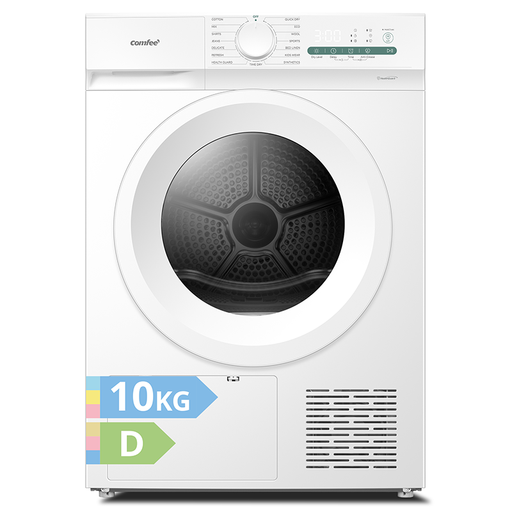 Image unavailable
Worth looking at if you’re after a heat pump tumble dryer, but confirm its capacity before choosing it for your laundry needs.
The product name lists 10 kg, while another product detail states 8 kg. Ask for confirmation of the exact model’s capacity. Also check the dimensions, noise level, energy use shown on the label and how condensed water is managed.
No, not if you don’t have an external opening or a usable ventilation duct. Que Choisir explains that a vented model needs one of these connections, so compare condenser options instead.
No. Conventional condenser dryers and heat pump models don’t need an external air connection. Check separately how the model collects water from the laundry and whether it can be connected to a drain.
Compare the energy labels and information for the exact models. The European Commission says the EPREL database brings together efficiency data and performance parameters for the models it covers. Also consider the cycle times that suit your needs.
Measure the space, the route to it and the room needed with the door open, then check access to the filters and water tank. As examples for specific models, Bosch lists dimensions of 842 × 598 × 613 mm for the WQG2450SFR, while LG gives a depth of 1 115 mm with the door open at 90° for the RH9V76WH.
A small, enclosed room isn’t suitable for regularly drying clothes on an airer. ADEME highlights the significant amount of moisture released when clothes are air-dried indoors, so choose a large, well-ventilated room or one with suitable extraction.