Parents who prefer individual portions
A sealed bottle lets you know exactly how much you’re packing, without having to portion it out from a larger container. The 100 g and 180 g sizes give you two handy options to choose from.


For a school lunchbox, first check whether the storage instructions for your chosen product are suitable for the journey, then choose a sealed 100 g or 180 g bottle to suit the portion you want. An opened large bottle is less convenient to transport: Yoplait says its large Yop bottles should be kept chilled and consumed within 72 hours of opening. Then compare sugar content on a like-for-like basis and check the allergens on the label.
A sealed bottle lets you know exactly how much you’re packing, without having to portion it out from a larger container. The 100 g and 180 g sizes give you two handy options to choose from.
If the bottle will stay in a lunchbox until break time, follow the instructions for that specific product. Yoplait’s guidance on storing small Yop bottles outside the fridge does not apply to all drinking yoghurts.
The flavour alone won’t tell you about the ingredients or sugar content. Check the ingredients, allergens and nutritional information for each product to make a more accurate comparison.
For a school lunchbox, check the storage instructions before choosing a bottle size. Then compare the labels of products that are suitable for this purpose.
| Criteria | What to check | Most relevant for |
|---|---|---|
| Storage | Check the required temperature and any stated period for which the chosen size can be kept out of the fridge. | If the bottle will sit in the lunchbox for several hours, I need to know how it can be stored. Around 36% of consumers put this need first. |
| Individual portions | Compare the weight of each bottle, especially 100 g and 180 g sizes, and check that the bottle stays sealed until it’s time to drink it. | When packing a set portion in a school bag, I prefer to choose the bottle size directly. Around 29% of consumers prioritise this. |
| Recipe and allergens | Read the ingredients and compare the sugar content per 100 g, then work out the amount for your chosen portion. | When several recipes are available in a suitable size, I want to compare their sugar content and check whether they contain milk. Around 21% of consumers prioritise this comparison. |
| Planning portions | Check how many bottles are in a pack. For a large bottle, also read the instructions for use after opening. | If I’m preparing several lunchboxes during the week, I want to plan portions without confusing a pack of small bottles with a container that’s already been opened. Around 14% of consumers prioritise this. |
Yoplait says its small Yop bottles can be kept out of the fridge for up to 8 hours. The Actimel product information checked at Auchan, however, says to keep the product at a maximum temperature of +6 °C and no lower than +1 °C.
Always read the instructions for the product you’ve bought. If it needs to be kept chilled, make sure you have a suitable way to keep it cold until it’s consumed.
An opened bottle needs to be handled differently from a sealed individual portion. Yoplait says its large Yop bottles should be kept chilled and consumed within 72 hours of opening.
For school, choose an individual size with storage instructions that suit a lunchbox. Keep the large bottle for occasions when you can follow its storage guidance.
Two drinking yoghurts with the same flavour can have different recipes and portion sizes. The amount of sugar in each bottle depends both on the stated sugar content and on how much the bottle contains.
Compare the sugar content per 100 g, then check the amount in the portion you’ll actually be packing. Also read the ingredients and allergens for each product.
Actimel is one of the small-bottle options worth comparing. Auchan’s product information for a pack of 12 × 100 g says to keep it at a maximum temperature of +6 °C and no lower than +1 °C.
The Yop range includes small and large sizes. Yoplait says its 100 g, 180 g and 250 g bottles can be kept out of the fridge for up to 8 hours.
Carrefour Sensation offers, among other options, a pack of 100 g mini bottles and a 180 g strawberry product. These are two portion sizes to assess separately.
Auchan offers, among other options, a mixed drinking yoghurt pack of 8 × 100 g. Its product information says the bottles have resealable caps.
E.Leclerc’s Déli'max range includes an 850 g size, which is better suited to serving portions than to taking a small individual bottle with you.
These two products come in packs of small 125 ml units that are worth considering for a lunchbox. WANT WANT Wantzai is described as a flavoured yoghurt; the other product is labelled as a lactic acid bacteria drink, not a drinking yoghurt. For both products, check the storage instructions and allergens on the packaging of the one you buy.
 Image unavailable
The small units may suit you if you’re looking for an individual portion for a lunchbox. Check the packaging for storage instructions during transport and to see whether milk is listed as an allergen.
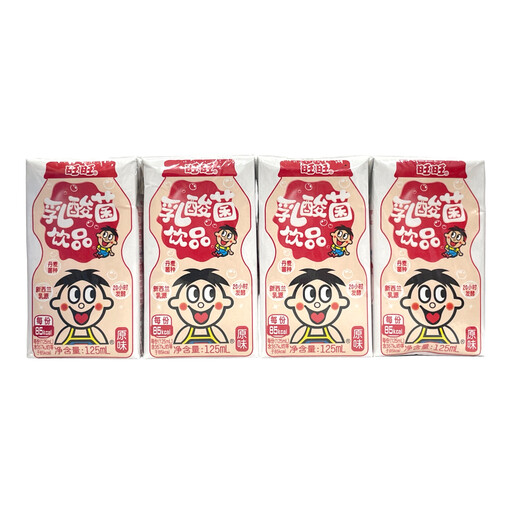 Image unavailable
This pack of small units is worth considering if you’re looking for a lactic acid bacteria drink rather than a drinking yoghurt. Check the storage instructions on the packaging; milk and soya are listed as allergens for this product.
Only if the product’s instructions allow it to be stored in the conditions you have planned. Yoplait says its small Yop bottles can be kept out of the fridge for up to 8 hours, but this doesn’t apply to other products. If a product needs to be kept chilled, you’ll need to keep it cold until it’s consumed.
A large bottle is mainly intended for serving portions and isn’t a direct substitute for a sealed individual bottle. Yoplait says its large Yop bottles should be kept chilled and consumed within 72 hours of opening. Read the instructions for the specific product before packing a portion to take with you.
Start by comparing the ‘sugars’ line in the nutritional information on a like-for-like basis, such as per 100 g. Then take into account how much each bottle contains to compare the portions you’ll be packing.
Check the ingredients list for the specific product. For prepacked food sold in France, allergenic ingredients must be highlighted in the list, as the DGCCRF explains. If milk needs to be avoided, don’t rely on the flavour or the appearance of the bottle when choosing a product.