Runners preparing for long runs
You’re looking for something to have with a meal or as a snack on training days, without mistaking it for a drink to consume during exercise.


For meals and snacks around your marathon training, choose a large bottle of drinking yoghurt if you can keep it chilled and finish it within the stated time after opening. If you want to take it with you, check how long the specific small-format product can be kept out of the fridge. A protein milk drink serves a different purpose and is not a substitute for a sports drink: the French Athletics Federation distinguishes drinks suitable for exercise according to their composition.
You’re looking for something to have with a meal or as a snack on training days, without mistaking it for a drink to consume during exercise.
After a session, you look at the protein content, but also the carbohydrates, ingredients and storage instructions, rather than relying on the product range name alone.
You buy in bulk and have a fridge where you can store the product and finish it within the stated time after opening.
When buying in bulk, start by thinking about when you’ll drink the product. This will determine the format and storage requirements before you compare the nutritional values.
| What to compare | What to check | Who this matters to |
|---|---|---|
| Carbohydrates around training | Compare the carbohydrate and sugar content per 100 g or 100 ml, then per serving. Distinguish a snack from a sports drink. | When planning snacks around my long runs, I want to know the carbohydrate content without using this yoghurt as a running drink; around 29% of shoppers prioritise this. |
| Protein snack | Check the protein and carbohydrate content per serving, as well as the product’s exact description. | After a session, I’m mainly looking for a protein-rich snack, while also considering the rest of my meal; around 21% of shoppers prioritise this. |
| Format and storage | Check the container size, storage instructions before opening, and how long the product can be kept after opening or out of the fridge. | If I buy several servings, I need to be able to store them at home or take them with me until I’m ready to drink them; around 29% of shoppers put this consideration first. |
| Recipe and allergens | Check the ingredients list, sugars, allergens and storage instructions for the specific product you choose. | When the ingredients matter more than the format, I want to distinguish the sugars listed and identify any ingredients I need to avoid; around 21% of shoppers make this their top priority. |
The fact that a product is liquid doesn’t mean it’s suitable to drink during a race. The French Athletics Federation says that intestinal absorption during exercise is helped by isotonic or hypotonic solutions that are low in salt and not too sweet.
Have drinking yoghurt with meals or as a snack around your training, and test your race-day nutrition during training runs.
According to Yoplait, its large Yop bottles need to be kept chilled and consumed within 72 hours of opening. This guidance won’t necessarily apply to other products.
Before choosing a large container, check the label instructions and make sure you can store it in the fridge.
If you can’t finish an opened container within the stated time, you may end up wasting it.
A drinking yoghurt, drinkable skyr and protein milkshake aren’t necessarily the same type of product. Check the nutritional values and ingredients for the specific product and serving size.
Compare the product description, ingredients list and nutritional values per 100 g or 100 ml, as well as per serving.
‘Lactose-free’ doesn’t mean a product is free from milk. For example, HiPRO states ‘Contains: MILK’ for its vanilla UHT speciality, which is described as lactose-free.
If you need to avoid milk, check the allergen information on the packaging of the specific product.
The range includes dairy drinks, including a vanilla UHT version in a carton.
Yoplait offers Yop in small and large formats, as well as a drinkable Skyr.
Carrefour stocks its own-brand drinking yoghurts, including Carrefour Sensation vanilla in a multipack of six 180 g bottles.
Auchan offers drinking yoghurts in individual servings and a 850 g strawberry format to share.
E.Leclerc offers Déli’max drinking yoghurts in 850 g containers, as well as SPORT range drinks in multipacks of 4 × 190 g.
If you’re buying a multipack of individual snacks, this option is a vanilla milkshake, not a large bottle of drinking yoghurt. If you’re specifically looking for fermented yoghurt, check the product description before choosing.
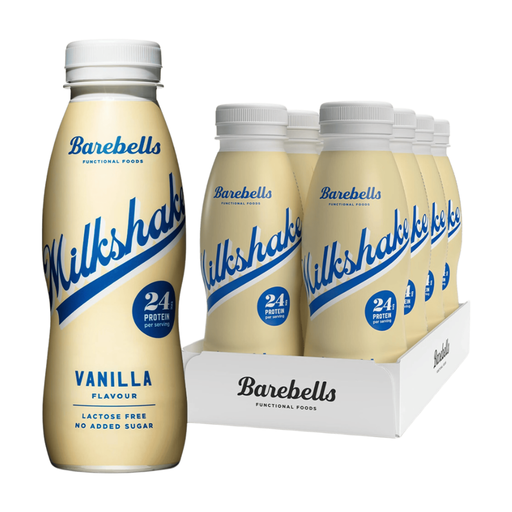 Image unavailable
Worth considering if you want individual milk drinks for after-training snacks. The multipack contains eight 330 ml bottles. It’s described as a ‘milkshake’, not a ‘drinking yoghurt’. Check the ingredients, allergens and storage instructions for the product being sold.
Don’t assume it’s a suitable substitute. The French Athletics Federation says that intestinal absorption during exercise is helped by isotonic or hypotonic solutions that are low in salt and not too sweet. It’s better to have drinking yoghurt with a meal or as a snack around your training, and to test your race-day nutrition during training.
It depends on the product and format. Yoplait says the small Yop products concerned can be kept out of the fridge for up to 8 hours, and its drinkable Skyr for up to 4 hours. Its large Yop bottles need to be kept chilled. Always check the instructions on the container you buy.
First compare the product description, net quantity, ingredients, allergens and nutritional values on the same basis, then check the serving sizes and storage instructions. The DGCCRF states that prepacked food labels include, among other things, ingredients, a nutrition declaration, net quantity and an applicable date.
No. A lactose-free product may still contain milk. HiPRO states ‘Contains: MILK’ for its vanilla UHT speciality, which is described as lactose-free. If you need to avoid milk, read the allergen information on the specific product’s packaging.