
Livraison le jour même ou le lendemain

Qualité garantie

Débloquez vos offres de bienvenue: Livraison GRATUITE | Jusqu'à -80 % | 30 jours d'essai gratuits à JoyPlus
Téléchargez l'application
Hanging a picture, organising your kitchen, or decorating for the holidays without reaching for a drill—it’s an appealing promise. Yet, the market for drill-free hooks is flooded with products that fail to deliver, leading to broken belongings and damaged walls. As the Head of Product Recommendations at Joybuy, my mission is to guide you through this jungle to find THE reliable drill-free mounting solution that’s perfectly suited for your project.
But before you get started, let's review the common pitfalls that too often turn a great idea into a total headache.
To avoid these disappointments, there are a few technical points to check. They will make all the difference in ensuring your hook lives up to its promises.
The maximum weight a hook can support is directly dependent on the wall it's mounted on. Don't just go by the weight printed on the packaging; always check for compatibility with your specific surface type.
A hook in a shower or on an front door isn't subjected to the same stresses as a hook in a bedroom.
A clean removal is just as crucial as the strength of the hold. The most reliable technologies use stretch-release tabs: by pulling the tab straight down, parallel to the wall, the adhesive comes off without leaving residue or damaging the surface. If the manufacturer is vague about the removal method, be wary.
We have selected solutions that meet specific needs, strictly applying our criteria for performance and reliability.
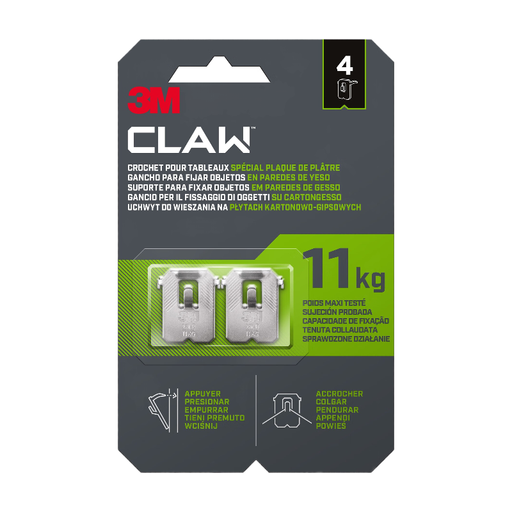
The use case: For hanging mirrors, frames, or pictures weighing up to 11 kg directly on drywall, without needing to find a stud.
This system bypasses the fantasy weight-rating trap. It's not an adhesive, but a hardened steel claw that anchors securely into drywall with just a push of your thumb. It provides a foolproof hold where traditional adhesives give up on heavy loads.
No tools are required—thumb pressure is all it takes. Its strength lies in its high weight capacity, specifically designed for drywall, a common wall type in modern homes.
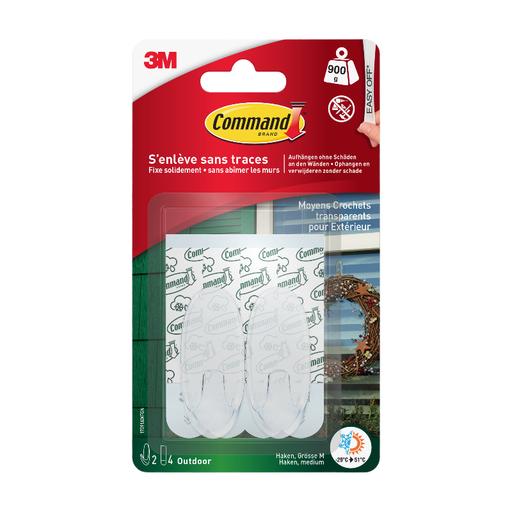
The use case: Perfect for hanging string lights, Christmas wreaths, and other seasonal decor on a window, PVC door, or any smooth outdoor surface, without worrying about the weather.
It solves the problem of adhesives that lose their grip when exposed to moisture and UV rays. Its adhesive is specially formulated to withstand rain, sun, and extreme temperatures (from -29°C to +51°C), ensuring a solid hold all year round.
Completely transparent, it's virtually invisible on glass surfaces. Its clean removal allows you to change your decor with the seasons without leaving a single trace behind.
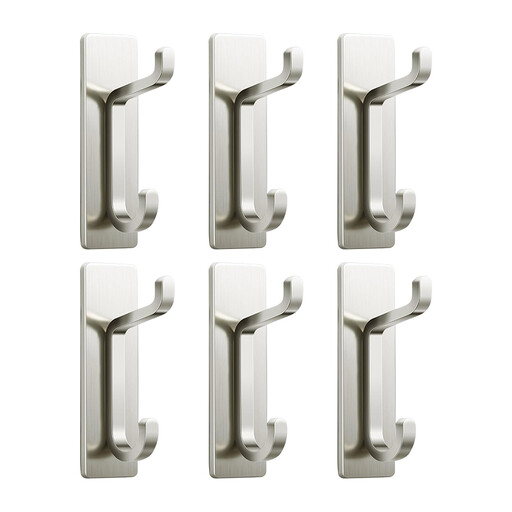
The use case: The versatile, budget-friendly solution for tidying up the kitchen, bathroom, or entryway. Perfect for hanging tea towels, utensils, towels, or keys on any smooth surface.
This product plays it straight: it's designed for smooth, non-porous surfaces (tile, glass, metal), where its adhesive performs best. No false promises on painted walls means no disappointment.
Excellent value for a pack of six. Its stainless steel construction guarantees good longevity and rust resistance, a major plus for wet areas.
Explore our complete and regularly updated selection of products that meet our selection criteria and safety standards.
It all depends on the technology. Hooks with adhesive strips (like those from the Command brand) are often reusable: you just need to buy the corresponding adhesive refill strips. However, for models with a non-replaceable integrated adhesive, reuse is generally impossible once the hook has been removed.
For models with a pull-tab, gently pull the tab straight down, parallel to the wall, until the hook releases. Never pull the tab towards you! For other adhesives, you can gently heat the base of the hook with a hairdryer to soften the glue. Then, carefully slide dental floss or a thin plastic spatula behind the hook to pry it off.
It is essential to respect the curing time indicated by the manufacturer. As a general rule, you should wait at least one hour after application before hanging anything. For some high-performance adhesives or in humid environments, this waiting period can be up to 24 hours. This is the time required for the adhesive to reach its maximum bonding strength.