People keeping an eye on the fat in their prepared soup
If you keep a quick soup in the cupboard, a value given for the soup after reconstitution helps you compare what you’ll actually serve, rather than the powder on its own.


To choose a dried soup while keeping an eye on fat, compare the nutritional values for soups as prepared, using the same basis – preferably per 100 ml. A value per 100 g of powder cannot be compared directly with one for a reconstituted bowl. Also check the salt, allergens and best-before date on the packet: fat content alone isn’t enough to determine whether a recipe suits your needs.
If you keep a quick soup in the cupboard, a value given for the soup after reconstitution helps you compare what you’ll actually serve, rather than the powder on its own.
If you’re comparing recipes for their fat content, check the salt separately too, taking account of the other foods you eat during the day.
Depending on the recipe, dried soup may contain ingredients such as wheat, milk or celery. The ingredients list and any ‘may contain’ warnings matter just as much as the nutritional values when making your choice.
For a cupboard staple, start with the fat content of the prepared soup, then check the salt and the ingredients in the recipe you’re considering.
| What to check | What to look for | Who it matters to |
|---|---|---|
| Fat in the bowl | Compare the fat content per 100 ml of prepared soup. If only the value for the powder is given, look for the value after preparation. | I want to know what’s in the soup once it’s served, without confusing the powder with the prepared bowl; around 50% of consumers make this their priority. |
| Salt | Compare the ‘salt’ line on the same basis and take the portion size into account. | I also keep an eye on the salt in my soup throughout the day; this comes first for around 30% of consumers. |
| Ingredients and allergens | Read the ingredients list, highlighted allergens and any ‘may contain’ warnings on the exact packet. | An ingredient or trace in my household could rule out a recipe, even if its fat content suits me; around 20% of consumers prioritise this check. |
These values describe the product with different amounts of water. The DGCCRF says nutritional values are given per 100 g or 100 ml to make comparisons easier, but you still need to compare like with like.
To compare two recipes, look for their values after preparation using the same unit, and follow the amount of water stated on each packet.
A soup called ‘vegetable soup’ or ‘velouté’ doesn’t reveal its fat content from the name alone. Carrefour’s listing for Knorr 9 Vegetables gives 20 g of fat per 100 g of dry product: you can’t compare this directly with a value per 100 ml of prepared soup.
Check the nutritional values and ingredients for the exact variant. If a Nutri-Score is shown, use it as additional information rather than a substitute for checking the label.
Ingredients and potential traces vary from one recipe to another. A fat content that works for your comparison tells you nothing about whether the soup meets a dietary restriction.
Check the packet again before buying, especially if the recipe or packaging has changed. The DGCCRF says that allergens present in the ingredients must be highlighted.
The range includes single-serve dried soups, including Chicken, Vermicelli and Carrot, and Tomato, Vermicelli and Chicken.
The brand offers dried soup varieties such as Noodles, Black Mushrooms and Spices.
The retailer sells dried soups under its own brands, with a range of recipes and pack sizes.
These Royco and Maggi packets are handy cupboard staples. To compare them by fat content, check the amount of water to add and the values for the prepared soup on each pack. Check salt and allergens separately.
 Image unavailable
The pack of three portions could be a good choice if you want to keep individual sachets in the cupboard.
Before choosing this recipe, check the nutritional values for the reconstituted soup, salt content and allergens on the packaging.
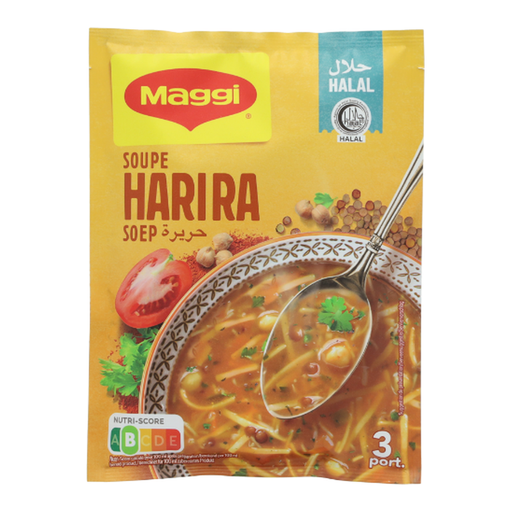 Image unavailable
This dried soup sachet could be a handy addition to your cupboard supplies.
Before comparing values per 100 ml, check the amount of water to use and the portion size stated on the packaging, then read the ingredients and allergen information.
 Image unavailable
This dried soup sachet is another recipe to consider for your cupboard.
Before comparing, check the preparation instructions and the basis used for the nutritional values on the packaging, as well as the ingredients and allergens.
Compare values for reconstituted soups given on the same basis, such as per 100 ml. A value per 100 g of powder won’t, on its own, let you compare that recipe with a soup whose values are for the prepared product.
No. The recipe name alone doesn’t tell you its fat content. Carrefour’s listing for Knorr 9 Vegetables gives 20 g of fat per 100 g of dry product. Check the values and ingredients for the exact variant, and don’t compare this dry-product value directly with one for prepared soup.
Yes. Salt and fat are separate pieces of information. Compare salt values on the same basis, and take account of how much soup you’ll have and what else you eat during the day.
Read the ingredients list and any ‘may contain’ warnings on the packet for the recipe you’ve chosen. The DGCCRF says that allergens present in the ingredients must be highlighted; a different recipe from the same brand may have a different composition.