People comparing energy content
You’re looking for a comparatively lower-calorie snack. The value per 100 g helps you compare products; the portion you eat then determines the energy content of your snack.


If you’re looking for a comparatively lower-calorie snack, first compare the energy values per 100 g, then consider how much you plan to eat. Two products listed by Carrefour show why: Reflets de France pitted prunes contain 250 kcal per 100 g, while Carrefour Bio’s raisin and nut mix provides 123 kcal per 25 g, or around 492 kcal per 100 g. This difference applies to these specific recipes, not to all prunes or all mixes.
You’re looking for a comparatively lower-calorie snack. The value per 100 g helps you compare products; the portion you eat then determines the energy content of your snack.
You prefer unsalted, unsweetened nuts without chocolate, such as almonds, walnuts or hazelnuts, as recommended by Manger Bouger. This preference for simple ingredients doesn’t mean you can skip comparing energy values if calories are your priority.
You want to choose a product and pack size before collection. Check the ingredients and pack weight, then confirm that the exact product is listed in your chosen store’s range.
When comparing dried fruit, nuts and mixes, start with the ingredients and nutritional information on each pack. Don’t assume that an entire category is lower in calories.
| What to consider | What to check | Who is it for? |
|---|---|---|
| Energy value and portion | Compare the kcal per 100 g, then consider how much you plan to eat. For the two products mentioned above, Carrefour lists 250 kcal per 100 g for Reflets de France prunes and 123 kcal per 25 g for Carrefour Bio mix. | If I want a comparatively lower-calorie snack, the words ‘dried fruit and nuts’ aren’t enough to help me choose. Around 50% of consumers put energy value and portion size at the heart of their choice. |
| Ingredients and allergens | Read the ingredients list for the exact product and check for allergens. Also compare the sugars and salt listed per 100 g. | If I prefer a simple recipe or need to avoid an ingredient, the mix’s ingredients matter just as much as its name. This is the main priority for around 30% of consumers. |
| Pack size and availability | Check the pack weight and whether the product is available for click and collect from your selected store. | When planning my shop, I want a pack size that suits how I plan to use it and a product stocked by my store. Availability and pack size come first for around 20% of consumers. |
Recipes can change the comparison. Carrefour Bio’s raisin and nut mix, listed at 123 kcal per 25 g, works out at around 492 kcal per 100 g. By comparison, the Reflets de France prunes featured by Carrefour contain 250 kcal per 100 g.
Compare both values using the same weight, then decide how much you’ll have. Don’t apply this difference to products with different recipes.
A product category name doesn’t tell you all the ingredients in a mix or its nutritional information. According to the DGCCRF, nutritional information is given per 100 g or 100 ml to make comparisons easier.
Open the listing for the product you’ve chosen and compare its ingredients with its energy value, sugars and salt.
The Carrefour Bio mix mentioned here contains walnuts, cashews, hazelnuts and almonds, among other ingredients. The DGCCRF states that allergenic ingredients must be highlighted on the label.
Check the allergens for the exact product when ordering, then check the pack you receive. The general description ‘dried fruit and nut mix’ doesn’t tell you what it contains.
These examples relate to specific products or ranges. Always check the label of the product you’re thinking of ordering.
Carrefour’s range includes an organic mix of raisins and nuts under this brand.
Carrefour sells pitted Agen prunes under this brand.
Seeberger almonds feature in the dried fruit and nut section listed by Monoprix.
Lidl France’s range includes nuts, dried fruit and snacks for aperitifs.
ALDI France sells raisins and unsalted shelled almonds under this brand.
This selection features pitted prunes to compare with other dried fruit and mixes you’re considering for a snack. Decide on your portion before comparing the energy content of your snack.
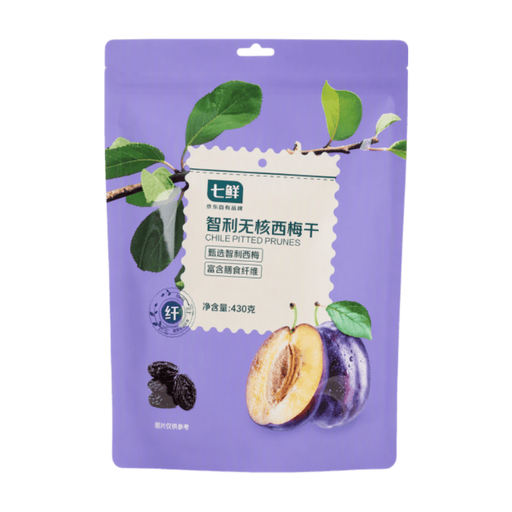 Image unavailable
Worth considering if you’d like to compare a simple dried fruit with a mix of dried fruit and nuts. The pack contains 430 g of pitted prunes. Decide how much you plan to eat rather than treating the whole pack as one portion.
No. Compare products by weight, then take the portion you eat into account. Carrefour lists 250 kcal per 100 g for its Reflets de France pitted prunes and 123 kcal per 25 g for its Carrefour Bio raisin and nut mix. These figures describe two specific products, not entire categories.
If you prefer unsalted, unsweetened nuts without chocolate, Manger Bouger recommends a small handful of walnuts, hazelnuts or almonds. If comparing energy content is your priority, check the kcal per 100 g and your portion for the specific products you’re interested in, whether they’re dried fruit or nuts.
Read the highlighted allergenic ingredients for the exact product, then check the label on the pack you receive. The DGCCRF reiterates this labelling requirement; a general name such as ‘dried fruit and nut mix’ doesn’t tell you which nuts it contains.
After selecting your store, check that the exact product is available, along with its weight and ingredients. The ranges listed by Auchan and Monoprix can give you some ideas, but you’ll need to check what’s available from your store to plan your collection.