You compare fat content first
You’re looking for dried fruit for a snack and want to compare values per 100 g, rather than relying on the term ‘dried fruit’, which can also be used to mean nuts.


If fat content is your main priority for a snack, start by comparing plain dried fruit: Carrefour lists 0 g per 100 g for its Carrefour Bio dried apricots and 0.8 g per 100 g for its Carrefour Original sultanas, compared with 7.5 g per 25 g for its Carrefour Bio nut mix. Also check the sugars, how much you plan to eat and any allergens. Manger Bouger points out that dried fruit is naturally high in sugars.
You’re looking for dried fruit for a snack and want to compare values per 100 g, rather than relying on the term ‘dried fruit’, which can also be used to mean nuts.
You specifically want walnuts, cashews or hazelnuts in your snack. Check the ingredients and portion size, rather than assuming the mix meets the same criteria as plain dried fruit.
Ingredients, ‘may contain’ warnings and the form of the nuts all matter when choosing. Whole nuts are a choking hazard for young children.
First, distinguish plain dried fruit from a mix with nuts. Then compare the nutritional values on the same basis and consider how much you plan to eat.
| Priority | What to check | Who is this for? |
|---|---|---|
| Fat | Compare fat per 100 g and check whether the recipe contains nuts. | For my snack, I’m looking first for dried fruit whose fat content I can compare with that of a mix. Around 46% of consumers put this criterion first. |
| Sugars and portion size | Check sugars and energy per 100 g, then consider how much you’ll eat. | Low fat content alone isn’t enough for me if I’m also keeping an eye on sugars and the size of my snack. This is the top priority for around 36% of consumers. |
| Ingredients and allergens | Check the ingredients, ‘may contain’ warnings and, for a young child, the form of any nuts. | If I’m buying for someone with allergies or for a young child, ingredients come before nutritional values. Around 18% of consumers make this their top criterion. |
Carrefour Bio’s mix contains walnuts, cashews, hazelnuts and almonds, among other ingredients. Its nutrition declaration lists 7.5 g of fat per 25 g. Carrefour Bio dried apricots contain 0 g per 100 g.
If fat content is your main priority, compare values for the same quantity and check the ingredients before you choose.
The coconut chips in the Carrefour range reviewed list 65 g of fat per 100 g. You can’t infer their fat content from that of another type of dried fruit.
If you’re comparing a coconut product with sultanas or dried apricots, check its nutrition declaration.
Manger Bouger points out that dried fruit is naturally high in sugars. So a low fat value doesn’t tell you, on its own, how much sugar or energy the product contains.
Compare all three values on the same basis, then consider how much you plan to have for your snack.
A mix may contain several types of nuts and carry ‘may contain’ warnings. Whole nuts are also a choking hazard for young children.
Check the ingredients and ‘may contain’ warnings on the pack you buy. Don’t serve whole nuts to a young child.
Two different products let you compare plain dried fruit with a mix containing nuts.
The sultana product gives you another type of dried fruit to compare for a snack.
The product reviewed is a mix of sultanas and nuts, not plain dried fruit.
Dried apricots to consider for a snack if you want to compare the fat content shown on the pack.
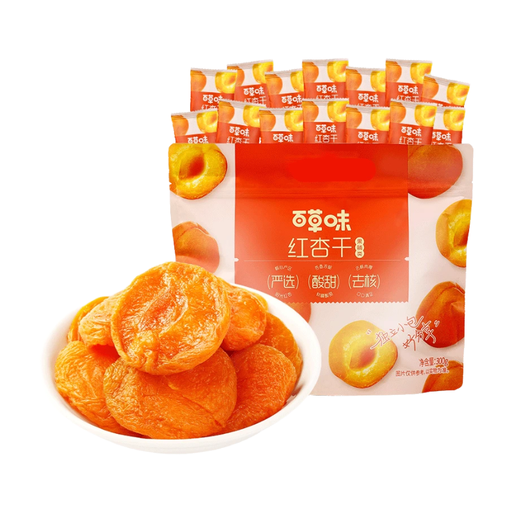 Image unavailable
A 300 g pack of dried red apricots for a dried-fruit snack. Before choosing, compare fat and sugars per 100 g, decide how much you’d like to eat and check the allergen information on the pack if needed.
No. Fat and sugars are two separate values. Compare them per 100 g, along with energy, then take the amount you’ll eat into account. Manger Bouger points out that dried fruit is naturally high in sugars.
Compare their values for the same quantity, but check their ingredients too. Carrefour lists 0 g of fat per 100 g for its Bio dried apricots, 0.8 g per 100 g for its Original sultanas and 7.5 g per 25 g for its Bio mix containing nuts.
Check the ingredients, highlighted allergens and ‘may contain’ warnings on the product you buy. The DGCCRF points out that allergenic ingredients must be highlighted on the label.
Avoid giving whole nuts to a young child because they’re a choking hazard. If you choose a product containing nuts, check its ingredients and allergen information too.