What should you check first?
‘Dried fruit’ can mean fruit such as raisins and apricots, or nuts such as almonds and walnuts. For a back-to-school snack, start with your main need, then check the nutrition information and ingredients list for the product you’ve chosen.
| What matters |
What to check |
Who is it for? |
| How much is actually eaten |
Compare the kcal per 100 g, then weigh or portion out what you’ll take with you. |
If I’m preparing a snack for a school bag, I want to know what’s in the amount set aside, not just compare the packets. Around 50% of consumers are said to put portion control at the top of their list of concerns. |
| Sugar and ingredients |
Check the ‘of which sugars’ figure per 100 g and look for any added ingredients in the list. |
When I choose dried fruit or a mix, sugar has more of a bearing on my choice than how easy it is to carry. For around 30% of consumers, sugar and ingredients are said to be the main concern. |
| Taking it along and precautions |
Check the pack size, salt, declared allergens and any age-related guidance for the child. |
For a snack to take along or share, I first look for a practical format without overlooking precautions around nuts. This is said to be the main priority for around 20% of consumers. |
Brands to compare for these products
The details below relate to the products mentioned, not each brand’s full range. They offer useful points of comparison when checking the labels of other products.
Carrefour Bio
Carrefour Bio’s soft dried apricots are an example of dried fruit whose product information lists organic dried apricots and water.
- Carrefour states that this product contains 232 kcal per 100 g.
- This is above the EU threshold of 40 kcal per 100 g for the ‘low energy’ claim on solid foods.
Auchan
The Auchan nature mix mentioned here combines hazelnuts, almonds, walnuts and cashew nuts.
- Its product information states 598 kcal per 100 g and 179 kcal per 30 g portion: two useful figures for comparing the product and preparing a portion.
- The per-portion figure only reflects what you’ll eat if you actually have 30 g.
Daco Bello
Daco Bello offers roasted almonds with no added salt or fat.
- This product lets you choose roasted almonds with no added salt.
- The brand states that they contain 629 kcal per 100 g: no added salt or fat doesn’t mean low energy content.
Maître Prunille
Maître Prunille offers dry-roasted almonds with no added fat or salt, as well as several pack sizes.
- The brand offers 250 g and 400 g packs, among others; its online shop also lists a 40 g pack.
- Before comparing calories or treating the 40 g pack as a portion, check the nutrition information on the pack you buy.
Dried fruit available on Joybuy
These two products are dried fruit options to consider if you’re preparing a portion before you leave. Compare their labels to find what suits your needs; their inclusion here doesn’t mean they carry a low energy claim.
 Image unavailable
Haoxiangni pitted red dates (Grade 2), 500 g
Worth considering if you’d like to prepare a portion of pitted dates in advance for a snack. The pack contains 500 g; set aside the amount you’ll take with you and check the kcal and sugars per 100 g on the label.
View on Joybuy
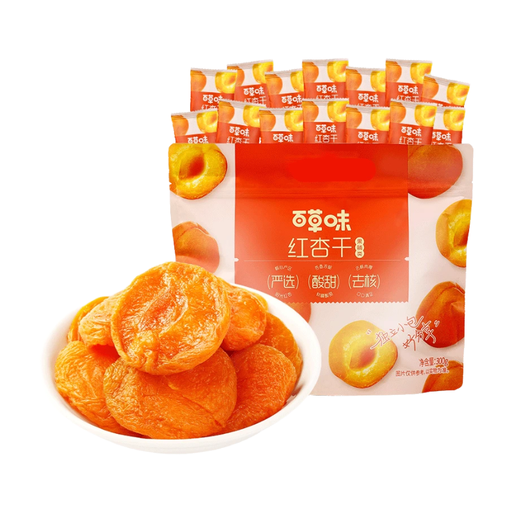 Image unavailable
Be&Cheery dried red apricots, 300 g
Worth considering if you prefer dried apricots that you can portion out before setting off. The pack contains 300 g; check the energy, sugar and salt per 100 g on the label before comparing this product with another.
View on Joybuy
Frequently asked questions
Can you choose ‘low-calorie’ dried fruit for back to school?
Don’t confuse a product with a lower energy content than another with the ‘low energy’ claim. EU nutrition claims regulations limit this claim to solid foods containing no more than 40 kcal per 100 g; Carrefour’s soft dried apricots, for example, contain 232 kcal per 100 g. To choose, compare products per 100 g and prepare a portion that’s suitable for what you plan to take with you.
Should you compare kcal per 100 g or per portion?
Use both figures for different reasons: kcal per 100 g lets you compare products on the same basis, while the portion figure relates to the amount you plan to eat. The DGCCRF points out that nutrition information is given per 100 g or 100 ml to make comparisons easier. If you’re preparing the snack yourself, check its weight.
Can dried fruit automatically replace fresh fruit in a school bag?
No. Manger Bouger says dried fruit is naturally high in sugar and can be eaten occasionally. When choosing a snack, bear this difference in mind rather than treating fresh and dried fruit as interchangeable portions.
What should you do if the snack contains nuts?
Check the allergens listed on every pack, especially if the snack is going to be shared. Avoid whole nuts for young children because of the choking risk, and choose a texture that’s suitable for their age.
How can you spot allergens in a prepacked product?
Read the ingredients list and check for any ‘may contain traces’ statements. The DGCCRF explains that allergenic ingredients must be highlighted on the label, so check the packaging of the product you buy, even if you already know the brand.


