Sporty shoppers who put fat content first
If fat content is your main consideration when choosing a snack, compare the nutrition information per 100 g rather than relying on the broad label ‘dried fruit’.


If you want to keep fat content down in a post-exercise snack, start by comparing plain dried fruit. The dried apricots listed by Carrefour and Monoprix contain 0.5 g of fat per 100 g. However, this figure alone tells you nothing about the ingredients or protein content. If you have another session coming up soon, also consider including a source of protein in your diet to support recovery.
If fat content is your main consideration when choosing a snack, compare the nutrition information per 100 g rather than relying on the broad label ‘dried fruit’.
Dried fruit can be part of a snack that provides carbohydrates. A review of recovery after endurance exercise, referenced by the National Library of Medicine, also highlights the benefits of combining carbohydrates and protein when the aim is to optimise recovery.
If you want to tell plain dried fruit apart from a mix, check the ingredients and allergen information. The examples listed by Auchan and Monoprix show that some mixes also contain syrup, sugar, oil or salt.
First, separate dried fruit from nuts and mixes, then compare the nutrition information and ingredients for the product you’re considering.
| Criteria | What to check | Who it matters to |
|---|---|---|
| Fat | Compare the ‘fat’ figure per 100 g for products in the same category. The dried apricots mentioned by Carrefour and Monoprix contain 0.5 g per 100 g. | If fat is the deciding factor for my snack, I want to distinguish plain dried fruit from a mix containing nuts. Around 36% of shoppers would put this first. |
| Carbohydrates and protein | Check both figures per 100 g: the Seeberger dried apricots listed by Monoprix contain 55 g of carbohydrates and 4.8 g of protein. | If I have another session coming up soon, I want to see how dried fruit fits into a snack that isn’t based on carbohydrates alone. This would be the top priority for around 29% of shoppers. |
| Ingredients | Read the full list: some ingredients in the Holyfruits mix listed by Auchan contain glucose syrup or cane sugar, while a Monoprix mix contains oil and salt. | If I choose a mix for its variety, I want to know what else it contains besides fruit. Around 21% of shoppers would put simple ingredients first. |
| Allergens | Check the information on the specific pack: the ingredients for ECO+ dried apricots published by E.Leclerc list sulphites, while the Monoprix mix mentioned contains several types of nuts. | If certain ingredients aren’t suitable for me, I need to be able to identify them before buying. Checking allergens would be the main concern for around 14% of shoppers. |
This term can refer to either dried fruit or nuts. Manger Bouger describes nuts as high in fat, so the two categories don’t meet the same needs if you’re trying to limit fat.
First identify the category, then compare the nutrition information for the products you’re considering.
Some of the products listed by Auchan and Monoprix contain syrup, sugar, oil or salt. Seeing fruit in the mix doesn’t tell you everything about its ingredients.
Check the ingredients and nutrition information per 100 g before comparing a mix with plain dried fruit.
The Seeberger dried apricots listed by Monoprix contain 55 g of carbohydrates and 4.8 g of protein per 100 g. For athletes looking to optimise recovery after endurance exercise, the review referenced by the National Library of Medicine considers a strategy that combines carbohydrates and protein.
If your sessions are demanding or close together, consider including a source of protein elsewhere in your snack or meal.
The ingredients for ECO+ dried apricots published by E.Leclerc mention sulphites; the Monoprix mix cited contains pecans, macadamia nuts and cashews, among other ingredients. A familiar product name is no substitute for checking the specific pack.
Check the ingredients and allergen information every time you buy, especially if you’re switching brands or moving from a single fruit to a mix.
These examples relate to specific products; their ingredients don’t represent everything sold by each retailer.
Carrefour’s product listing for Brousse & Fils dried apricots lets you look at a dried fruit product rather than a mix.
The product listing for ECO+ dried apricots provides an example of ingredients to compare with those of other dried fruit.
The Holyfruits mix listed by Auchan shows why it’s important to check the ingredients of each item in a mix.
The Monoprix product listings mentioned let you compare Seeberger dried apricots with a mix of nuts and apricots.
An ALDI listing features soft apricots, a category to distinguish from mixes of fruit and nuts.
These products are pitted red dates and dried apricots to consider as post-exercise dried fruit. Compare their nutrition information per 100 g and their ingredients before choosing to suit your priorities.
 Image unavailable
Worth considering if you prefer pitted red dates to a mix of fruit and nuts. The pack is 280 g; check its nutrition information for fat, carbohydrates, sugars and protein per 100 g.
 Image unavailable
This 500 g pack may appeal if you’re looking for pitted red dates. To choose between it and the 280 g Haoxiangni pack, compare their respective labels rather than assuming they have the same ingredients or nutrition information.
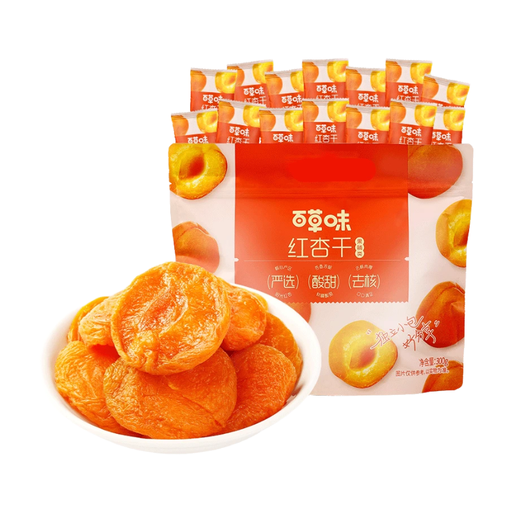 Image unavailable
This 300 g pack is worth comparing with other dried apricots if that’s the fruit you’d like to take with you after exercise. Check the fat, sugars, salt and allergens on the pack: figures for another brand of apricots won’t necessarily apply to this one.
Not for every recovery situation. The Seeberger dried apricots listed by Monoprix contain 55 g of carbohydrates and 4.8 g of protein per 100 g. A review of recovery after endurance exercise, referenced by the National Library of Medicine, supports a strategy combining carbohydrates and protein when the aim is to optimise recovery.
First, distinguish dried fruit from nuts, then compare the ‘fat’ figure per 100 g for similar products. The dried apricots mentioned by Carrefour and Monoprix contain 0.5 g per 100 g, while Manger Bouger describes nuts as high in fat.
Read the full ingredients list and allergen information for the product you’re considering. Some ingredients in the Holyfruits mix listed by Auchan contain glucose syrup or cane sugar; the Monoprix Gourmet mix mentioned contains several types of nuts, oil and salt.
Follow the storage instructions on the pack you’ve bought. In particular, check whether you need to reseal it and what storage conditions are recommended for that product.