If calories per 100 g are your main priority, start by comparing plain dried fruit: a Carrefour product listing shows 232 kcal per 100 g for soft dried apricots, while a Monoprix listing shows 629 kcal per 100 g for unsalted roasted almonds. These figures apply to specific products, not every recipe in each category. Before stocking up on several bags, check the sugars, ingredients and the amount you plan to eat. Unsalted nuts are a different choice: they’re intended to be enjoyed by the small handful.
Who are these options for?
People who compare calories first
If you’re stocking up on snacks, you’ll want to compare the values per 100 g rather than relying on the name of the fruit or the size of the bag. Carrefour listings show 232 kcal per 100 g for soft dried apricots and 250 kcal per 100 g for pitted Agen prunes; a Monoprix listing shows 629 kcal per 100 g for unsalted roasted almonds. Each figure applies to the specific product listed.
People who prefer nuts
You’re looking for almonds, walnuts or other unsalted nuts to enjoy by the small handful, without assuming they’re low in calories per 100 g. Manger Bouger recommends a small handful of unsalted, unsweetened nuts with no chocolate.
People buying several large bags
You want to shop less often, but the pack size needs to suit your portions and storage options. Before choosing several bags, compare the nutritional information, ingredients, allergens and storage instructions on each pack.
What should you compare before buying?
When stocking up on snacks, start with the factor that matters most to you, then check the other details on the packaging of the product you choose.
| What to compare |
What to check |
Who is this for? |
| Calories for the same weight |
Compare kcal per 100 g, then consider how much you plan to have in each snack. |
I want to compare products in different pack sizes before stocking up. Around 42% of consumers rank calories per 100 g as their main concern. |
| Sugars and ingredients |
Check the ‘of which sugars’ figure per 100 g and the full ingredients list, including any added ingredients. |
If a recipe includes a coating or other ingredients, I want to be able to distinguish it from plain dried fruit. Around 25% of consumers prioritise checking sugar and ingredients. |
| Portions and storage |
Check the net weight and storage instructions, then plan how you’ll divide up the contents after opening. |
A large bag appeals to me if I can prepare the portions I plan to eat and store the rest as instructed. For around 17% of consumers, managing portions and supplies is the main priority. |
| Unsalted nuts |
Check the salt information, ingredients and allergens; compare the kcal per 100 g too. |
I prefer a small handful of unsalted nuts, even if I’m not choosing the option with the fewest calories for the same weight. Around 16% of consumers put this preference first. |
Calories and sugars answer two different questions. Manger Bouger points out that dried fruit, including dates, raisins and dried apricots, naturally contains a lot of sugar and can be eaten occasionally. When comparing two products, the nutrition information per 100 g gives you a common basis; the ingredients and the portion you plan to eat complete the picture.
What should you watch out for when buying large bags?
-
Assuming ‘unsalted’ means low in calories
Whether a product contains salt tells you nothing about its energy value. Monoprix’s listing for Daco Bello unsalted roasted almonds shows 629 kcal per 100 g.
Treat salt and calories as two separate factors, then check the portion you plan to prepare.
-
Overlooking sugars and added ingredients in dried fruit
Dried fruit already contains naturally occurring sugars. Manger Bouger notes that this is particularly true of dates, raisins and dried apricots; the recipe may also contain other ingredients.
Check the ‘of which sugars’ figure and the ingredients list for each product. A lower calorie figure isn’t enough to tell you what’s in it.
-
Choosing the largest pack without planning how you’ll use it
A large bag is only practical if the quantity suits your snacks or recipes and you can follow the storage instructions after opening.
Check the net weight, prepare the portions you’ll use and follow the instructions on the pack you buy.
A bag left open or containing more than you need can lead to waste or larger portions than you intended.
-
Overlooking allergens in a mix
The ingredients can vary from one mix to another, even when product names look similar. The DGCCRF states that allergenic ingredients must be highlighted in the ingredients list on prepacked foods.
Check the ingredients and allergen information on every new pack.
Which retailers should you look at?
These retailers offer products or categories worth comparing. The details mentioned apply to the products listed, not their entire ranges.
Carrefour
Its dried apricot and prune listings make it easy to compare two specific dried fruits.
- The listing for Carrefour Bio soft dried apricots gives the ingredients as ‘organic dried apricots, water’ and shows 232 kcal per 100 g; the listing for Reflets de France pitted Agen prunes shows 250 kcal per 100 g.
- These figures don’t automatically apply to other recipes or pack sizes.
E.Leclerc
The Tokapi range includes nuts with different recipes and pack sizes.
- The E.Leclerc category includes, among other products, 500 g bags of salted roasted peanuts, 400 g bags of salted roasted cashews and 200 g bags of almonds with no added salt.
- A large bag alone tells you nothing about the salt or calorie content.
Auchan
Its categories include nuts and dried fruit in a range of pack sizes.
- Auchan lists, among other products, 400 g bags of roasted almonds with no added salt, 500 g bags of soft pitted apricots and 500 g bags of pitted Agen prunes.
- Compare the labels on the products you choose: the category and pack size alone don’t tell you their energy value.
Lidl
Lidl describes Alesto as a range of nuts, dried fruit and savoury snacks.
- The variety makes it easier to distinguish dried fruit from nuts and savoury recipes when choosing.
- Check the nutrition information and ingredients of the product you’re considering instead of assuming its characteristics from the range name.
Aldi
An Aldi listing features TRADER JOE'S raisins in a 250 g bag.
- This pack size offers a useful comparison if you’re deciding between several smaller bags and a larger one.
- This product listing alone doesn’t prove that raisins are lower in calories than the other dried fruit you’re considering.
Monoprix
Its nuts category includes almonds and cashews, among other products.
- The listing for Daco Bello unsalted roasted almonds shows 629 kcal per 100 g, a useful reminder that salt and calories are separate factors.
- This figure applies to the Daco Bello almonds in the listing, not to all the nuts sold by the retailer.
Prunes and dates to compare on Joybuy
These prunes and dried dates give you the chance to compare bags weighing several hundred grams with an individual portion. If you’re buying in bulk, check the values per 100 g, the ingredients and the size of each bag before deciding how many to buy.
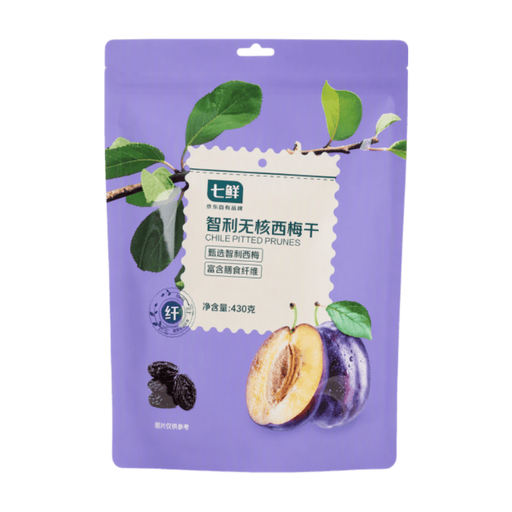 Image unavailable
7FRESH pitted prunes 430 g
A 430 g bag to consider if you want to prepare several portions of prunes. The listing gives dried plums as the only ingredient and shows 283 kcal and 24,5 g of sugars per 100 g. It recommends storing the product in a cool, dry place and eating it soon after opening. For a comparison between specific products, the Carrefour listing for pitted Agen prunes shows 250 kcal per 100 g.
View on Joybuy
 Image unavailable
Haoxiangni Grade 2 pitted red dates 500 g
This 500 g pack is useful for comparing larger bags of dried fruit. The listing states that it contains 100% dates and shows 300 kcal and 60 g of sugars per 100 g. It advises resealing the bag and storing it in a cool, dry place. If sugar is your main priority, check this figure on the label before deciding how much to buy.
View on Joybuy
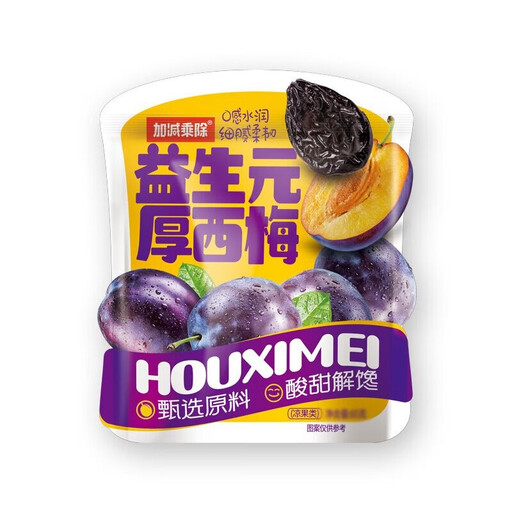 Image unavailable
Jia Jian Cheng Chu thickened prunes 65 g
This 65 g bag is more suited to an individual portion than a large pack. The listing shows 214 kcal and 41,3 g of sugars per 100 g, and includes fructose syrup among the ingredients. So the calorie figure doesn’t replace checking the ingredients, particularly if you’re planning to buy several bags.
View on Joybuy
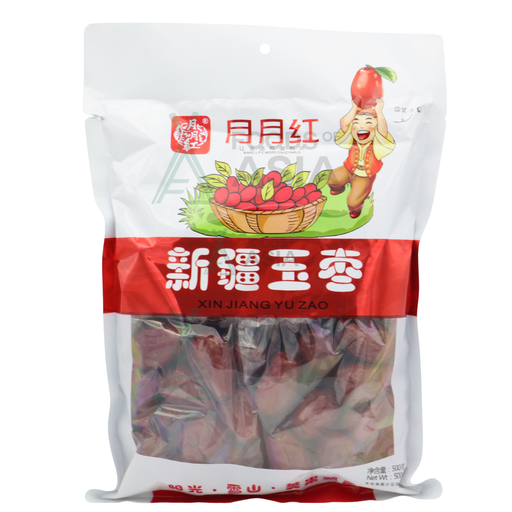 Image unavailable
YYH dried Xinjiang jujube dates 500 g
This resealable 500 g bag may suit you if you plan to use jujube dates as a snack or in cooking. The listing states that it contains 100% jujube dates and shows 307 kcal and 56 g of sugars per 100 g. If you compare calories first, weigh this figure against those of the other products you’re interested in, then follow the storage instructions on the bag.
View on Joybuy
Frequently asked questions
Which dried fruit should I compare if calories are my main concern?
Start with the kcal per 100 g for each product you’re considering, rather than looking only at the name of the fruit. Carrefour listings show 232 kcal per 100 g for soft dried apricots and 250 kcal per 100 g for pitted Agen prunes, compared with 629 kcal per 100 g for unsalted roasted almonds on a Monoprix listing. Another recipe may have a different value, so always check the label.
Is dried fruit with fewer calories always suitable for every snack?
No. The energy value doesn’t tell you about the sugars or how much you’ll eat. Manger Bouger says that dates, raisins and dried apricots naturally contain a lot of sugar and can be eaten occasionally. Check the ‘of which sugars’ figure, the ingredients and the portion you plan to have.
How do I compare two large bags of dried fruit?
Compare their nutrition information per 100 g, then check the ingredients, net weight and storage instructions. The DGCCRF states that nutrition information for prepacked foods is given per 100 g or 100 ml to make comparisons easier. For dried fruit, use the values per 100 g and take the portion you plan to serve into account.
Where can I check the allergens in a mix?
Check the ingredients list and any other allergen information on the packaging of the mix you choose. For prepacked foods, the DGCCRF states that allergenic ingredients must be highlighted in the ingredients list. Check again whenever you switch to a different product.


