
Livraison le jour même ou le lendemain

Qualité garantie

Débloquez vos offres de bienvenue: Livraison GRATUITE | Jusqu'à -80 % | 30 jours d'essai gratuits à JoyPlus
Téléchargez l'application
Whether you're an artist sketching out your next masterpiece, a student taking class notes, or a dedicated journaling enthusiast, the quality of your drawing supplies can transform your creative experience. However, the market is saturated with products that make enticing marketing promises but often fail to deliver. A beautifully designed notebook might prove unusable, and overpriced markers can give out after just a few days.
This guide is designed to help you navigate this jungle and identify the features that truly matter for a smart purchase. Together, we'll break down the common pitfalls and arm you with the right information to choose reliable tools perfectly suited to your needs.
Before you check out, it's best to know the most common disappointments so you don't throw your money away.
To avoid these traps, focus on a few objective technical specifications. They are the true arbiters of a product's quality, far beyond any marketing slogans.
Paper weight, expressed in grams per square metre (g/m?), determines the paper's thickness and opacity. For versatile use, especially with gel ink pens or fine-tip markers, a weight of 100 g/m? is an excellent starting point. An A6 notebook with this type of paper ensures you can write on both the front and back without fear of ink bleeding through. For watercolour or alcohol markers, you'll need to look for much higher weights (above 180 g/m?).
Not all inks are created equal. For creative stationery and journaling supplies, prioritise pigment-based inks. They are generally permanent once dry and light-resistant, which guarantees the longevity of your creations.
For professional drawing pencils, the hardness grading (from 10H, very hard, to 12B, very soft) must be reliable. A quality set will offer predictable consistency across the entire range. For a metal mechanical pencil, beyond its appearance, make sure the lead advancement mechanism is precise and smooth. A well-balanced body is also a significant plus for comfort and line control.
Here are a few products that tick all the boxes, designed for different user profiles.

The ideal user: Perfect for those who need a reliable everyday notebook. Its A6 size is ultra-portable, and its integrated extras (pen loop, elastic band, bookmark) make it a remarkably effective companion for work or journaling.
It directly beats the trap of poor-quality paper. Its paper of 100 g/m? is thick enough to handle most inks without bleed-through, making every page fully usable.
Thick, smooth paper; durable PU hardcover; multiple colours to suit any style.
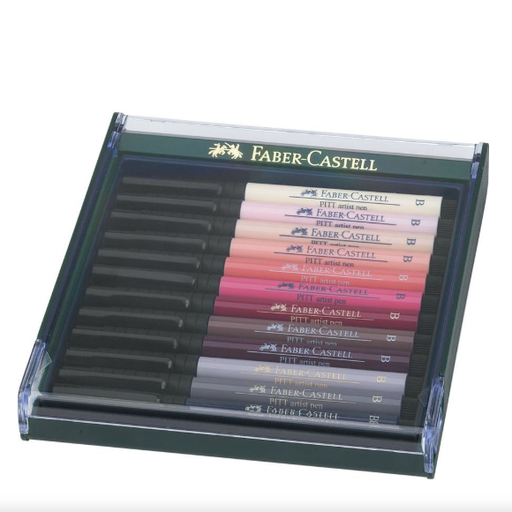
The ideal user: Perfect for illustrators, portrait artists, and lettering fans who demand absolute reliability from their tools. The quality of the ink and tip makes them a top choice for creating long-lasting artwork.
These pens beat the trap of fraying tips. The fibre brush tip is designed to be both flexible and resilient, retaining its shape even after heavy use and ensuring consistent line control.
Archival-quality pigmented ink (permanent and light-resistant); resilient brush tip; odourless, pH-neutral ink.
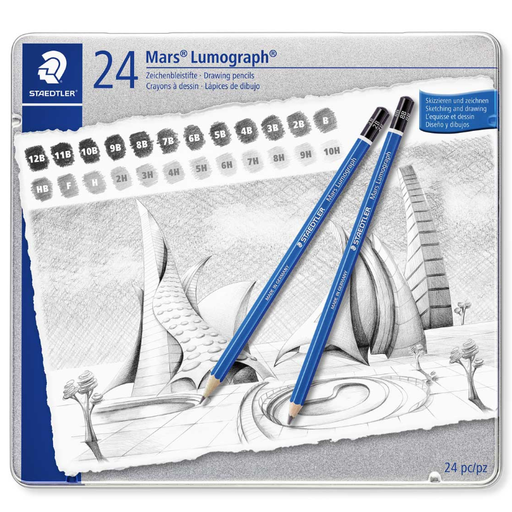
The ideal user: A complete set for art students, architects, and drafters who need a wide range of hardness grades for their sketches, diagrams, and rendering work. A trusted choice, renowned for its reliability and impeccable quality.
This set avoids the inconsistency of low-end pencils. Each hardness grade, from 12B to 10H, is precise, and the lead is known for its high break-resistance, which limits breakage (and waste) when sharpening.
Complete range of 24 hardness grades; high-quality graphite for smooth, consistent lines; highly break-resistant lead.
We have compiled a complete selection of products that meet our strictest quality criteria.
Q1: What paper weight should I choose to prevent ink from bleeding through? For everyday use with ink pens (gel, fine-tip marker), 100 g/m? paper is an excellent baseline. It significantly reduces the risk of show-through (ghosting) and bleed-through (bleeding). If you use alcohol markers or watercolour, it's essential to choose specialised papers of at least 180 g/m? to 300 g/m?.
Q2: How do I care for my brush pens to make them last longer? The golden rule: always recap them tightly after use to prevent the tip from drying out. It's also recommended to store them horizontally to ensure even ink distribution. Finally, avoid pressing too hard on the tip to prevent premature damage.
Q3: Is a metal mechanical pencil really more durable than a plastic one? Generally, yes, provided the quality is there. A metal body offers better impact resistance and a more pleasant grip thanks to its weight. However, true durability lies in the internal mechanism. A metal mechanical pencil with a quality mechanism will be a long-term investment, whereas a low-end model, even if made of metal, will prove just as disappointing.