
Livraison le jour même ou le lendemain

Qualité garantie

Débloquez vos offres de bienvenue: Livraison GRATUITE | Jusqu'à -80 % | 30 jours d'essai gratuits à JoyPlus
Téléchargez l'application
Whether you're an artist deep in the creative process, a student annotating lecture notes, or a bullet journal enthusiast starting a new page, the right tools make all the difference. Faced with an overwhelming selection of drawing pens, finding the right one can quickly become a puzzle: fine tip or brush? Water-based or permanent ink?
As a Product Recommendation Manager at Joybuy, my mission is to help you see things more clearly. This guide offers our best advice and a selection of products to help you find the pens that will bring all your creative projects to life.
Before diving into our selection, let's review the key points that will help you find the perfect pen for your needs.
It's the pen's tip that gives your lines their unique character. There are two main families:
The ink's composition plays a crucial role in the final result and how you use your pens.
A set is often the most cost-effective and practical solution for getting started or for having a wide range of colours and tip sizes on hand. Buying individually, on the other hand, is perfect for replacing a favourite shade or simply testing a model before splurging on the full set.
Here is a selection of products that stand out for their performance and suitability for various creative uses.
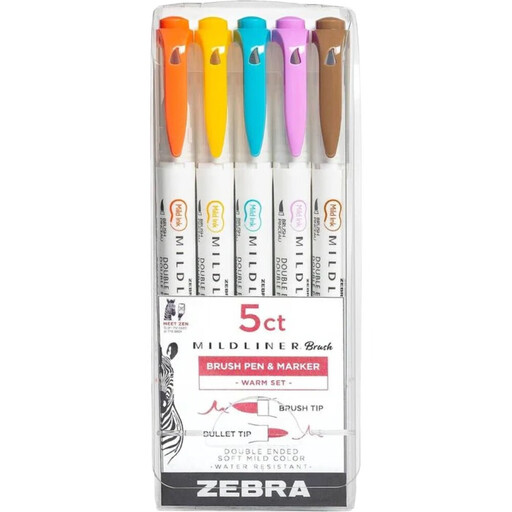
Why we love it: This set ticks all the right boxes: it combines the famous pastel colours of Mildliners with the versatility of a dual tip. On one side, a soft brush for creativity; on the other, a fine tip for precision.
Advantages:
Who is it for?: Ideal for fans of bullet journal pens, students who want to organise their notes with harmonious colours, and creative lettering enthusiasts.
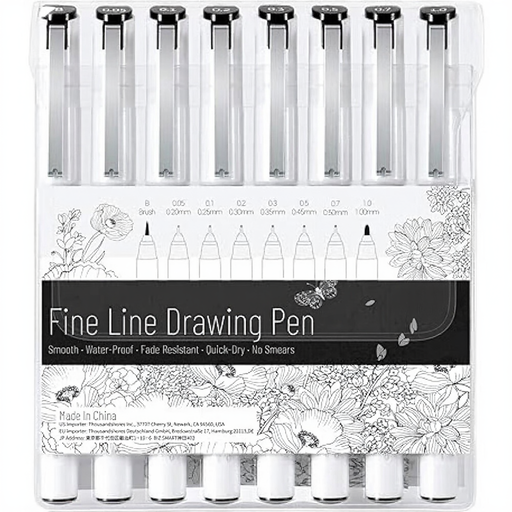
Why we love it: This set is the ideal toolkit for line drawing. It contains 7 fine-tipped pens in various sizes (from 0.05mm to 1.0mm) and one brush tip pen, all with permanent black ink.
Advantages:
Who is it for?: Illustrators, technical artists, architects, and anyone who demands a crisp, clean, and lasting black line.
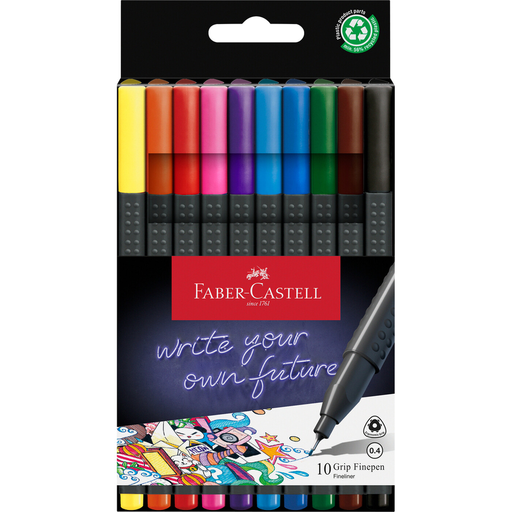
Why we love it: Faber-Castell needs no introduction, being an absolute benchmark in fine art supplies. This set of fineliners stands out with its ergonomic "Grip" zone and its metal-encased 0.4mm fine tip.
Advantages:
Who is it for?: Students, professionals, and creative hobbyists looking for a fine drawing pen that combines comfort, precision, and colour.
Does our selection not cover all your needs? Want to explore other brands, colours, or tip types? Take a look at our complete collection.
A fineliner has a hard, calibrated tip for a consistent line width. It's perfect for writing, outlines, and details. A brush tip pen has a flexible tip that responds to the pressure you apply: press lightly for a thin line, harder for a thick line. It's mainly used for calligraphy, colouring, and dynamic illustrations.
To prevent ink from bleeding through, the secret is the paper itself! Opt for a paper weight of at least 100 g/m?. The best practice: always test your pens on a scrap piece of the same paper before you begin. Water-based inks, like those in the Zebra Mildliners, are generally designed not to bleed through standard papers (like office or notebook paper).
Yes, absolutely. Brush tip pens have even become a staple in modern calligraphy supplies. Their flexibility is perfect for creating the characteristic thick downstrokes and thin upstrokes of many styles. As for fineliners, they are perfect for "faux calligraphy," a technique that mimics the appearance of calligraphy through drawing.