
Livraison le jour même ou le lendemain

Qualité garantie

Débloquez vos offres de bienvenue: Livraison GRATUITE | Jusqu'à -80 % | 30 jours d'essai gratuits à JoyPlus
Téléchargez l'application
Whether you're a budding artist, an adult colouring enthusiast, a parent searching for quality supplies, or a professional polishing a presentation, choosing the right drawing marker can quickly become a headache. Between the flashy packaging and marketing jargon, disappointment is often the end result. As the Head of Product Recommendations at Joybuy, my mission is to help you see things more clearly. Let's break down the pitfalls to avoid and the criteria that truly matter for finding the perfect marker set for your projects.
Investing in a marker set only to find it unusable after a few weeks is a frustration we all know. Here are the most common flaws that should be red flags.
To avoid these traps, you just need to look for a few objective technical features. These are the true indicators of a marker's quality and its suitability for your needs.
The tip is the core component. Your choice will depend entirely on your project.
The ink determines not only the vibrancy of the colours but also their behaviour on paper and their longevity.
A good marker is an investment. To make it worthwhile, some brands have developed impressive anti-drying technologies, allowing a marker to be left uncapped for several hours (or even days!) without drying out. Don't overlook ergonomics either: a triangular barrel, for example, ensures a better grip and welcome comfort during long adult colouring or drawing sessions.
To guide you, here are a few options that meet specific needs, based on the quality criteria we've just discussed.
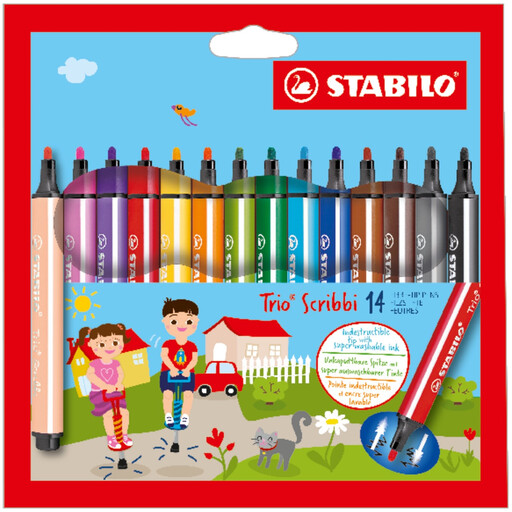
Why we chose it: Designed for the youngest artists, this set checks the two essential boxes for parents: durability and cleanliness. Its triangular shape is perfect for small hands and helps develop fine motor skills.
Its spring-loaded tip absorbs pressure without ever flattening, sidestepping pitfall #2. The ink, designed like that of a washable marker, eliminates the stress of stains on skin or clothing.
Nearly indestructible cushioned tip. "Super-washable" ink for stress-free creativity. Ergonomic triangular barrel.
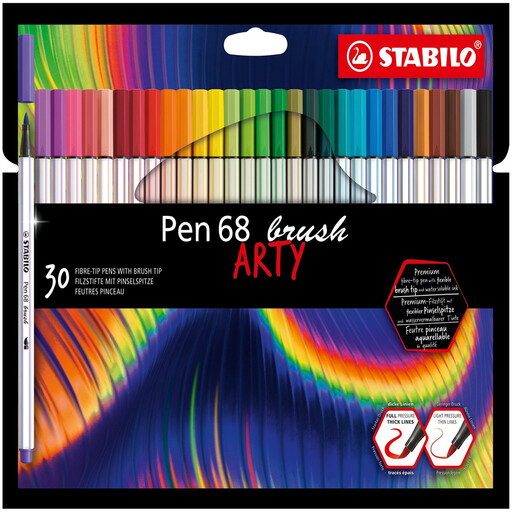
Why we chose it: For arts and crafts enthusiasts, versatility is key. This set combines the legendary quality of the Pen 68 with a flexible brush tip, opening up a world of possibilities for lettering, illustration, and decorating notebooks.
The brush tip is designed to vary line thickness without ever fraying. Its water-based, water-soluble ink allows you to create gradients and blend colours, avoiding the trap of flat, incompatible shades.
Ultra-versatile brush tip. Water-soluble ink for artistic effects. Up to 24-hour anti-dry-out technology.
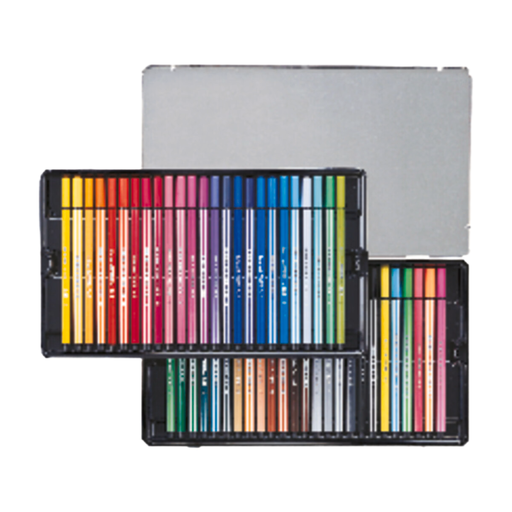
Why we chose it: For an artist or illustrator, nothing beats a rich, reliable, and well-organised colour palette. This metal case contains 50 Pen 68 markers—the gold standard for tip robustness and colour intensity—all in a case that protects your investment.
The 1 mm bullet tip, true to its reputation, is built to last without losing its shape. The 24-hour anti-dry-out technology puts an end to waste, while the metal box provides optimal protection, even on the go.
Vast palette of 50 intense colours. Robust and durable tip. Metal storage box for protection and organisation.
We've curated a complete selection of products that meet our quality criteria and current standards.
The golden rule: always replace the cap until you hear that satisfying "click." Store your markers horizontally so the ink is distributed evenly in the nib. For valuable sets, keep them away from heat and direct sunlight. A rescue tip: if a water-based tip seems dry, briefly dipping it in a drop of water can sometimes work wonders.
The water-based marker is the most versatile: often odourless, it's perfect for standard paper, and its ink can be diluted to create watercolour effects. The alcohol-based marker, typical of professional-grade supplies, dries at lightning speed. It allows you to layer colours without damaging the paper and offers vibrant shades, but it will bleed through standard paper and has a distinctive smell.
Absolutely, as long as you use markers with water-soluble ink (i.e., water-based). The technique is simple: apply the colour to a fairly thick paper (like watercolour paper), then use a slightly damp brush to dilute and spread the pigment. Another method: apply ink to a non-porous surface (a plastic palette, a ceramic tile, etc.) and pick it up with a wet brush, just as you would with pan paints.