
Livraison le jour même ou le lendemain

Qualité garantie

Débloquez vos offres de bienvenue: Livraison GRATUITE | Jusqu'à -80 % | 30 jours d'essai gratuits à JoyPlus
Téléchargez l'application
Whether you're a seasoned illustrator, a DIY enthusiast, or an art student, the right drawing marker can literally transform your creations. Fine tips or brush tips, water-based or alcohol-based inks, infinite colour palettes… Faced with an overwhelming selection, it's hard to know where to start. This guide aims to cut through the noise and help you choose the perfect tools for your projects, without the marketing jargon.
As product experts, our mission is to break down the features of each model so you can make the right choice with complete confidence.
Before diving into our selection, let's review the essential criteria for finding the perfect fit.
The tip is what sets the tone and precision of your linework. The most common options are:
The ink is the heart of the marker: it determines the colour, opacity, and how your markers will interact with the paper.
A portrait illustrator won't have the same needs as a bullet journal fan. Carefully evaluate the colour palette on offer. A set of blacks and greys is essential for inking and shading, while a drawing kit with a hundred colours will unleash your creative freedom for illustration.
Let's get down to business with our selection of markers that caught our eye for their versatility and performance.
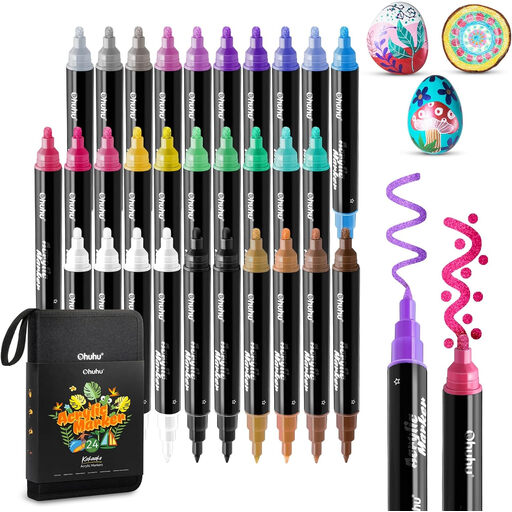
Why it stands out: This set combines the convenience of a marker with the finish of acrylic paint. Its key strength? Unbeatable versatility: it works on almost any surface, from paper and wood to ceramic and fabric. The palette includes 24 shimmering metallic colours, ideal for adding a touch of sparkle to your creations.
Key features:
Who is it for?: Creatives and DIY enthusiasts who love to customise objects, paint on various surfaces, or add metallic effects to their illustrations.
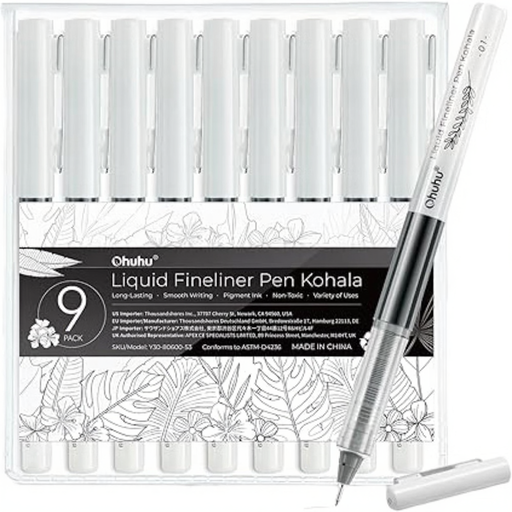
What makes it special: This set of 9 fineliner pens is an essential for any artist's toolkit. It stands out for its generous ink supply (advertised as 1.5 times more than average) and its high-quality pigment ink. This ink is resistant to water and alcohol, allowing you to colour your drawings (with alcohol markers or watercolour) without the risk of the outlines smudging.
Key features:
Who is it for?: Illustrators, architects, comic book artists, and bullet journal fans looking for precise, crisp, and long-lasting black lines.
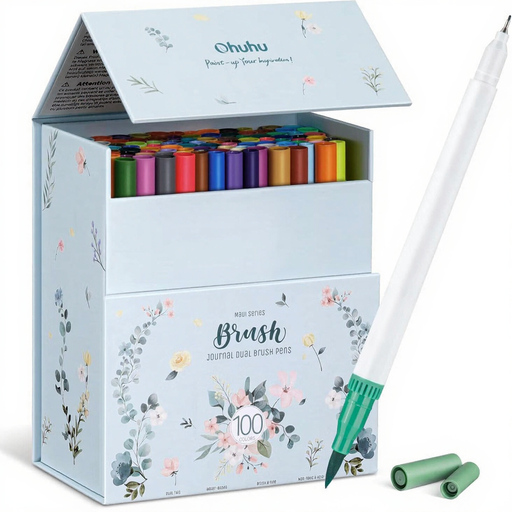
Why we love it: With 100 vibrant colours, this set is a true portable art studio. Each dual-tip marker combines a flexible brush tip for large areas and calligraphy with a 0.4 mm fineliner tip for details. Its water-based, blendable ink opens up endless possibilities for mixing and creating gradients.
Key features:
Who is it for?: Illustrators, colourists, calligraphers, and all creatives looking for an ultra-comprehensive drawing kit with a massive colour palette, all at an affordable price point.
Our selection is just a glimpse of what's possible. The world of fine art supplies is vast! To explore other types of markers, discover alternative colour palettes, or find tools for more specific techniques, feel free to browse our catalogue.
Explore our complete collection of paint pens to discover other models and find the tool that will bring your ideas to life.
It's all in the ink's solvent. Water-based markers (like the Ohuhu Maui set) use water. They are odourless, easy to blend for watercolour effects, and generally don't bleed through paper. Alcohol-based markers use alcohol, which allows them to dry very quickly and create perfectly smooth blocks of colour without any streaks. Highly valued by professionals, they do, however, require thick paper (specifically for markers) to prevent the ink from bleeding through.
The secret is the paper! For alcohol-based markers, use paper with a weight of at least 180 g/m?, ideally a coated or "layout" paper specially designed for this purpose. For all types of markers, placing a scrap sheet or a blotter under your drawing is a simple and foolproof precaution to protect your work surface and the next page in your sketchbook.
Absolutely, as long as you choose the right markers. Acrylic markers, like the 30-colour Ohuhu set featured, are designed for this. Their opaque ink adheres to many non-porous (ceramic, glass, plastic) and porous (wood, fabric, stone) surfaces. For a permanent hold on ceramic or glass, baking in an oven is often recommended. On fabric, a pass with an iron (without steam) usually helps to set the colour. In any case, always read the manufacturer's instructions carefully.