
Livraison le jour même ou le lendemain

Qualité garantie

Débloquez vos offres de bienvenue: Livraison GRATUITE | Jusqu'à -80 % | 30 jours d'essai gratuits à JoyPlus
Téléchargez l'application
Buying drawing and fine art supplies can quickly become expensive when descriptions promise “professional quality”, exceptional durability or a “complete” palette. Yet the ideal product for illustration won’t necessarily meet the needs of a student, a journaling enthusiast or a parent putting together a school pencil case.
To avoid disappointing purchases, it’s better to examine the nib, the type of ink, the compatible paper and the storage conditions. Here is a selection of recommended options, along with concrete criteria for comparing art supplies.
A pen or marker advertised as water-resistant can behave differently depending on the paper, the drying time and the amount of water applied. An ink that is resistant once dry doesn’t necessarily mean it will never bleed during colouring.
For drawings intended to be preserved, check the mentions regarding lightfastness, the recommended surface and the manufacturer’s instructions. Always test on a sheet similar to the one you’ll use for your project.
A set of 40 or 48 colours may seem like good value, but it can contain shades you rarely use or functional duplicates. Conversely, a more compact set can be perfectly adequate for urban sketching, visual notes or adult colouring.
The number of colours doesn’t make up for nib quality, ergonomics or compatibility with your paper.
Fine nibs dry out when left uncapped. Acrylic markers can lose their fluidity if not closed properly, while dry pastels produce dust and need to be stored flat. These details directly affect how long the product lasts.
Fineliner pens are suitable for outlines, hatching and details. A range from 0.05 mm to 1.0 mm lets you vary line thicknesses, but very fine nibs require a light touch. For lettering, brush pens offer more variation thanks to the pressure you apply to the tip.
Markers with a brush nib work well for expressive strokes, but they need paper that is sturdy enough to avoid fraying.
A sketchbook of 120 g/m² can work for graphite, pens and light sketches. For watercolour or heavily saturated markers, choose a specific paper, which is usually thicker and more absorbent.
Dry pastels adhere better to a slightly textured surface. Because they can transfer easily, an interleaving sheet or suitable fixative can be useful. The fixative should be used according to its label, in a well-ventilated space.
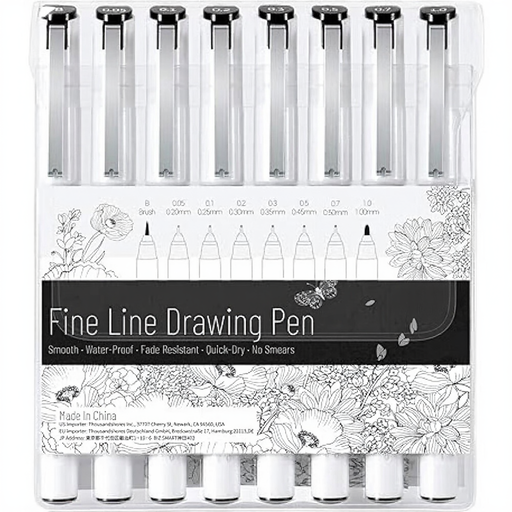
Why this product suits them: A compact set for starting detailed drawing, manga, note-taking and journaling without buying lots of extras.
The nibs are labelled from 0.05 mm to 1.0 mm, with a brush nib included. The listing mentions quick-drying, water-resistant ink, but no independent safety certification is provided.
Seven line widths, a brush nib and size-coded caps.
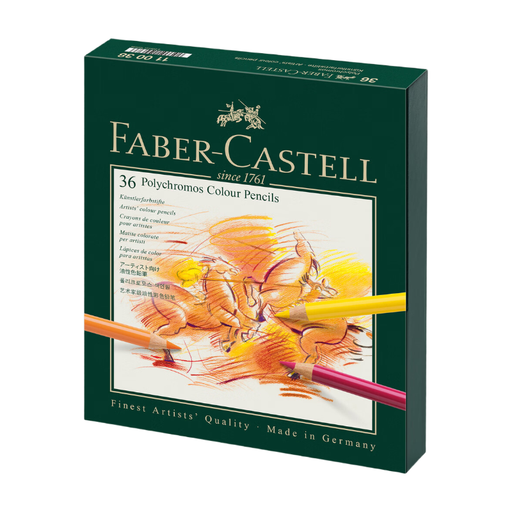
Why this product suits them: An option suited to illustrators, art students and artists who work on gradients, portraits or graphic details.
The 3.8 mm oil-based core is designed for layering. The product listing mentions a core-bonding process and lightfast pigments, though this doesn’t replace testing on your own paper.
36 shades, layering application and a rigid storage box.
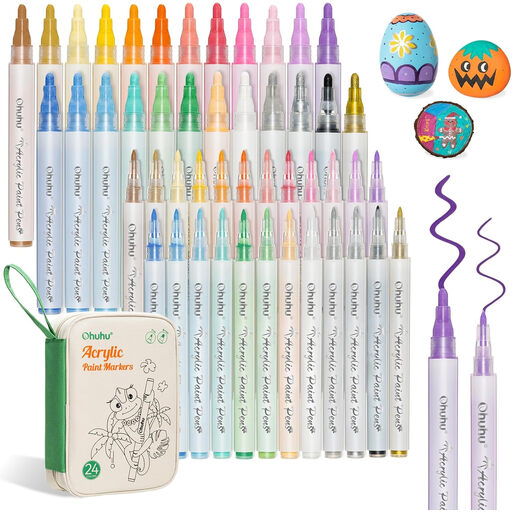
Why this product suits them: A set intended for decoration projects, crafts and customising on paper, wood, glass, ceramic or stone.
The set combines 24 fine 0.7 mm tips with 24 markers featuring a reversible round and chisel nib. You need to shake the markers before first use and store them flat.
Two nib formats for details and broad areas, with 24 coordinated colours.
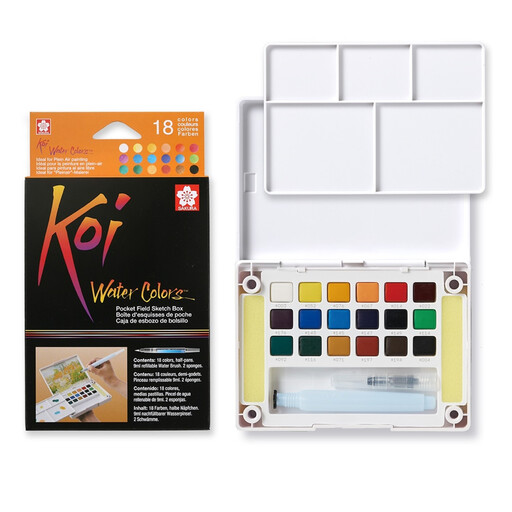
Why this product suits them: Its pocket size meets the needs of urban sketching, travel journals and outdoor painting.
The case holds 18 half-pans and a mixing area. Before buying, check the exact contents listed by the seller, particularly whether a water brush is included.
18 colours in a compact case with an integrated palette for mixing.
We’ve put together an updated selection of products that meet practical choice criteria and the safety requirements applicable in France.
A sketchbook, a few HB and 2B graphite pencils, an eraser, a sharpener and a small assortment of drawing pens are enough to get started. Add coloured pencils or watercolour markers depending on the technique you want to try, rather than buying a very large set straight away.
For pens and graphite, paper around 120 g/m² can work. For watercolour and wet techniques, choose a thicker paper designed to absorb water. Acrylic markers can bleed through some thin papers despite their opaque ink, so a protective sheet is still useful.
Close each cap immediately after use, store markers according to the manufacturer’s instructions and avoid heat as well as direct sunlight. For fineliner pens, moderate pressure reduces nib wear. Dry pastels should be stored flat and handled in a well-ventilated space to minimise dust inhalation.