
Livraison le jour même ou le lendemain

Qualité garantie

Débloquez vos offres de bienvenue: Livraison GRATUITE | Jusqu'à -80 % | 30 jours d'essai gratuits à JoyPlus
Téléchargez l'application
Buying drawing and colouring supplies seems straightforward… until you start comparing formats, materials and marketing claims. A brightly coloured set isn’t necessarily suitable for a nursery-age child, while a fine-lead pencil can prove impractical for filling in large areas. Whether you’re shopping for families, schoolchildren, drawing enthusiasts or bullet journal fans, a few simple checks are all it takes to avoid disappointing or short-lived purchases.
A large number of colours naturally catches the eye, but the shades you actually use are often limited. To start with, a set of 12 to 24 pencils covers most needs. A more comprehensive set becomes worthwhile for working on gradients, portraits or detailed compositions.
A standard pencil can be difficult for a small hand to grip. Conversely, a very thick model sometimes lacks precision when you need to tackle fine details. Triangular pencils for children encourage a stable grip, while a fine lead is better suited to sketching and writing.
A lead described as tough doesn’t mean you can skip checking its diameter, the quality of the wood and its compatibility with your sharpener. A tip that’s too fragile or a poorly matched sharpener can lead to premature wear. For products intended for children, also check the recommended age and whether there are any small parts.
Coloured pencils with a thick lead cover a page quickly and are particularly good for colouring. Models with a finer lead allow for precise outlines and hatching. For black-and-white drawing, graphite pencils are chosen according to hardness: an H lead produces a lighter line, while a B lead gives a darker result, ideal for shading.
Water-based ink felt-tips are suitable for colouring, lettering and diluted effects. The STABILO Pen 68, for example, has a 1 mm bullet tip and water-based ink. It is claimed to resist drying out for up to 24 hours without its cap, but it’s still best to recap it after use.
For nursery and early primary school, choose a triangular barrel, a generous diameter and a sufficiently robust lead. The age recommendations on the packaging should be followed. A pencil is not a chew toy: younger children should remain under adult supervision.
Washable crayons can make life easier at home, but ‘washable’ doesn’t mean every stain will disappear from every fabric. Test on an inconspicuous area and clean up quickly if there’s a spill. For stick gouache, check compatibility with paper, card or smooth surfaces, as well as the cleaning instructions.
A sturdy case helps prevent lost pencils. A sharpener with a reservoir stops you finding shavings at the bottom of your pencil case or on your desk. Models with two openings usually accommodate both standard and thicker pencils. To preserve the leads, sharpen gradually without forcing, and store supplies in a dry place away from heat sources.
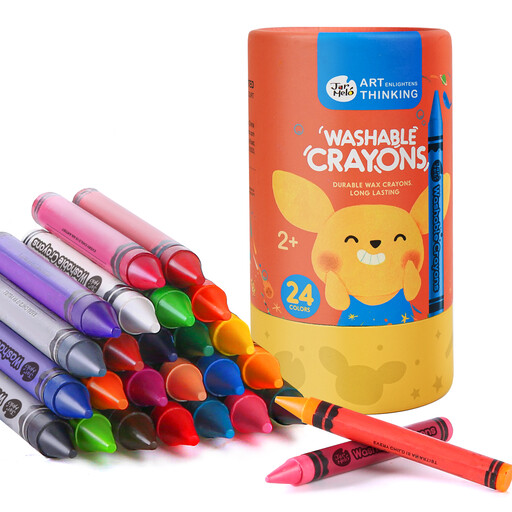
Why this choice suits this profile: With its 24 colours and jumbo format, this set makes early creative activities easy at home and in the classroom.
The thick format avoids choosing pencils that are too thin for small hands. The washable claim can also simplify cleaning on compatible surfaces.
24 colours, a jumbo shape and materials described as non-toxic and washable on the product page.
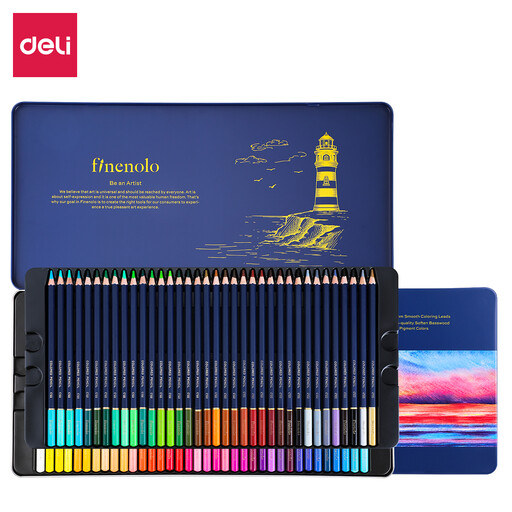
Why this choice suits this profile: With its 72 colours, this palette is aimed at people who enjoy working with shades, layering and detailed compositions.
The metal tin protects and keeps the pencils together, which reduces losses compared to a collection of individually bought pencils.
A 72-colour assortment and a metal storage tin, suitable for projects that require an extensive palette.
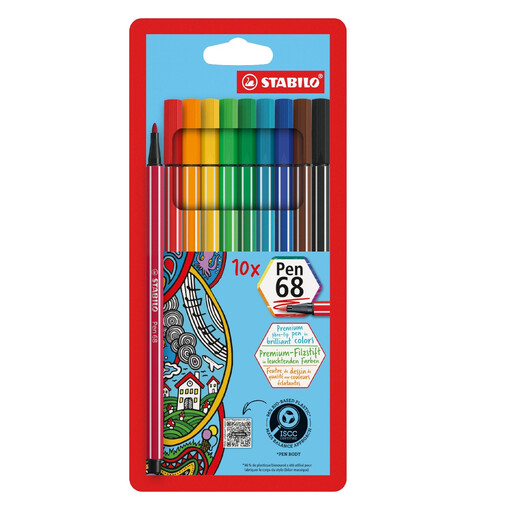
Why this choice suits this profile: Its 1 mm tip is suitable for drawing, colouring, outlines and bullet journaling, thanks to its water-based ink.
The stated line width and bullet tip make the result more predictable than with a felt-tip whose stroke varies significantly.
A robust 1 mm tip, odourless water-based ink and a body and cap claimed to be 96% bio-based according to the mass balance method.
We have put together a comprehensive, real-time updated selection of products that meet these strict selection criteria and the requirements of European safety regulations.
For a child or a beginner, 12 to 24 colours are enough for everyday use. A larger set becomes worthwhile for gradients, portraits or regular projects. It’s better to prioritise a good grip and practical storage than an excessive palette where half the colours will never be used.
Recap felt-tips after each use, store them according to the manufacturer’s recommendations and avoid exposing them to high temperatures. For pencils, use a sharpener suited to their diameter and keep them in a pencil case or rigid box. A lead that breaks regularly may indicate that the tool isn’t suitable for the surface or the pressure being applied.
No. They make cleaning easier, but you need to act quickly and check their compatibility with the fabric or surface in question. For use at school or at home, always have a table protector ready and put supplies away as soon as the activity is finished.