
Livraison le jour même ou le lendemain

Qualité garantie

Débloquez vos offres de bienvenue: Livraison GRATUITE | Jusqu'à -80 % | 30 jours d'essai gratuits à JoyPlus
Téléchargez l'application
Double-walled glasses have plenty going for them: an attractive visual effect, a comfortable grip and a drink that appears to float between two layers of glass. The outer wall generally remains more comfortable to touch, even when holding a hot drink. However, some purchases quickly disappoint: the capacity may not suit your needs, cleaning may be more delicate than expected, or you may confuse a thermal glass with a purely decorative model.
The selection recommended by the Joybuy Product Recommendation Officer is based on practical criteria: format, material, intended use and care requirements. The aim is to help you choose glasses for hot and cold drinks without being swayed by marketing alone.
A double wall creates a layer of air between the inner and outer surfaces. This design limits heat exchange, but it does not turn the glass into a heated or refrigerated container. The drink will therefore always eventually reach room temperature.
Thermal glasses are mainly useful for slowing the cooling of coffee or the warming of a cold drink. The actual duration depends on the starting temperature, the volume served and the room temperature.
An 80 ml glass is suitable for an espresso or tasting portion, but will feel too small for a latte. Conversely, a 450 ml model may look disproportionate for a short coffee and take up more space in the dishwasher or cupboard.
Before ordering, match the capacity to your habits:
Borosilicate glass generally handles thermal variations better than ordinary glass, thanks to its low coefficient of expansion. That does not make it unbreakable, however. An impact on the rim, a fall or a sudden change from cold to very hot can cause a crack.
Also check the manufacturer’s instructions regarding the dishwasher, oven and microwave. Recommendations may vary from one model to another, including within the same range.
For everyday use, prioritise product descriptions that clearly state borosilicate glass, the capacity and the presence of a double wall. Some models also incorporate a silicone valve at the base to manage pressure changes between the two walls.
The transparency lets you admire the different layers of a cappuccino or the colour of a tea. Ceramic or stoneware cups offer a different experience: they retain heat well and often withstand everyday knocks better, but they do not provide the distinctive visual effect of a double wall.
For example, the Secret de Gourmet Gift set of 6 Bistrot cups 10 CL contains six 10 cl earthenware cups, suitable for espresso, short coffee or hot chocolate. They are not a substitute for double-walled glasses, but they can take pride of place on a bistro-style table or in an establishment looking for a consistent service.
A glass without a handle puts the drink more firmly in the spotlight, while a handle makes very hot drinks easier to serve. Handled models are particularly practical for a latte or cappuccino enjoyed at leisure.
The 150 ml coffee glasses are more suited to smaller servings. 450 ml insulated mugs and large cups are better for milky drinks and longer coffee breaks. For entertaining, a six-glass set ensures a uniform presentation; a set of two is enough for a couple or occasional use.
Even when a product is advertised as dishwasher-safe, washing it by hand with a soft sponge can help preserve the glass’s transparency. Avoid abrasive products and regularly check the condition of the rim and base.
Do not routinely pour a boiling drink into a glass straight from the fridge. Also avoid placing the glass on a cold, wet surface. A model with a crack, chip or deep scratch should no longer be used for hot drinks.
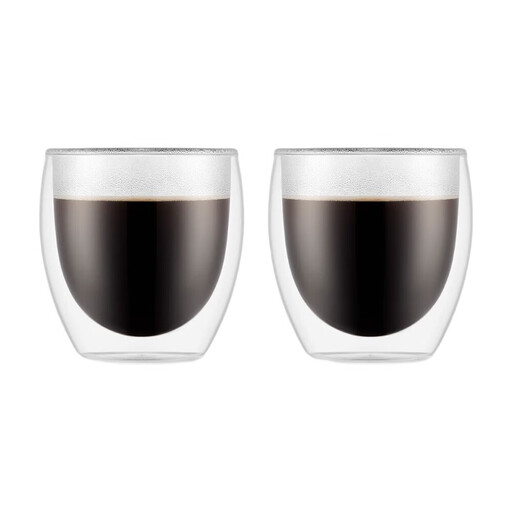
Why this choice suits this profile: A set of two 250 ml glasses lets you get started without investing in a large set. The size is suitable for coffee, tea and a wide range of cold drinks.
The clearly stated capacity prevents you from confusing an espresso glass with a more versatile model. The double wall also limits condensation on the outside.
Borosilicate glass, a 250 ml capacity and a two-piece format that is ideal for getting started.
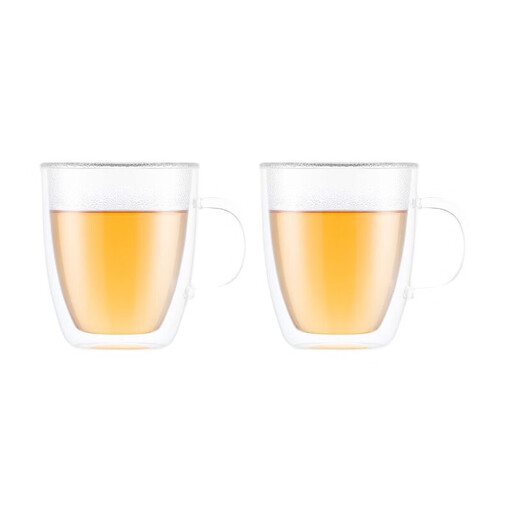
Why this choice suits this profile: The 450 ml capacity and handle are ideal for latte, cappuccino, tea and generously sized drinks.
The handle means you do not have to hold the outer wall directly. The product description also states that it is dishwasher-, microwave- and oven-safe, provided you follow the precautions relating to temperature changes.
Two hand-blown borosilicate glass cups with a double wall and integrated handle.
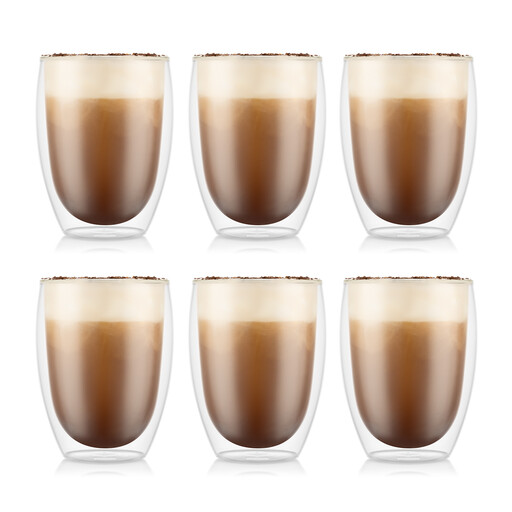
Why this choice suits this profile: The six 350 ml glasses are suitable for families, entertaining, and cafés or guest houses looking for a matching set.
The set clearly states the number of pieces and the capacity of each glass, making it easier to organise your service. However, store them separately to minimise knocks between the glasses.
Six 350 ml double-walled borosilicate glasses, advertised as dishwasher-safe.
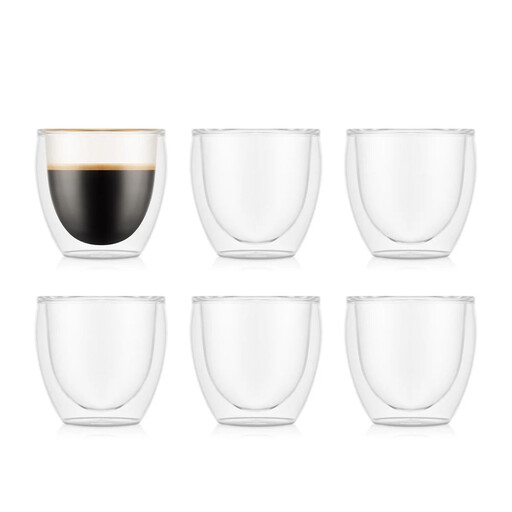
Why this choice suits this profile: The 80 ml format is designed for espressos, small servings and tastings. The six-piece set is practical for sharing special moments.
The small capacity makes its purpose clear: this glass is made for short coffee, not a large latte.
Six double-walled borosilicate glasses designed for espresso and small tasting portions.
We have put together a complete, real-time updated list of products that meet these demanding selection criteria as well as European safety standards.
Some models are advertised as dishwasher-safe, but it is best to check the product description. Washing by hand with a non-abrasive sponge reduces the risk of scratches and helps preserve transparency, particularly with hand-blown models.
For an espresso, 80 to 150 ml is generally suitable. A cappuccino or milky coffee usually requires 200 to 300 ml, depending on the amount of milk and foam. For a generous latte, choose a model with a capacity of 350 to 450 ml.
Their lifespan depends on how often they are washed, knocks and temperature changes. Borosilicate glass withstands thermal shock better than some conventional glasses, but it can still break. Storing the glasses so they do not come into direct contact with one another, along with regularly checking their condition, will help extend their useful life.