
Livraison le jour même ou le lendemain

Qualité garantie

Débloquez vos offres de bienvenue: Livraison GRATUITE | Jusqu'à -80 % | 30 jours d'essai gratuits à JoyPlus
Téléchargez l'application
A double-sided tape can make fitting a skirting board, a picture frame or a decorative item much simpler. But not all tapes are designed for the same jobs. An adhesive that works well on paper won't necessarily suit an outdoor installation, while a very strong mounting tape could leave marks on a painted wall.
Before you buy a double-sided tape, check the intended use, the type of surface and the weight it needs to hold. Taking this precaution will help you avoid the most common mistakes.
The words "extra strong" aren't enough to tell you whether a tape can hold a heavy object. The stated load depends on the length of tape applied, the temperature, how flat the surface is and how long you apply pressure.
An extra-strong double-sided tape can work for a picture frame or a letterbox. However, a loaded shelf or an object that gets moved regularly needs more care. For heavy items, spread the tape across several areas and follow the manufacturer's instructions to the letter.
Moisture, temperature changes, rain and UV rays can quickly degrade some adhesives. For fixing something to a fence, a wall or a garden shed, choose a product that's explicitly labelled as outdoor double-sided tape, with weather and UV resistance clearly stated in its specifications.
A dusty, greasy or crumbly wall will seriously reduce adhesion. Freshly painted walls, fragile wallpaper, polyethylene and polypropylene may also need a special adhesive or some preparation.
On a delicate surface, start by testing the product on a small, hidden area. A tape that's described as removable or reusable won't necessarily work on all surfaces.
The length and width determine the actual area covered. For example, a 15 m roll that's 50 mm wide is said to cover 12 m², while a narrower tape will be better for small items or discreet fixing lines.
For floors, measure the length of the joins and allow a bit extra. For a picture frame, cut several strips rather than one piece that's too short. Applying the tape evenly helps spread the load better.
The values given by manufacturers are guidelines that apply under specific conditions. The Pattex tape shown below claims up to 120 kg per roll, while some Scotch models for outdoor use state 10 or 13 kg, depending on the product. These figures can't be automatically applied to your own installation.
Clean and dry the surface, remove any dust, then press firmly over the whole area. For heavy objects, consider a mechanical fix as a backup if safety is a concern.
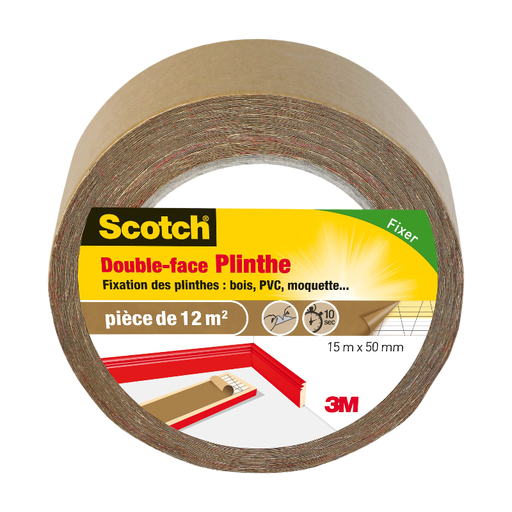
Why this suits this profile: Its 50 mm width and 15 m length are ideal for fitting wooden, PVC or carpet skirting boards without any special tools.
Its use is clearly intended for skirting boards and floor fitting, rather than heavy wall mounting.
15 m roll, 50 mm width and can be cut by hand.
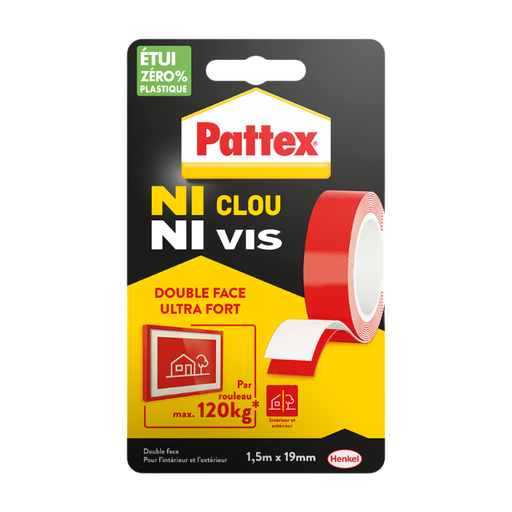
Why this suits this profile: This 1.5 m x 19 mm format is designed for installations that need a claimed adhesion of up to 120 kg per roll, indoors and outdoors.
The product details specify compatible materials and remind you that the surface must be clean, dry and grease-free.
Compatible, according to the product details, with glass, metal, wood, stone and some plastics; claimed resistance to moisture and high temperatures.
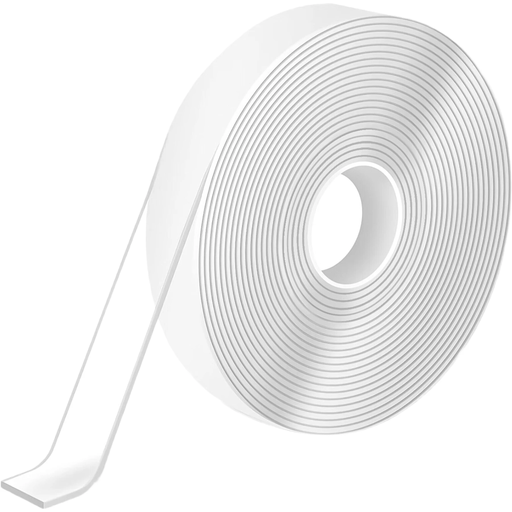
Why this suits this profile: This reusable nano gel tape is described as washable and removable. That makes it a good choice for flexible decorating in a rented home.
Removal should still be done gradually. Test the tape on the surface first to reduce the risk of pulling off paint.
3 m roll, 1.3 cm wide, described as washable and reusable.
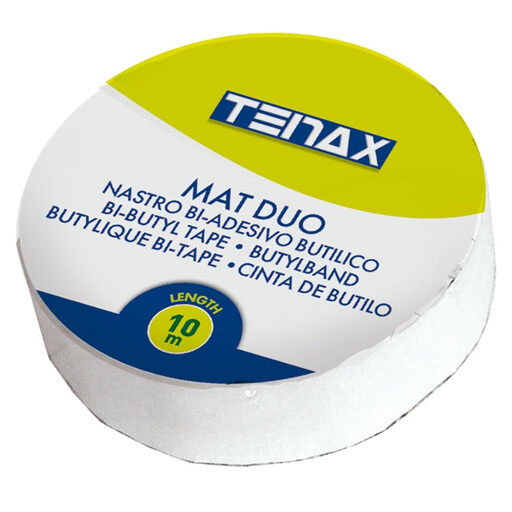
Why this suits this profile: Its bitumen-based composition and 5 cm x 10 m format are designed for repairs, sealing and jobs exposed to the weather.
It's designed for sealing and jointing, not as a clear decorative adhesive for an indoor wall.
Claimed resistance to weather, UV and temperature changes; instant adhesion according to the product details.
We've put together a full, real-time list of products that meet these strict selection criteria and comply with European safety regulations.
For fitting artificial grass, use the dedicated joining tape, usually with a grass glue. For floors, make sure the covering is properly positioned before applying final pressure.
A clear double-sided tape or a nano gel model can work for light objects. However, the result depends on the paint, its cohesion and the weight of the object. Test it on a hidden area and remove the tape slowly.
The lifespan varies depending on exposure to UV, rain, frost and heat, as well as the quality of the surface. Choose a product whose details clearly state it's for outdoor use, and check the fix regularly.
No single method works on every surface. Pull gradually in the direction recommended by the manufacturer, without yanking the tape off in one go. On fragile paint or wallpaper, there's still a real risk of damage.