
Livraison le jour même ou le lendemain

Qualité garantie

Débloquez vos offres de bienvenue: Livraison GRATUITE | Jusqu'à -80 % | 30 jours d'essai gratuits à JoyPlus
Téléchargez l'application
A chilly draught sneaking under the door, a heating bill that skyrockets without warning... Who hasn't been there? Yet, proper door and window insulation is often the simplest and most cost-effective solution to restore both thermal and acoustic comfort. But when faced with a jungle of products making tempting promises, it's easy to make the wrong purchase.
Before you start, here are three classic pitfalls that can turn a good idea into a useless purchase:
Choosing wisely is the key to sustainably reducing heat loss and achieving real energy savings.
To make the right choice, a few technical specifications need to be scrutinised. This is what will make all the difference in the effectiveness and lifespan of your installation.
Your choice of material directly determines the performance and longevity of your seal.
This is THE essential criterion, yet it's the one most often overlooked. A seal that's too thin won't create any seal, while one that's too thick can prevent the door or window from closing properly.
How to measure? It's simple: using the edge of a coin or a small ruler, measure the widest gap between the frame and the sash (window) or between the bottom of the door and the floor. Note this measurement in millimetres. Each product clearly indicates the range of gaps it can fill (for example, 1 to 3 mm, 2 to 6 mm).
The fastening method must match your surface, as well as your DIY skill level.
For a door bottom, the type of floor is a decisive factor. An uneven floor door bottom seal is often equipped with a flexible brush, whereas a model for smooth floors may have a more rigid PVC lip.
To help you see more clearly, here are a few proven products tailored to distinct needs and profiles.
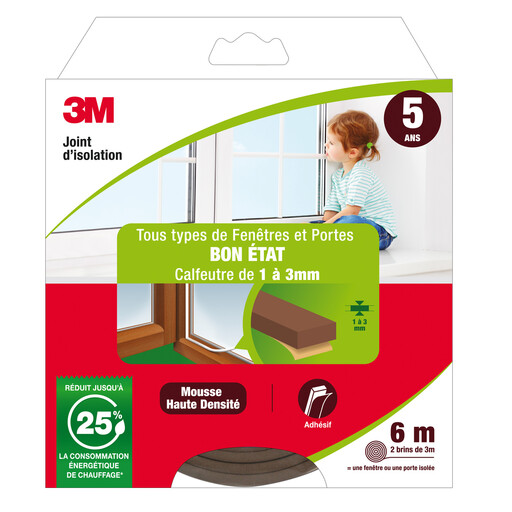
Perfect for a first foray into insulation, this seal is designed for the most common scenarios: wood or PVC windows with a slight gap. Its ultra-simple adhesive installation requires no tools.
Its high-density, very flexible foam is designed to resist crushing much better than standard versions. The manufacturer promises thermal efficiency for several years.
Designed for gaps of 1 to 3 mm, it covers the most common need for windows and doors in good general condition.
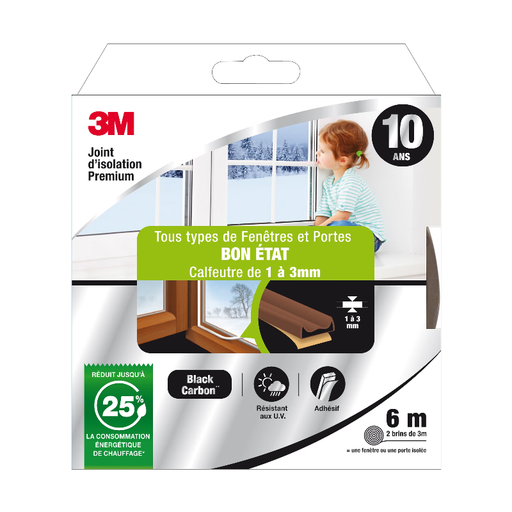
For those aiming for performance and durability, this seal is the solution. The initial investment is slightly higher, but it's the price for long-term peace of mind.
Its secret? A material made of carbon powder-reinforced rubber, which gives it outstanding resilience and UV resistance. No more seals that harden and crack after two seasons.
The manufacturer claims a lifespan of 10 years under normal conditions, making it a particularly sustainable solution for the long haul.
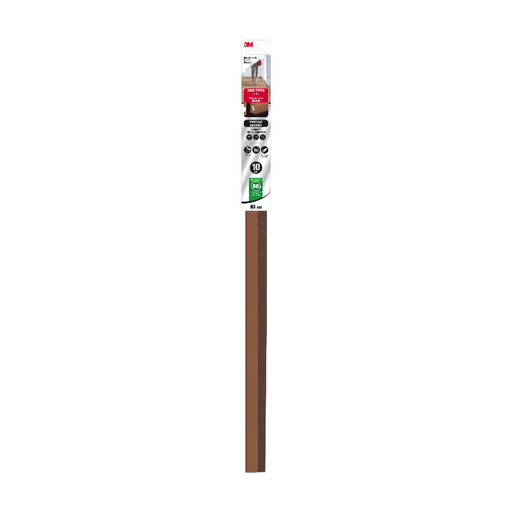
This is the last-resort solution for complex cases. Does your front door open onto old terracotta tiles or a floor with deep grout lines? A standard door bottom seal won't cut it.
It avoids the "wrong product for the wrong floor" trap. Its clever design, which combines brushes and a thin membrane, allows it to conform to irregularities while ensuring a flawless seal.
Capable of filling gaps up to 25 mm, it outperforms most traditional door bottom seals.
Discover our complete and up-to-date selection of products that meet our demanding selection criteria and current safety standards.
It all depends on the material and its exposure. A budget foam might last 1 to 2 years. In contrast, a high-density foam or a quality rubber seal, like those in our selection, can remain effective for 5 to 10 years, or even longer, depending on use and the manufacturer's claims.
This is the step you absolutely cannot skip. The surface must be impeccably clean, dry, and degreased. Wipe the frame with rubbing alcohol or a degreaser, let it dry completely, and you're good to go. Most importantly, do not stretch the seal as you apply it; it will try to return to its original shape and eventually peel off.
Absolutely, and the impact is far from negligible. Studies by manufacturers like 3M show that proper weatherstripping can significantly reduce energy consumption related to heating. By blocking cold air from entering and warm air from escaping, your heating system works less to maintain a comfortable temperature. The result is directly visible on your bill.