
Livraison le jour même ou le lendemain

Qualité garantie

Débloquez vos offres de bienvenue: Livraison GRATUITE | Jusqu'à -80 % | 30 jours d'essai gratuits à JoyPlus
Téléchargez l'application
A donut dog bed is appealing thanks to its enveloping shape and ultra-plush look. It is particularly suitable for dogs that love to snuggle, circle before lying down, or sleep against a soft rim. But a bed that looks cosy isn't necessarily right for every animal.
Some models are a pain to clean, slide across laminate flooring, or become too cramped once your dog settles in. Others arrive vacuum-packed and need several hours to regain their volume. Here are the criteria to consider before choosing a donut dog bed, whether it's for a small, medium or large animal.
A round dog bed of 70 cm doesn't necessarily offer 70 cm of flat surface – the padded rim takes up some of that space. Measure your dog from nose to the base of its tail, then add enough extra room to allow it to change position.
The dimensions given usually refer to the overall footprint. For a dog that sleeps stretched out fully, an 80 or 100 cm model will often be more suitable than a small, very thick bed.
The phrase washable dog bed deserves a closer look. On many models, only the cover or the central cushion can be removed via a zip. The inner padding then has to be spot-cleaned and air-dried.
Before placing an order, check the following:
A base with rubber nubs can help limit movement on a smooth surface, but it doesn't replace a stable floor or a clean surface. The nubs need to be in direct contact with the floor, without a thick rug in between. With a lively puppy or an older dog, check the base, seams and zip regularly.
For a soft bed for a small dog, a 70 cm diameter can work depending on your dog's build and sleeping position. 80 cm models are better suited to medium dogs or animals that like to curl up while still having some space. A 100 cm diameter can suit some medium to large dogs, but you must check the maximum weight capacity and the inner surface area.
Also measure the space you have at home: a bulky donut bed can block a door from opening, narrow a hallway, or not fit inside a crate.
Padding made from polypropylene fibres, often labelled as PP cotton or PP fibres, provides a soft, comfortable volume. A height of 20 cm means a well-defined rim, but it doesn't mean the whole surface offers the same level of support.
A calming dog cushion should be seen as a snug resting space, not as a piece of medical equipment. If your dog has trouble moving around or particular sensitivities, seek advice from a veterinary professional.
Long plush or sherpa fabric feels especially soft, but it also holds onto more hair and dirt. Shake the bed out regularly, gently vacuum its surface, and treat stains promptly. Avoid bleach and harsh products if the care instructions advise against them.
A bed that arrives vacuum-packed needs to be unpacked, shaken out and fluffed up by hand. Some manufacturers recommend leaving it to fully regain its shape for 48 hours.
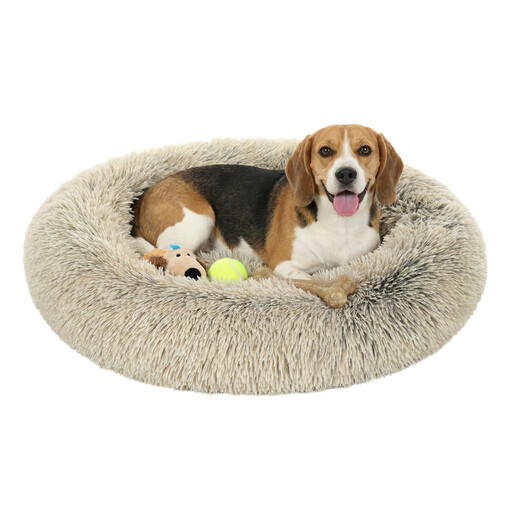
Why this choice suits this profile: This 70 cm size is suitable for small and medium dogs that like to sleep curled up. The cover and central cushion are accessible via a zip.
The dimensions, material and non-slip nub base are clearly stated, rather than relying solely on a promise of softness.
Plush, PP padding, 70 cm diameter and removable cover, according to the care instructions.
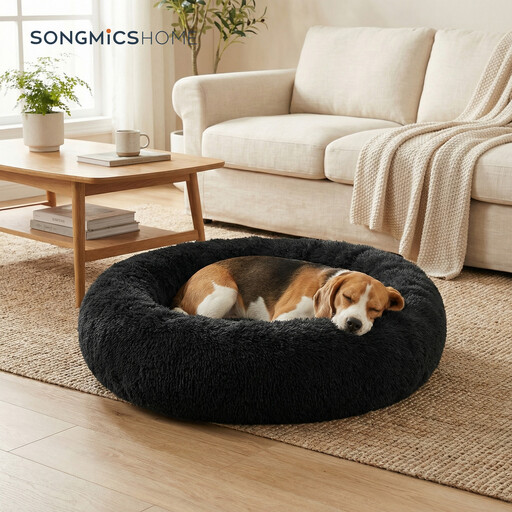
Why this choice suits this profile: Its 80 cm diameter offers more room for medium dogs or cats, while keeping that enveloping shape.
The description distinguishes the removable central cushion from the cover and states that the bed needs to be fluffed up after unpacking.
80 cm diameter, 20 cm height, plush and PP padding, with a base featuring rubber nubs.
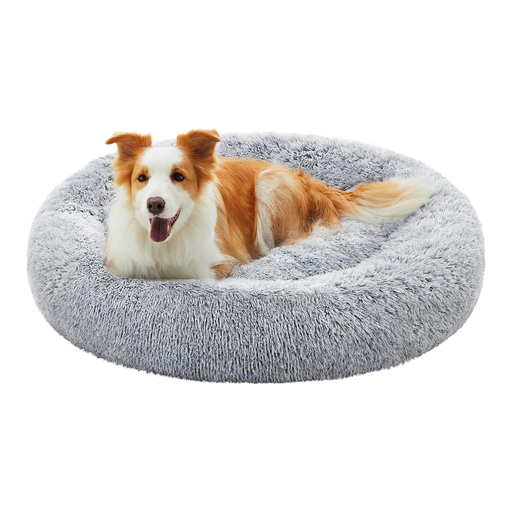
Why this choice suits this profile: This bed for medium to large dogs has a 100 cm diameter and a stated capacity of up to 30 kg. Your dog's actual build should still be taken into account.
The stated weight limit, diameter and height are all specified. The central cushion can be removed via a zip for easier cleaning.
100 cm diameter, 20 cm rim, non-slip base and a cover stated as washable according to the instructions.
We've put together a complete, real-time updated selection of products that meet these demanding criteria as well as European safety standards.
When it arrives, remove the vacuum packaging, shake the bed and distribute the padding by hand. Place it on a dry, level surface in a quiet spot. A familiar blanket or toy can help a puppy settle into this new space.
Check the seams, zip and base every week. If your dog chews the fabric or the padding becomes accessible, stop using the bed immediately. Its lifespan depends on how often it's washed, your dog's weight and its behaviour – it's impossible to guarantee a specific figure.
Measure your dog when it's lying down, then compare that length to the stated inner surface area. For an animal that sleeps stretched out, allow extra room. The outer diameter doesn't always match the actual sleeping area.
Remove the central cushion using the zip, then follow the instructions on the label. Use a gentle cycle and a mild detergent if the manufacturer allows it. Dry each component completely before reassembling the bed.
Rubber nubs can help reduce slipping on a smooth floor, but their effectiveness depends on how clean and grippy the surface is. Always place the base flat and check its condition regularly.