
Livraison le jour même ou le lendemain

Qualité garantie

Débloquez vos offres de bienvenue: Livraison GRATUITE | Jusqu'à -80 % | 30 jours d'essai gratuits à JoyPlus
Téléchargez l'application
Dental treats for dogs offer two benefits: they provide a reward or something to keep your dog occupied, while also supporting good oral hygiene. However, not every product is suitable for every dog. Your choice should take into account your dog’s weight, age, chewing style and the treat’s ingredients.
Statements such as “complete cleaning”, “anti-tartar” or “fresh breath” generally refer to a function claimed by the brand. They do not mean that the treat can replace tooth brushing, a veterinary check-up or treatment if a visible problem occurs.
Some Dentastix for dogs product listings, for example, advertise a reduction in tartar formation of up to 80% with daily use. This figure should be viewed as a brand claim, not as a guarantee that applies to every dog. Results depend on factors including chewing time, the condition of the dog’s teeth and its eating habits.
A stick intended for a dog weighing 10 to 25 kg may be too large for a small dog. Conversely, a treat designed for dogs weighing less than 10 kg may not be suitable for a large dog that chews quickly.
Size is therefore more than just a marketing point. It affects how easily the product can be held in the mouth, chewing time and the risk of swallowing it too quickly. Always check whether the product is described as being for “small, medium or large dogs”, as well as the weight range shown on the packaging.
Even a dog dental toy described as durable can eventually wear down, crack or release small pieces. Dogs that chew intensively should be checked regularly, particularly during their first few uses.
Remove the toy as soon as it becomes badly damaged. Textile, rubber, nylon and hide-based models do not wear down in the same way, so they require different levels of attention when checking them.
Start by considering your dog’s actual weight. Some products are suitable for puppies from 4 months old, while others are not suitable for very young animals. If your dog is older, sensitive or has fragile teeth, ask a vet for advice before choosing a dog chew treat.
Here is the essential information to check:
Dog dental sticks with a slightly abrasive texture are designed to create friction while your dog chews. An X shape, grooves or raised sections may help reach certain hard-to-access areas, but their usefulness also depends on how your dog chews.
A treat that is too soft may be swallowed quickly. On the other hand, a very hard product may not be suitable for a dog with fragile teeth. For toys, choose a clearly specified material and a shape without protruding edges. Claims about reducing plaque should always be considered alongside the instructions for use and warnings.
Dental treats are generally complementary foods. They should therefore be included in your dog’s daily ration without exceeding the recommended amount. Check for cereals, vegetable by-products, fats, minerals, flavourings and any added sugars.
A formula described as low in fat or with no added sugars does not mean you can disregard the analytical values shown on the packaging. To compare two products, look in particular at the weight of each unit, the calories where stated and the recommended frequency of use.
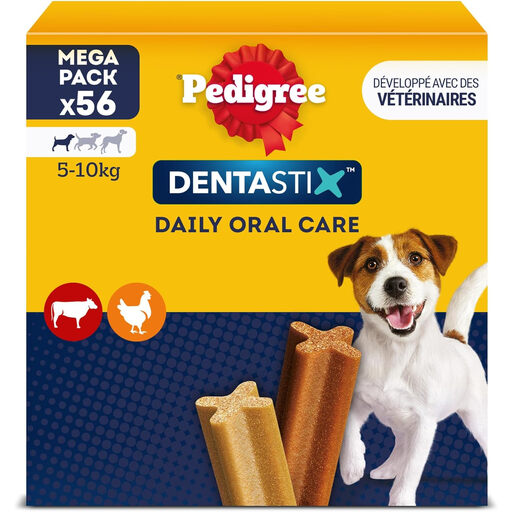
Why this product suits this profile : This size is intended for small dogs weighing less than 10 kg and puppies from 4 months old. Individually wrapped sticks make daily serving easier.
The weight range is clearly stated, reducing the risk of choosing a stick that is too large. The product listing recommends giving one stick per day.
An X shape, a texture described as slightly abrasive, a pack of 56 sticks and no added sugars according to the product listing.
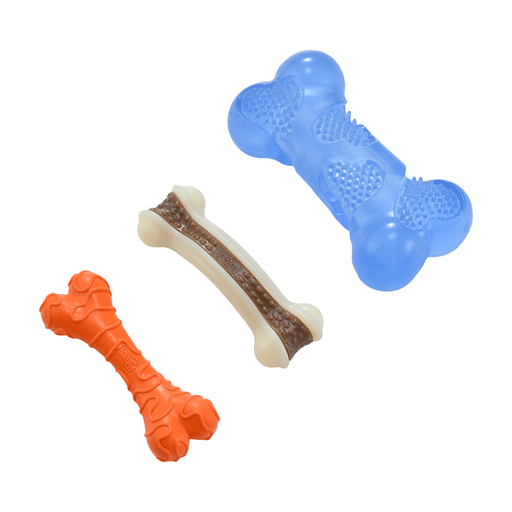
Why this product suits this profile : This set combines chewing, games of fetch and interactive moments with the owner. It is aimed at households that prefer a reusable solution to a consumable treat.
The product listing recommends supervising your dog and replacing the toy if it becomes damaged. This reminder makes clear that claimed durability does not guarantee unlimited use.
A shape combining cheese and a bone, a material described as wear-resistant, the option to rinse it with water and a design suited to interactive play.
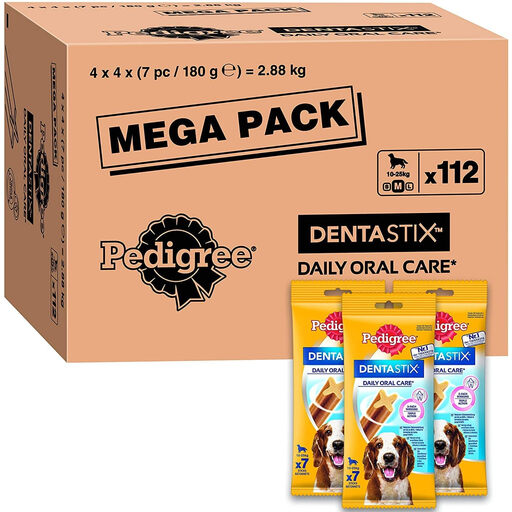
Why this product suits this profile : This pack is intended for dogs weighing 10 to 25 kg and owners who want to establish a daily routine over several weeks.
The pack of 112 units reduces the need for repeat purchases while retaining a clear recommendation of one stick per day. Each unit must nevertheless be counted as part of your dog’s daily ration.
16 packs of 7 sticks, an X shape, a texture described as slightly abrasive and a size suited to medium-sized dogs.
We have put together a comprehensive, real-time updated selection of products that meet these strict criteria, as well as European safety requirements.
Give your dog the treat at a regular time and stay nearby while they chew. Follow the manufacturer’s recommended quantity and always provide a bowl of fresh water. For a toy, rinse or wipe it according to the product listing’s instructions, then allow it to dry completely.
Chewing can contribute to the mechanical cleaning of your dog’s teeth, but it may not be enough to remove tartar that has already built up. Persistent bad breath, red gums, pain or difficulty eating should prompt a visit to the vet.
No. They can complement your dog’s dental care through chewing, but they do not replace suitable regular cleaning or advice from a vet. Their effect also depends on how long your dog actually chews the product.
Follow the instructions on the label. For some Dentastix for dogs, the product listing recommends closing the pack carefully, storing it in a cool, dry place and using its contents within 14 days of opening to help preserve freshness.
It may be suitable provided your dog is supervised, but no toy should be considered indestructible. Check it regularly for cracks, detached pieces, open seams or parts that could be swallowed. Replace the toy immediately as soon as it shows significant wear.